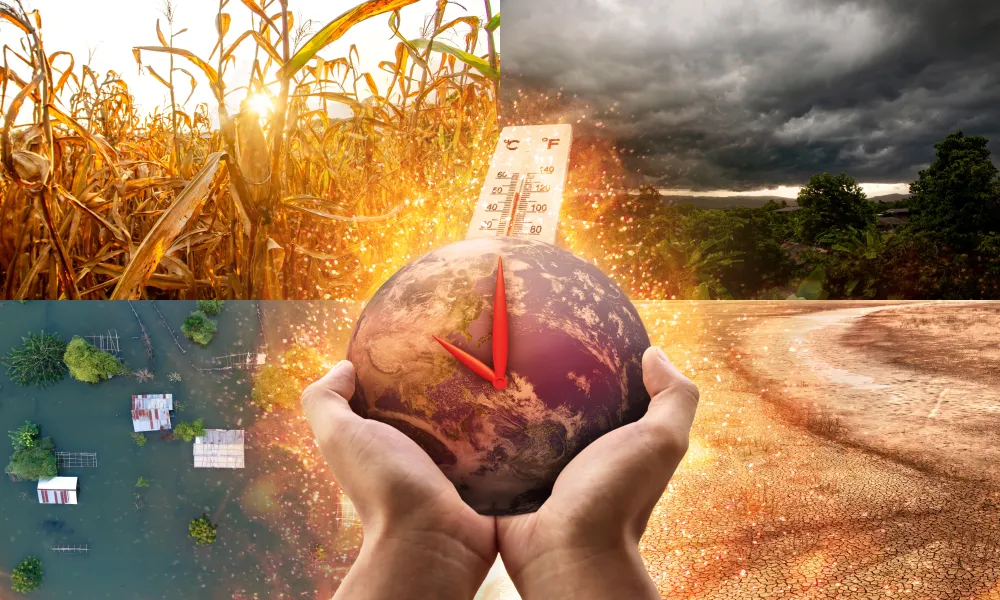

Climate change is no longer just an environmental concern for Cyprus. According to a new policy brief by the Cyprus Institute, it is already translating into measurable financial losses for households, with lower-income families bearing the heaviest burden.
The study finds that heatwaves, droughts and the combined effects of extreme heat and water scarcity over the past two decades have reduced the disposable income of Cypriot households by an average of 5%. For the poorest 20% of the population, the impact has been even more severe, with income losses reaching 9%.
Researchers Jessie Ruth Schleypen, a climate analyst at Humboldt University of Berlin and the International Security and Development Center (ISDC), and Professor Theodoros Zachariadis estimate that extreme climate events have already cost the poorest Cypriot households between €1,000 and €1,500 annually.
Nearly one in two households could face poverty risk
The study warns that the outlook could deteriorate dramatically if global temperatures continue to rise.
Based on current projections, which point to a global temperature increase of approximately 2.7°C by the end of the century, researchers estimate that almost one in two Cypriot households could be at risk of poverty within the coming decades.
Cyprus among Europe's most vulnerable countries
The report identifies Cyprus as one of the regions most exposed to climate-related economic impacts because of its hot and semi-arid climate.
Across the European Union, the average income loss linked to extreme heat and drought is estimated at 4%. In Cyprus, the figure reaches 5%, while some parts of southern Europe, including Spain, have already seen losses approach 10%.
The picture is even more concerning among lower-income groups. Across Europe, the poorest 20% of households have lost an average of 7% of their income due to extreme climate events, compared with significantly lower losses among wealthier households. In Cyprus, the equivalent loss rises to 9%, highlighting how climate change is also widening social inequalities.
Researchers note that lower-income households devote a larger share of their budgets to essentials such as food, electricity and healthcare, which are among the sectors most affected by climate-related cost increases.
'We can already see it in our bills'
Speaking to Politis, Professor Zachariadis said the decline in disposable income does not necessarily mean wages have fallen by 5%.
Instead, households now need more money simply to maintain the same standard of living.
More frequent and intense heatwaves have increased demand for air conditioning, leading to higher electricity bills. Climate impacts on agriculture are contributing to food price pressures, while extreme temperatures are also increasing some health-related expenses.
These additional costs weigh more heavily on lower-income families, as they absorb a larger proportion of household budgets.
Climate change is also affecting labour productivity, particularly in occupations that require outdoor work. Over the longer term, it may influence property values, especially in areas vulnerable to extreme weather events or severe urban heat-island effects.
Stark projections for the future
The study examines not only current impacts but also potential future scenarios.
Under the most optimistic pathway, where global warming is limited to 1.5°C, Cypriot households are projected to lose an average of 12% of their income due to increasingly frequent and severe heat and drought events.
If temperatures rise by 2°C, projected income losses increase to 21%.
Under the scenario currently considered most likely, where global temperatures rise by around 2.7°C by the end of the century, income losses in Cyprus could reach an alarming 54%.
Researchers say this would place Cyprus among the hardest-hit countries in Europe and well above the projected European average.
Progress has been made, but risks are growing
Professor Zachariadis noted that global efforts to tackle climate change have improved the outlook compared with forecasts made 15 years ago.
At that time, projections suggested global temperatures could rise by as much as 3.5°C by the end of the century. Current estimates have moved closer to 2.7°C.
However, he stressed that this does not mean the danger has diminished proportionately.
According to Zachariadis, scientists are discovering that the consequences of climate change are proving more severe than many earlier models anticipated. Extreme weather events, economic impacts, health pressures, agricultural disruption and income losses are emerging sooner and at greater intensity than expected.
"The projected temperature increase may be lower, but the impacts are turning out to be greater than we thought," he said.
Adaptation and social protection needed
The authors argue that reducing greenhouse gas emissions alone will not be enough.
They call for a comprehensive adaptation strategy aimed particularly at protecting vulnerable households from the economic consequences of climate change.
Among the measures recommended are:
- Improving the energy efficiency of homes.
- Expanding insulation programmes for older buildings.
- Increasing access to solar power through energy communities.
- Creating greener and cooler urban neighbourhoods.
- Using resources from the European Social Climate Fund to support households at risk of poverty and energy poverty.
The study concludes that without stronger adaptation measures, climate change is likely to deepen existing inequalities and place growing pressure on household finances across Cyprus.