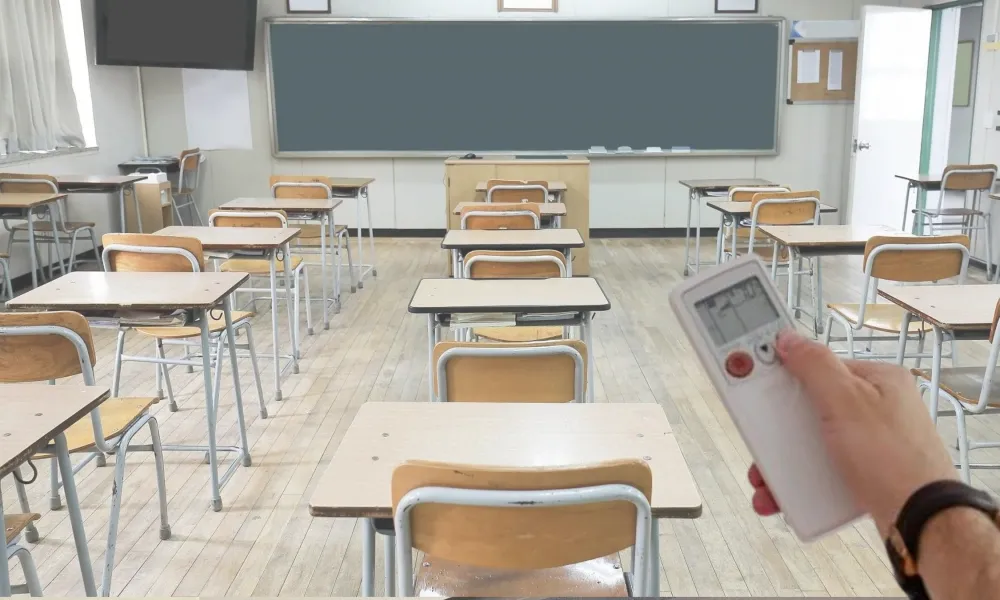

Air-conditioning units were operating in some Cyprus schools before required electrical inspections and safety certifications had been completed, according to an Audit Office report that identifies problems with the planning, oversight and implementation of the project.
The findings also point to delays, limited competition in tenders and significant cost discrepancies. The Education Ministry faces criticism over its handling and coordination of the programme, which is now expected to be completed in 2028 rather than 2026.
Audit Office calls for safety checks
The Audit Office said air-conditioning units had been put into operation without prior inspection and certification of electrical installations and before final inspections and approvals were completed.
Following its findings, it called on the Education Ministry to immediately inspect all schools where air-conditioning units have been installed or are being installed to identify any safety-related deviations.
It also called for units to be switched off immediately where the required inspection and certification stages have not been completed.
The Audit Office further recommended examining possible responsibility among individuals at the ministry or School Boards who allowed units to operate under these circumstances, warning of the risk of serious accidents.
Five Nicosia schools inspected
An on-site inspection on 24 September covered five Nicosia schools that the Education Ministry had presented as having operational air-conditioning systems. The Audit Office found that the situation did not correspond with the picture that had been presented.
At Ethnomartyras Kyprianos Lyceum in Strovolos, inspectors identified significant safety issues, numerous air-conditioning units that had not been connected, units operating on a rotational basis and temporary connections allowing equipment to operate before electrical work had been completed.
At Engomi A Primary School, electrical work, a load upgrade and an Electricity Authority of Cyprus inspection were still pending, while air-conditioning units were operating on a rotational basis.
At Lykavitos Primary School, an electrical load upgrade remained pending and units were also operating on a rotational basis.
At Aglantzia VI Primary School, which had been presented as having completed works, inspectors recorded frequent tripping of the main switch because of overloading.
At Archangelos Lakatamia Gymnasium, the air-conditioning units were operating despite electrical work remaining outstanding.
Completion pushed back to 2028
The project has also fallen behind its original timetable.
Completion had initially been scheduled for the end of 2026, but is now expected in 2028.
By July 2026, only 81 of 219 works under the first three phases had been completed, equivalent to 37%.
Electrical work remained outstanding in 79 cases, air-conditioning installation was continuing in 52, six were awaiting inspections by the Electricity Authority of Cyprus, while work had not begun in one case.
Central coordination was also established after implementation was already under way. The Education Ministry appointed a central coordinator in April 2026, when the project had already reached its third phase.
The Audit Office said the ministry had effectively been “absent” during much of the implementation, leaving School Boards with limited staffing to handle a complex technical project.
Tenders attracted limited competition
The report also raises concerns about competition within procurement procedures.
According to Audit Office tables covering five School Boards, installation tenders were repeatedly awarded to three companies: Blue Sun Automation, Teklima and Chanat, while many procedures attracted only one or two bids.
In Nicosia, all three phases were awarded to Blue Sun Automation. The first two received only one bid each, while the third attracted two.
The three contracts had a combined estimated value of €2.68 million, but were awarded for a total of €3.311 million, an increase of €631,214.
In Larnaca, both tenders were awarded to Teklima.
In Limassol, contracts were again divided between the same three companies. In Paphos, the two contracts went to Teklima and Chanat, while in Paralimni-Deryneia they were awarded to Blue Sun and Chanat.
Few operators approved under procurement systems
Limited participation was also recorded under the Dynamic Purchasing Systems.
By June 2026, only four economic operators had been approved for air-conditioning installers and four for electricians, while only one had been approved for designers.
No economic operators had been approved under the new Dynamic Purchasing System for electricians for installations of up to 150 kVA.
The Audit Office linked the small number of participants to insufficient competition, higher costs and delays.
Project cost reaches €9.819 million
By July 2026, the project had reached a cost of €9.819 million excluding VAT, without a detailed budget broken down by phase, School Board or expenditure category.
The Audit Office identified overruns in several tenders but said it was unable to quantify the project's overall cost overrun because the information supplied to it had been presented in different formats.
The largest discrepancy cited was in Nicosia, where a tender with an estimated value of €280,000 was awarded for €570,670, representing an increase of 103.8%, after receiving a single bid.
In Paphos, another tender increased from an estimated €180,000 to €307,125, a rise of 70.6%.