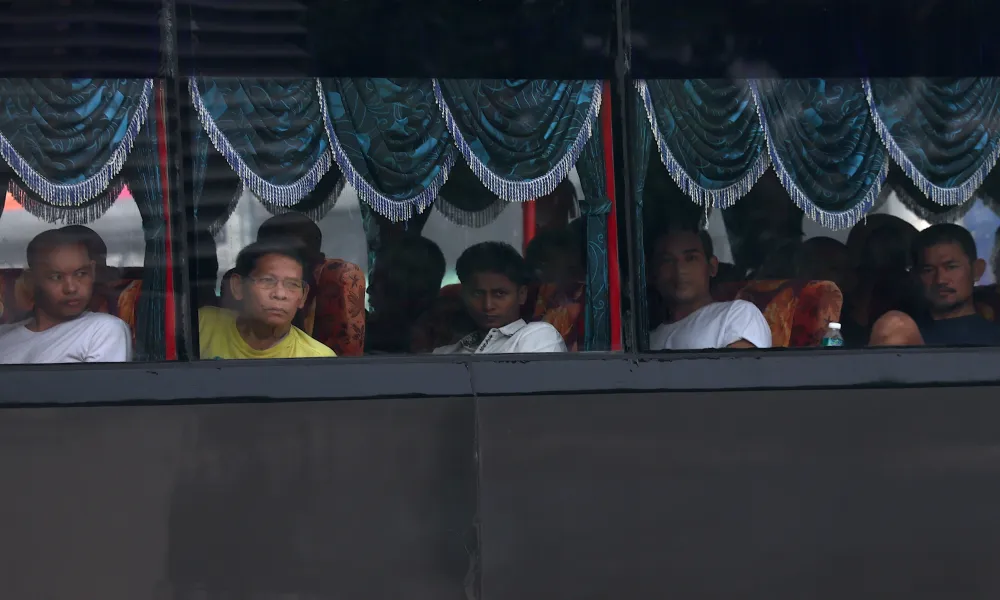

Malaysian authorities began sending around 1,500 Myanmar nationals back to their country on Tuesday, in the first phase of a repatriation programme criticised by human rights organisations.
They are the first group among a total of 5,000 Myanmar nationals who, according to Kuala Lumpur, agreed to “voluntary” repatriation from detention centres in Malaysia. Rights groups have raised serious questions over whether the returns are genuinely voluntary and whether those being sent back will be safe in Myanmar.
Repatriation process begins
Dozens of buses, escorted by police, arrived at a stadium near the Lumut naval base in north-western Malaysia, according to AFP journalists at the scene.
Journalists were not permitted to enter the stadium. Those being transferred were expected to undergo an identity verification process before boarding a ship bound for Myanmar, according to media reports.
Malaysian authorities have not specified how many of the 1,500 people being returned to Myanmar are members of the Rohingya minority.
Rohingya nevertheless account for around two-thirds of the approximately 190,000 refugees and asylum seekers in Malaysia, according to the United Nations.
Questions over Rohingya returns
Malaysian Prime Minister Anwar Ibrahim announced in July that Myanmar had agreed to accept the return of around 5,000 members of the Rohingya minority.
Hundreds of thousands of Rohingya fled Myanmar following a military operation launched in 2017, which is the subject of genocide proceedings before the International Court of Justice in The Hague.
In a report issued in early September, UN Secretary-General António Guterres assessed that conditions for the “voluntary, safe, dignified and sustainable return” of the minority “do not currently exist”.
Many Myanmar nationals are held in closed detention centres in Malaysia, raising questions about whether they were able to make the decision to return freely.
Programme followed Rohingya arrests
Malaysia announced the repatriation programme after the arrest of more than 100 Rohingya who had gathered outside the UN Refugee Agency, UNHCR, in Kuala Lumpur.
They were threatened with deportation before being released because they possessed valid documents issued by the UN agency.
Myanmar said earlier this month that it guarantees the “safe and dignified” return of its nationals living abroad.
Anwar has also said he intends to invite Myanmar leader Min Aung Hlaing, the general who led the country's 2021 coup, in an effort to accelerate the repatriation programme.
Malaysia does not formally recognise refugee status
Malaysia has not signed the 1951 Refugee Convention and does not formally recognise refugee status.
AFP fact-checking teams have also reported that the Rohingya community in Malaysia has become the target of online disinformation campaigns that fuel xenophobia, while human rights organisations have denounced a series of acts of intimidation targeting members of the minority.
Source: ANA-MPA / AFP