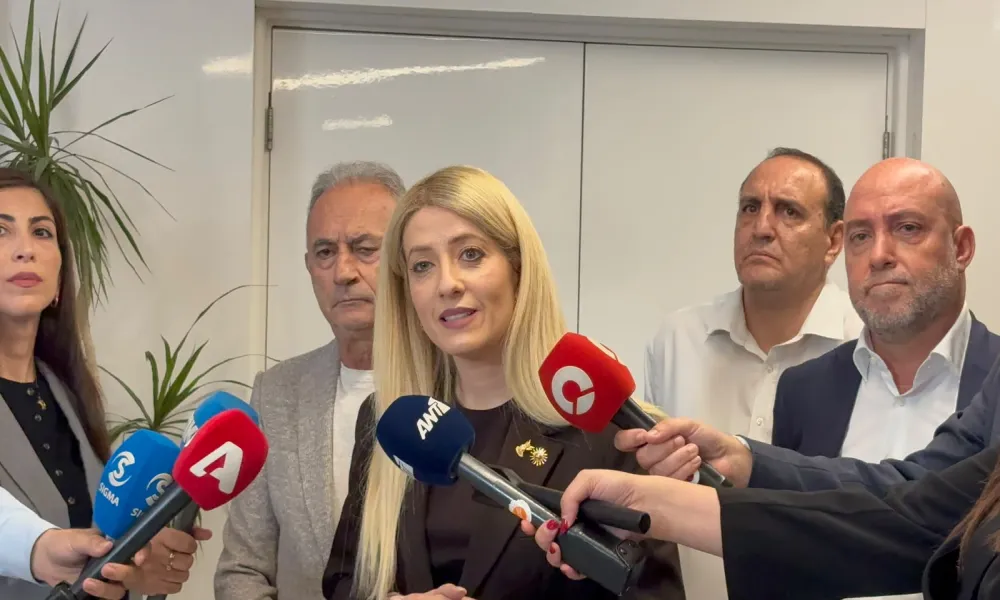

First, let us correct a common misperception. DISY leader Annita Dimitriou withdrew not from the 2028 presidential election itself, but from the race to become her party’s nominee. She said she wanted to prevent DISY from splitting again, as it did during the 2023 election campaign, when the division helped clear the way for Nikos Christodoulides’s victory. Former DISY leader Averof Neophytou and Giorgos Pamboridis remain in the contest. Early assessments suggested Neophytou could benefit from Dimitriou’s withdrawal. It does not mean, however, that one of Christodoulides’s direct rivals has left the presidential race. DISY has yet to choose its candidate, and it remains to be seen whether the party can unite behind that person.
Dimitriou’s decision has prompted questions about power balances and electoral calculations in Greek Cypriot politics. Are elements of a so-called deep state, the Church or circles associated with ELAM influencing DISY’s internal process? The question can be asked, but the available reporting does not establish that any of these actors engineered her withdrawal. For now, the clearest explanation is that DISY is trying to contain the risk of another internal split. If the party fields a strong candidate and unites behind that person, Christodoulides could face a serious challenger. If internal rivalry persists, the incumbent may benefit. Dimitriou’s decision alone settles none of this.
A new package at the final meeting before New York
Christodoulides’s 19-point package was introduced at the leaders’ last meeting before their contacts in New York. He said the proposals covered several areas, including the substance of the Cyprus issue, negotiating methodology and confidence-building measures. Yet the full text was never published. As far as can be established, the Turkish Cypriot leadership appears to have been unable to assemble and verify a complete item-by-item list from Christodoulides’s public statements. Perhaps the difficulty arose because he presented different issues under separate headings and as distinct proposals. Whatever the reason, the contents of all 19 points should be made public. Otherwise, the public is left to judge an undisclosed package through the leaders’ competing statements and selective reports in the media.
The timing matters. A comprehensive package of 19 points introduced at the last meeting before New York could hardly be discussed and resolved in the short time available. It placed numerous new issues before the other side and pressed it to take a position quickly, whether by accepting or rejecting them. Erhurman argued that the new proposals pushed aside the seven priority issues already on the table, describing the move as “throwing a spanner in the works.” In that light, the package looked less like a sequence of practical steps to advance negotiations and more like a broad agenda that shifted the burden of responding onto the other side.
The political calculation may have been less about expecting all the proposals to be accepted than about creating a position from which to use the other side’s response. If the package were accepted, Christodoulides could claim that his proposals had opened the way forward. If it were rejected, or if objections were raised, he could argue that the Turkish Cypriot side was blocking progress. This intention cannot be stated as proven fact. But the timing, breadth and subsequent handling of the proposals make that interpretation plausible. A package’s value in negotiations depends not on the number of points it contains, but on whether it was developed through mutual engagement and can produce results in practice.
Why not start with the seven confidence-building measures?
If the aim were genuinely to make progress, Christodoulides would first have worked on the seven confidence-building measures raised during UN Secretary-General Antonio Guterres’s visit to Cyprus. The Turkish Cypriot side said it accepted six of them without reservation. The seventh concerned the opening of new crossing points. On that issue, it asked for further talks on reciprocity so that the openings would be balanced for both sides. That was a request to negotiate a reciprocal arrangement, not a rejection of talks.
The introduction of a new 19-point package at the final meeting before New York, while those seven measures were available for discussion, therefore raises a basic question: did Christodoulides seek progress on the existing agenda, or did he want to appear diplomatically proactive by introducing difficult new issues and leaving the Turkish Cypriot side to carry the burden of responding? A new package does not answer why no progress was made on the six accepted measures or why the parties could not resolve the reciprocity issue on the seventh. It may instead draw attention away from the points where the process is actually stuck.
Why was only the Varosha proposal leaked?
The failure to disclose the full package, alongside the leak of the Varosha–Famagusta Port formula to a newspaper considered close to Christodoulides, raises further doubts about how the process was handled. The report said the proposal would place fenced-off Varosha under UN administration, allow its former residents to return, and operate Famagusta Port under European Commission supervision. This was not a complete proposal formally released to the public. Erhurman said he had heard the idea for the first time at the meeting and rejected claims that he had immediately accepted it. He also questioned how details of a private, one-to-one meeting had reached the press. The Greek Cypriot administration, meanwhile, declined to confirm the details of the Varosha proposal and said only that the 19 points covered three broad areas.
This selective leak changed the terms of public debate. Before the public could examine all 19 proposals or learn what had been discussed at the final meeting before New York, attention was directed to one highly sensitive issue. Erhurman was then compelled to respond to a media narrative that risked portraying him as having rejected the Varosha proposal or having accepted it and later withdrawn his support. The demand to disclose the package and the discussion of the confidence-building measures that had made no progress were pushed into the background. The leak could plainly serve Christodoulides politically; it strengthens the impression that it was used to put the other side under public pressure.
Varosha and the port: an exchange with uncertain returns
Varosha is not a new subject. In 1993, the UN Secretary-General’s confidence-building package envisaged reopening fenced-off Varosha and Nicosia International Airport under UN administration. Its purpose was to build confidence between the two communities and support a comprehensive settlement, not to replace one. The formula linking Varosha’s return with the renovation and operation of Famagusta Port emerged in later initiatives, notably in 2004 and 2006. Varosha has been periodically revived in political debate since 1993, but it would be historically inaccurate to describe today’s port proposal as identical to the UN package of that year.
The right of Varosha’s former residents to return to their homes must be taken seriously. But the future of the area cannot be determined by an opening decision alone. The scope of UN authority, property claims, the security of return, infrastructure repairs and local arrangements all require resolution. Famagusta Port is not merely a commercial facility either: its status and administration are directly connected to Turkish Cypriots’ opportunities for external trade. What legal framework would govern the port? What role would Turkish Cypriots have in its management and decision-making? What concrete improvement would EU supervision bring to their international trade and contacts? Without answers, the proposal cannot be described as a fair and workable exchange.
An “rights for land” formula can become a trap if the scope, timetable and guarantees for the promised rights are left undefined. The step involving land could be taken immediately, while the promised economic or political rights are postponed, made conditional on new forms of oversight or deferred to later negotiations. Operating Famagusta Port under EU supervision would not, by itself, resolve Turkish Cypriots’ problems of trade and contact with the outside world. Without clear guarantees over the port’s powers and Turkish Cypriots’ place in its decision-making, the formula cannot be presented as an equal exchange.
Moreover, because the full 19-point proposal has not been disclosed, it is impossible to know with certainty what the package includes or omits. Yet no proposal has appeared in the information made public for reopening Nicosia International Airport or Ercan Airport to international flights under UN or Council of Europe supervision. That apparent omission makes it all the more important to ask how far the package would address Turkish Cypriots’ problems of international access and transport.
Not leaks, but reciprocal and concrete progress
Varosha is not an issue that can be settled easily or separated from the Cyprus problem. Property, administration, the port’s status and political representation are intertwined. Taken together, they would add an exceptionally complicated file to a process that is already stalled. Confidence-building measures should produce practical results that increase trust and contact between the two sides; they should not be used to impose concessions or create public pressure. The UN approach in 1993–94 likewise stressed that such measures should not be used to gain political advantage or as a substitute for a comprehensive settlement.
Christodoulides should publish the entire 19-point package from the meeting before New York, explain how each proposal would work and show how it relates to the seven confidence-building measures that have awaited progress since July. The parties should first advance the six measures accepted by the Turkish Cypriot side and negotiate reciprocity on the opening of new crossing points. The Varosha proposal should be addressed through a comprehensive arrangement that safeguards both sides’ political agency and the concrete rights of Turkish Cypriots, rather than through a selective leak. Dimitriou’s withdrawal did not automatically improve Christodoulides’s chances; introducing the 19-point package before New York appears only to have added to the confusion on the island.
The negotiators are now preparing the agenda for this week’s leaders’ meeting. Let us hope that, instead of adding further confusing initiatives, the meeting brings concrete movement on the seven issues where progress has been expected since July, and that the Greek Cypriot side, in particular, takes the necessary steps. Guterres’s term as UN Secretary-General ends at the close of the year. The identity, nationality and level of commitment to Cyprus of his successor cannot yet be predicted. The Greek Cypriot community is already approaching a new election cycle, and Turkey, too, will soon turn toward elections.
Holguin’s expected visit to the island at the end of October may be one of the last major opportunities in this period. It would be a serious loss if every available path toward a settlement were closed once again. The leaders must now act on the measures they have said they are prepared to take without expecting anything in return, whether or not those measures appear on their formal lists. The decisive test is whether they can move beyond tactics that shift responsibility onto the other side and take practical steps based on equality.