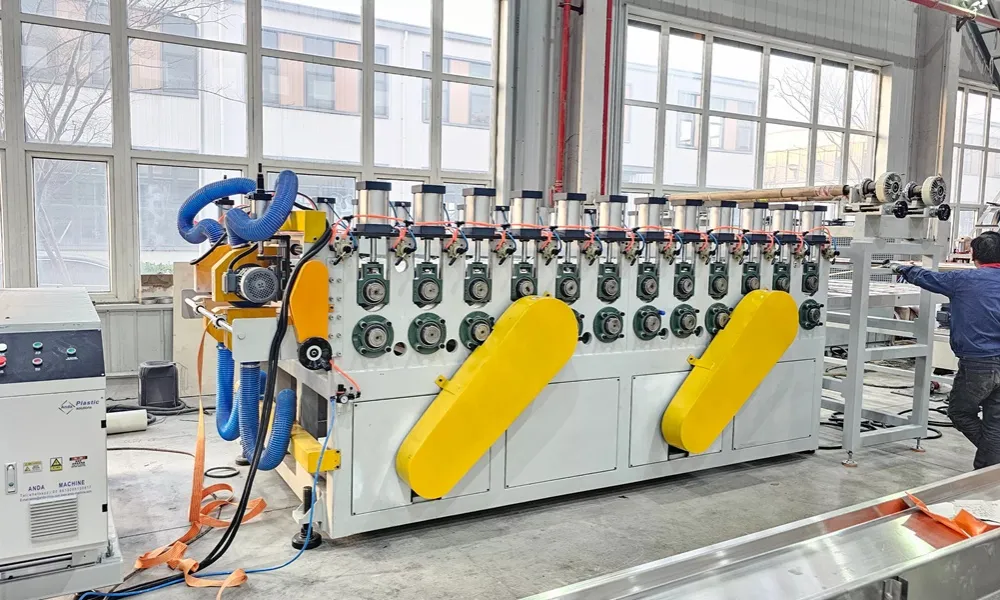

Specifically, the project αφορά the construction and operation of a plant that will process residues of recyclable polymer plastics made of foamed PVC together with new raw materials, with the aim of producing new products. These include foamed PVC boards amounting to an annual capacity of 11,000 tonnes, as well as components made of ABS polymer plastics (acrylonitrile–butadiene–styrene copolymers) with an annual capacity of 20 tonnes.
The production process for foamed PVC boards will begin with the pre‑treatment and homogenisation of the dry PVC mixture and additives, followed by shaping, cooling and final cutting of the product. Two injection moulding machines will also operate for the production of ABS components.
The final products will be used in building construction, pergolas, fencing, as well as other decorative and functional applications.
Management of gaseous emissions
According to the Environment Department, no solid waste is expected to be generated during operation, as the production system will be circular and any remaining materials will be recycled. However, dust release and emissions of gaseous pollutants such as hydrogen chloride (HCl) and volatile organic compounds (VOCs) are expected to occur at individual stages of the process.
To manage these emissions, a comprehensive pollution control system will be installed, including bag filters for dust retention and activated carbon adsorption units for the removal of gaseous pollutants.
For the effective reduction of emissions, the Environment Department also recommends:
– The use of forced mechanical ventilation.
– The connection of mixing reactors to the ventilation system at exhaust points, with the ventilation network linked to both the interior of the facility and the areas where extrusion takes place.
– The installation of local exhaust ventilation systems.
– The installation of collection systems at emission sources, including feeding, mixing, extrusion and cutting points, in order to limit the dispersion of dust and gases within the workspace.
– The collection of particles through bag filters.
– The use of high‑efficiency filters to capture fine particulate matter such as PVC powder and calcium carbonate, ensuring a significant reduction in suspended dust emissions.
– The use of activated carbon adsorption.
Site location and environmental impact
According to the Environment Department, the operation of the project is not expected to result in additional environmental pressures or permanent and irreversible impacts. Any impacts arising from the operation of the facility can be effectively managed through the mitigation measures outlined in the department’s reasoned assessment.
It also notes that no rare or significant species of flora or fauna are present within or around the development site. A special ecological assessment is not required, as the project site lies outside and approximately 1.2 kilometres west of the Natura 2000 Special Protection Area known as the Limnatis Valley. During the evaluation process, no consultations with other departments or services were deemed necessary.
Production processes
The production of foamed PVC boards includes:
– Grinding of foam PVC plastic residues.
– Mixing of raw materials, comprising approximately 27 per cent foam PVC residues and 73 per cent new raw materials.
– Injection following material melting.
– Moulding.
– Cutting.
The production of ABS polymer components includes:
– Mixing of materials.
– Injection moulding and demoulding.
During production, thermomechanical and physicochemical processes will be applied, including raw material handling and blending, high‑speed hot mixing to remove moisture and ensure uniform dispersion of additives, cool mixing to prevent agglomeration, maturation to enhance additive distribution and stability, extrusion, plasticisation and foaming under controlled conditions, and final calibration, cooling and finishing to ensure dimensional accuracy and product stability.