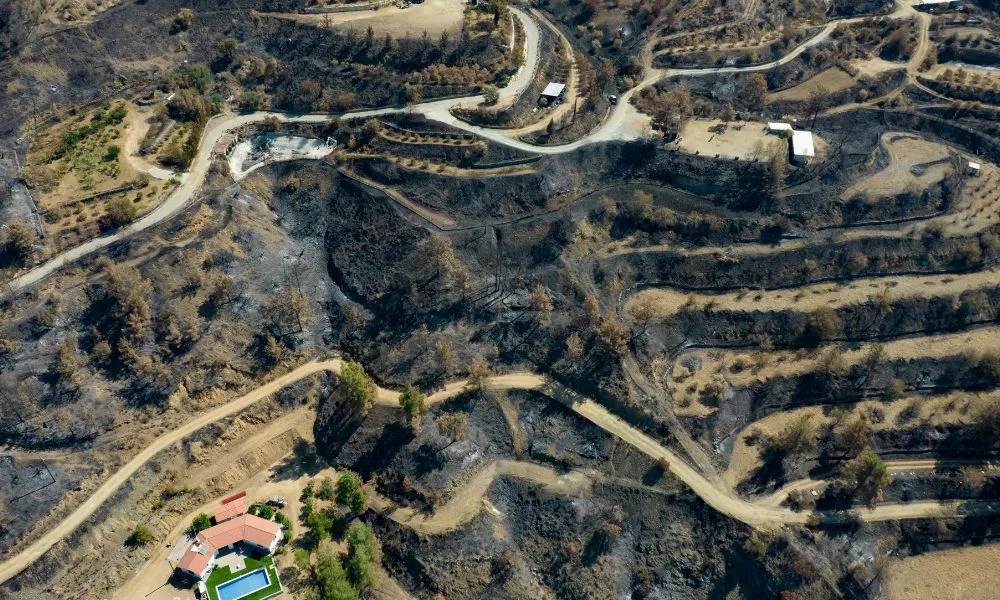
We are already in the summer season, yet the level of preparedness of those involved in fire prevention raises serious concern. While issues such as securing aerial firefighting resources and early warning systems may have been addressed, their effectiveness remains to be tested in practice. However, the situation is disappointing when it comes to grass clearing, which is particularly urgent this year due to increased rainfall, and the removal of approximately 850 illegal dumping sites across Cyprus.
These two issues represent potential “time bombs” in terms of public safety, environmental protection and public finances. Despite strong criticism from parliament and public opinion following last year’s deadly fires in Limassol, it appears that, one year later, key problems remain unresolved. Communities, despite increased funding from the Ministry of Interior for grass clearing amounting to €3.1 million, are now declaring themselves unable to cope and are preparing to submit new requests during a critical meeting on rural fire protection next Monday.
Specifically, they will request equipment and stricter penalties for private landowners who fail to clear their properties.
Blame game
On Wednesday, Interior Minister Constantinos Ioannou stated that several communities have still not fulfilled their obligation to clear vegetation, despite receiving €3.1 million since April based on their own requests.
Earlier, acting national fire coordinator and fire chief Nikos Logginou had told Politis that communities “must learn to take responsibility rather than shift it elsewhere,” referring to both vegetation clearing and illegal dumping sites.
However, the president of the Union of Cyprus Communities, Andreas Kitromilides, rejected claims that communities received the funds in April, asserting that the money was only made available at the end of May. He added that delays are also due to the lack of contractors willing to undertake the work.
“As a result, we begin the work with whatever means we have, either contractors or our own workers, who are very few,” he said.
He noted that each year communities try to complete grass clearing by June, adding: “Whatever we manage,” a phrase that reflects the current level of readiness.
Request for equipment
At Monday’s meeting, communities will request that cluster administrations be equipped with the necessary machinery for vegetation clearing and the removal of illegal dumping sites, so that work can be carried out year-round without relying on tenders that cause delays.
Kitromilides explained that the equipment needed includes excavators, trucks, tractors and shredders, as well as a dedicated service with at least two staff per cluster to operate them.
“If each cluster had its own service, cleaning could be done throughout the year,” he said, adding that continuous rainfall this year has made repeated clearing necessary.
Illegal dumping
Regarding illegal dumping sites, which fall under the responsibility of local communities, Kitromilides reiterated that they are not created by communities but by citizens who lack proper waste disposal options.
“You clean them one week, and the next they reappear,” he said. Communities, he added, cannot continue bearing the cost without proper tools and support.
Cameras and penalties
Communities have also cited the absence of environmental inspectors and obstacles to installing surveillance systems. A meeting has been scheduled for 25 June with the Commissioner for Personal Data Protection, who has reportedly expressed a conditional positive stance towards camera use.
At the same time, communities will push for stricter penalties for landowners who fail to clear vegetation. According to Kitromilides, 95% of owners neglect their properties, assuming the community will handle the work.
As a model, he referred to Greece, where fines are imposed based on square metre size, with additional penalties including possible imprisonment.
Why the delay?
Asked why these discussions were not held earlier, Kitromilides said that meetings have been ongoing since January with all relevant authorities. However, he stressed that the scale of the problem, combined with lack of resources and the extent of land owned by communities, makes it impossible to manage without additional support.
“We have now realised it cannot continue like this,” he said. “If communities are given responsibilities, they must also be given the necessary tools. Even now.”