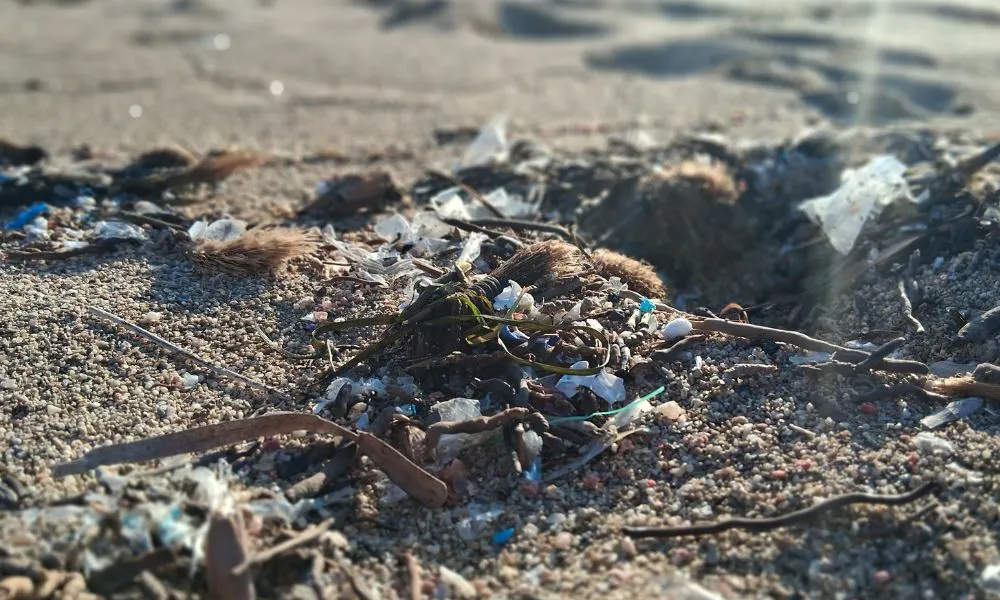

Beaches across the Paphos district are currently facing large quantities of microplastics, creating significant nuisance for bathers during a period of high tourist activity. The problem stretches from the northern coast to the south-west, affecting the Chrysochous Bay, the Akamas peninsula, Peyia, the Municipality of Paphos and the Municipality of Geroskipou.
According to a Politis report, following complaints during the Kataklysmos long weekend as well as reports by citizens on social media, the issue has been visible for about a month. Streaks of microplastics have spread across both the sand and the sea, sticking to swimmers’ bodies and getting caught in their hair after immersion in Cyprus’s widely promoted “crystal clear waters.”
Paradoxically, the phenomenon coincided with the awarding of Blue Flags, as well as the decision by the Central Beaches Committee to increase the maximum charge for sunbeds to €3.50 and umbrellas to €3. However, both developments are occurring amid a deterioration in beach conditions, meaning visitors are in practice unable to fully enjoy them.
Tourists express frustration
The situation has triggered strong complaints from both tourists and tourism professionals. A restaurant owner on Coral Bay Avenue in Peyia told Politis that after being asked for information, they recommended a group of tourists visit Maa Beach, also known as Coral Bay Beach, for swimming. The following day, however, the tourists returned with strong complaints about the pollution they encountered.
Dozens of reactions from both locals and foreigners can also be found in posts by the Municipality of Paphos.
Emergency meeting in Paphos
An emergency meeting is being held today at the Municipality of Paphos, convened by acting mayor Angelos Onisiforou, with the aim of finding immediate solutions and addressing the issue as soon as possible.
Those attending include the deputy director of the Shipping Deputy Ministry, Theodoulos Mesimeris, who has experience in pollution issues from his previous service in the Department of Environment, as well as representatives from the Department of Environment, the Cyprus Ports Authority, the Department of Fisheries and Marine Research, the Health Services and other municipalities in the Paphos district.
Lack of a central authority
Microplastics are an issue affecting many countries and are discussed at international conferences, Mesimeris told Politis. He said he intends to formally raise before the government and other stakeholders the issue of assigning responsibility for managing microplastics on beaches and developing a unified national strategy under a specific authority, noting that this has not yet been clarified.
He added that complaints he has received concern exclusively beaches in the Paphos district and not the rest of Cyprus.
“Not a new phenomenon”
Microplastics on Cyprus beaches are not a new phenomenon, but this time their large volume has appeared in summer rather than winter, which has caused widespread concern, said coastal engineer and head of the AKTI Project and Research Centre, Xenia Loizidou.
She noted that the seabed of the eastern Mediterranean has the highest plastic pollution in the world. She explained that strong wave activity in the eastern Mediterranean likely caused the movement and deposition of microplastics on beaches at this time of year, bringing the issue to public attention.
Regarding the conditions that trap microplastics on the coast, Loizidou referred to “hard” coastal infrastructure, such as the chain of breakwaters along the Paphos–Geroskipou coastline, which create accumulation conditions and disrupt coastal dynamics in the wider area.
According to her, microplastics come from the sea, mainly from illegal coastal landfills in neighbouring non-EU countries, as well as river outflows in those countries that carry large volumes of plastic.
“They cannot be collected”
Responding to a related question, she said that at present microplastics, defined as particles ranging from 0.1 micrometres to five millimetres, cannot be collected, unlike macroplastics, which are larger than five millimetres.
“For now, we have to wait for a wave to carry them away,” she said.
The issue has existed for years. The AKTI centre has been measuring microplastics on ten beaches in free Cyprus four times a year since 2022. According to its database, up to 4,000 microplastic particles per square metre have been recorded on beaches in Paphos.
A widespread problem
The head of the Health Services of the Municipality of Paphos, Christos Christou, told Politis that divers report seeing microplastics on the seabed. These are carried ashore by the first rough sea.
He said the municipality’s services and workers carry out clean-ups when such materials reach the beaches, but the sea continuously brings new debris. “The phenomenon must be tackled at its source, if identified, to be effective,” he stressed.
Describing the issue as significant, he said that initially the municipality believed it was limited to Paphos beaches. “However, when we invited relevant services to meet on the issue, it became clear that other municipalities in Paphos, such as Geroskipou and Polis Chrysochous, face the same problem,” he said.
Cyprus’s responsibilities
As for Cyprus’s own responsibilities, he said authorities can ensure that stormwater drainage systems do not discharge into the sea, monitor mini cruises, which he described as a source of waste in the coastal zone, and find practical solutions for recycling fishing gear without penalising fishermen.
He added that solutions are also needed for managing plastic ground covers and plastic greenhouse materials used in agriculture, and that all “hard” coastal interventions, such as breakwater chains along the Paphos–Geroskipou coast, should be suspended.
Need for monitoring
Marine pollution requires continuous coastal monitoring from the sea so that problems can be detected early. The Municipality of Paphos is in the process of assigning this work to a specialised private company, in cooperation with the Shipping Deputy Ministry, Christou said.
“Terms have been prepared and we are at the tender stage. I hope we will sign a contract by the end of the month,” he added.