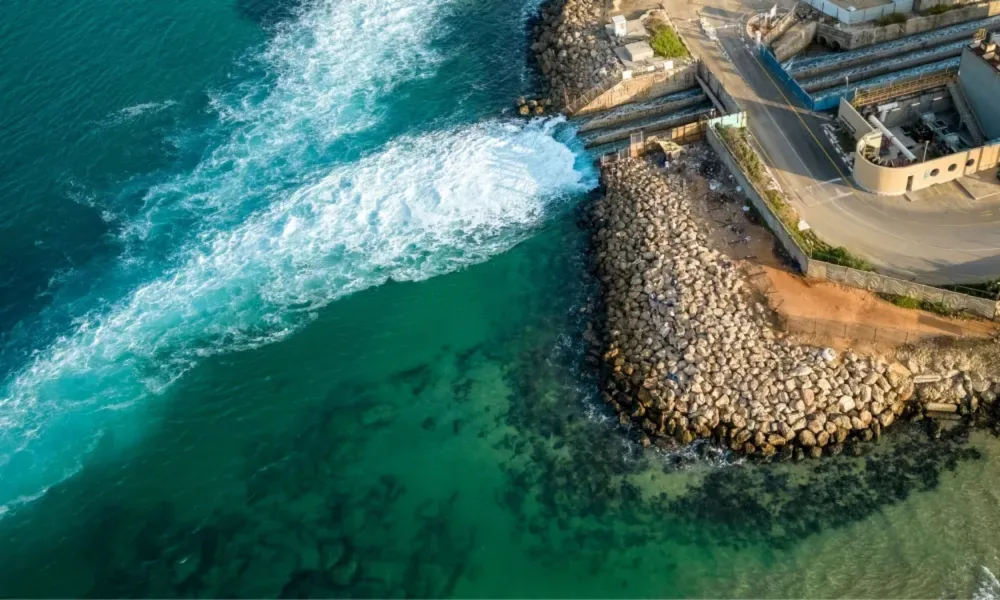

Scenarios put forward by the Water Development Department (WDD) for new permanent and mobile desalination plants, as well as expansions of existing facilities, are to undergo detailed evaluation before receiving final approval from the Ministry of Finance.
To secure the ministry's approval for the planned desalination infrastructure, the WDD is proceeding with the preparation of viability studies and value-for-money assessments.
The studies, which will cover the whole of Cyprus, will be assigned through a tender process that is already under way. The estimated value of the contract is €250,000 excluding VAT.
Under current legislation, projects with a value exceeding €15 million require such studies before they can proceed.
Viability studies
During the first phase of the contract, which concerns viability studies, the contractor will prepare project briefs, viability studies and project evaluation reports.
These will provide the Contracting Authority (the WDD), officials of the Ministry of Finance and the Directorate-General for Growth with sufficient information to assess:
- The necessity of each project.
- Technical viability.
- Alternative solutions.
- Environmental compatibility.
- Institutional compatibility.
- Preliminary economic viability.
The studies will form the basis for recommendations to the Minister of Finance regarding whether a project option should be accepted, modified or rejected for funding and implementation.
It is worth noting that the contractor will also be required to assess and recommend whether part of the energy needs of the proposed facilities could be covered by Renewable Energy Sources (RES).
This assessment must take into account:
- The characteristics of each project.
- Local conditions.
- The specific features of each proposed site.
- Existing legislative and regulatory frameworks.
Nicosia, Larnaca and Famagusta
Viability studies will be carried out separately for three study areas:
a) The districts of Nicosia, Larnaca and Famagusta
b) The district of Limassol
c) The district of Paphos
For the first study area, the following scenarios will be examined:
- A new permanent desalination plant at Dhekelia with capacity of 80,000 cubic metres per day.
-
Expansion of the existing Larnaca desalination plant to a capacity of 60,000 cubic metres per day.
-
A new desalination plant in the Municipality of Ayia Napa with capacity of 30,000 cubic metres per day, expandable to 40,000 cubic metres per day.
-
Expansion of the existing Vasilikos desalination plant to 80,000 cubic metres per day. According to the WDD, this facility should also be evaluated as an alternative scenario for meeting the needs of Limassol and/or those of Nicosia, Larnaca and Famagusta.
-
The Mazotos Mobile Desalination Unit with capacity of 40,000 cubic metres per day. The necessity of retaining the unit either in permanent or reserve operation will be examined.
-
The Vasilikos Mobile Desalination Unit with capacity of 20,000 cubic metres per day. The study will examine whether it should remain in reserve operation or be incorporated into the EAC desalination facility. This unit must also be assessed as an alternative option for serving Limassol and/or Nicosia, Larnaca and Famagusta.
The above scenarios must also consider the possibility of not constructing the proposed Ayia Napa desalination plant and the Mazotos mobile unit, the latter of which is opposed by local communities.
Desalination options in Limassol
For the Limassol study area, the following scenarios will be examined:
-
A new Eastern Limassol desalination plant with capacity of 60,000 cubic metres per day.
-
Expansion of the existing Episkopi desalination plant to 60,000 cubic metres per day.
-
Expansion of the existing Vasilikos desalination plant to 80,000 cubic metres per day. This facility must also be assessed as an alternative option for covering the needs of Limassol and/or Nicosia, Larnaca and Famagusta.
-
The Moni Mobile Desalination Unit with capacity of 15,000 cubic metres per day, which will remain in operation until the end of 2029.
-
The Limassol Port Mobile Desalination Unit with capacity of 10,000 cubic metres per day. The necessity of retaining it in permanent or reserve operation will be examined.
-
The Garyllis Mobile Desalination Unit with capacity of 10,000 cubic metres per day. The unit will remain with the WDD as a reserve facility.
-
The Episkopi Mobile Desalination Unit with capacity of 15,000 cubic metres per day. The necessity of retaining it in permanent or reserve operation will be assessed.
-
The Vasilikos Mobile Desalination Unit with capacity of 20,000 cubic metres per day. The need to retain it as a reserve facility or integrate it with the EAC plant will be examined. This option must also be evaluated as an alternative solution for meeting water needs in Limassol and/or Nicosia, Larnaca and Famagusta.
Paphos
For the Paphos study area, the contractor will examine the following scenarios:
- Expansion of the existing Kouklia desalination plant from 15,000 to 30,000 cubic metres per day.
-
A new desalination plant in the Municipality of Akamas with capacity of 15,000 cubic metres per day.
-
A new desalination plant in the Municipality of Polis Chrysochous with capacity of 10,000 cubic metres per day.
-
The Kissonerga Mobile Desalination Unit with capacity of 12,000 cubic metres per day. The study will examine whether it should remain as a permanent and/or reserve unit, potentially at another location, in order to serve the Municipality of Akamas.
It should be noted that the contractor may propose alternative and/or supplementary scenarios relating exclusively to the construction of new permanent desalination plants or revisions to the proposed capacities of existing or planned permanent facilities.
These scenarios may not involve mobile desalination units, as the latter will only be examined with regard to whether they should remain in permanent or reserve operation under the specified scenarios.
Value-for-money assessments
A second phase will follow only if a project is designated as a potential Public-Private Partnership (PPP) project and provided that the necessary approvals are granted by both the Ministry of Finance and the Contracting Authority.
In that case, value-for-money studies will be carried out.
These studies will provide detailed estimates of:
- Costs.
- Revenues.
- Financial indicators.
They will also examine alternative procurement models and, in particular, compare implementation through:
- State budget financing.
- Public-private partnerships (PPPs).
Timetable
The contract will take effect upon signature.
The start date for implementation will be determined through instructions issued by the project coordinator after the contract enters into force and will be no more than 14 days after signature.
The contract duration is 36 months from the official commencement date.
The WDD clarified to Politis that upcoming desalination projects, including the new mobile desalination unit planned for Limassol in September, will not be delayed pending completion of these studies.
According to the department, internal studies are already being carried out by the WDD alongside the formal evaluation process.