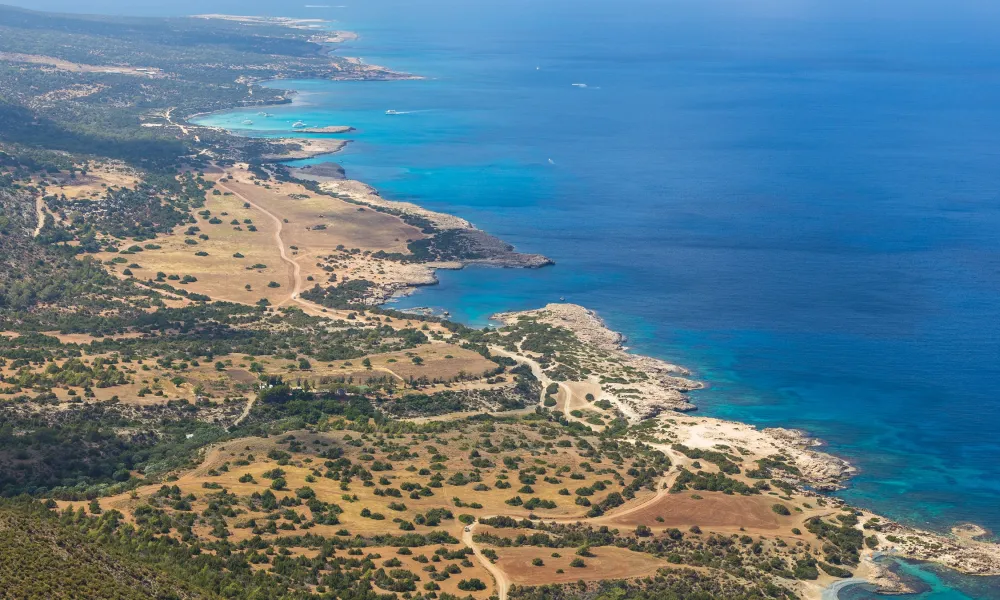

Three years after work on Phase One of the road network at the Akamas National Forest Park was suspended, and at a time when, according to reports, the Forestry Department is awaiting approval from the competent authorities to launch a new tender, the Audit Office is publishing a Special Report today examining what went wrong in the planning and implementation of the project.
The works were suspended in December 2023 following a Council of Ministers decision, and the relevant contract was subsequently terminated.
The stark reality regarding the management of public funds, according to the Audit Office, is that a project with a contractual value of €6.295 million had reached 94% of its contractual timeframe, while only 17.67% of the work had been completed.
Responsibility attributed to Environment and Forestry Departments
The entities under audit are the Environment Department, in its capacity as the Environmental Authority, and the Forestry Department.
The report attributes serious responsibility to both departments over Phase One of the road network works.
Among other findings, it says the Environment Department carried out an environmental assessment without first establishing specific conservation objectives for the area.
Both departments are also criticised for failing to identify in time discrepancies between the construction plans and the conditions imposed by the Environmental Authority.
As regards illegal catering and recreational establishments within the National Forest Park and Natura 2000 areas, the report concludes that the situation remains uncontrolled to this day.
Administrative investigations not submitted
At the outset, the Audit Office explains that it decided to begin a compliance audit of the two main departments involved for two reasons.
First, reports from administrative investigations ordered by former Agriculture Minister Maria Panayiotou have still not been submitted to the Audit Office.
In November 2023, following complaints concerning extensive breaches of legally binding environmental conditions, the Audit Office postponed the beginning of its audit so that the findings of those administrative investigations could be taken into account.
Second, more than three years after works began in October 2022, the project remains unfinished.
Six key areas of concern
The audit findings are divided into six main areas.
1. Weaknesses in environmental assessment
According to the report, the Environmental Authority, namely the Environment Department, carried out the required appropriate environmental assessment for the Sustainable Development Plan of the Akamas National Forest Park without specific conservation objectives having first been established for the area under examination.
The environmental conditions were also not always sufficiently specific regarding parameters that could materially influence the extent and intensity of the project's environmental impact.
Some conditions contained only general references, such as the “creation of side drains, where necessary, over a specified length” and that “stone walls will be constructed at certain locations where landslides occur”.
At the same time, the construction plans were not sent by the Environmental Authority to the Water Development Department before being finalised or approved, so that it could verify that all relevant legally binding environmental conditions had been incorporated into the design.
As a result, deviations from environmental conditions were identified only after hydraulic works had already been completed or were under construction.
The report also states that significant conditions contained in the Special Ecological Assessment Report were unclear, incomplete or determined without the necessary consultation with the competent departments.
One example was the failure to determine how the underground cold-water tanks at visitor service hubs would be supplied.
In addition, supplying three hubs in the Lara area through a pipeline was adopted in the Strategic Environmental Impact Assessment opinion and in the Reasoned Determination without the indirect, synergistic and cumulative effects being properly analysed and documented during the appropriate impact assessment.
Because of such shortcomings, it was subsequently decided that the pipeline and cable that had already been installed should be removed, something the Audit Office says demonstrates both a waste of public money and an environmental burden.
2. Construction plans deviated from environmental conditions
After reviewing construction plans prepared in October 2021 by the private consultant contracted for the project, the Audit Office identified breaches of legally binding environmental conditions imposed by the Environmental Authority.
These included issues involving hydraulic works, such as bridges and culverts, as well as road cross-sections within the Akamas National Forest Park road network.
Some standard cross-sections shown in the construction plans deviated from the maximum road width set out in the Reasoned Determination.
An inconsistency was also identified between the final construction plans and individual construction details regarding the final width of a particular road.
“We consider that the above deviations of the plans from the legally binding conditions, as well as the inconsistencies between the final construction plans and their individual construction details that we have highlighted, should have been identified by the Environment Department and the Forestry Department respectively before final approval of the construction works and the commencement of works,” the Audit Office said.
The report also identified deviations from the construction plans during implementation.
These concerned road cross-sections, with discrepancies found during an on-site inspection on 18 November 2025, as well as excavation works.
At one location, excavation reached a depth of 2.10 metres, compared with the maximum permitted depth of 1.875 metres under the construction plans.
Deviations were also identified in hydraulic works.
3. Fish passages at Lara and Toxeftra blocked
During a sample on-site inspection carried out by the Audit Office in April 2026, a number of constructed culverts were examined.
At box culverts at Point 2, Toxeftra Bridge, and Point 9, Lara, fish passages had been constructed.
However, debris and other transported materials had accumulated inside them, leaving the passages blocked and preventing the movement of the protected European eel.
4. €6.295m project only 17.67% complete
Beyond highlighting the delay, the Audit Office said the revised contract amount, or its estimated value, certified by the project's consultant stood at €1,378,505 plus VAT.
By May 2024, €965,955 plus VAT had been paid to the contractor.
Nine certificates for completed work had also been issued, eight of which had been paid.
The Audit Office said it asked the Forestry Department for additional information regarding the contractor's total additional claims and the department's counterclaims.
It was informed that these matters were being handled by the Law Office of the Republic and that no further details could be provided at that stage.
The Audit Office also reported that, in some cases, the Forestry Department was unable to provide complete information regarding the individual cost of each construction project.
According to the report, this weakness increases the risk of incorrect payments and limits the ability to calculate individual project costs.
By the completion of the audit, no evidence had been identified showing that the Forestry Department had taken steps to include the project in the THALIA 2021-2027 Cohesion Policy Programme, such as an inclusion call, project technical bulletin or inclusion decision.
Despite requests from the Audit Office dated 27 April 2026 and a subsequent reminder on 15 May 2026, the department did not respond or provide the requested information.
5. Cyprus referred to EU Court over Habitats Directive
In April 2026, the European Commission referred the Republic of Cyprus to the Court of Justice of the European Union over its continued failure to comply with the Habitats Directive.
The Audit Office stresses that the preparation and publication of Protection and Management Orders, including for the Special Area of Conservation and Special Protection Area in the Akamas Peninsula, is urgently required for their protection and management.
It calls for these measures to be completed as soon as possible to avoid further EU sanctions and ensure full compliance with the Habitats Directive.
6. Illegal catering and recreational premises remain
Under the section on illegal activities and interventions, the Audit Office states that illegal catering and recreational establishments continue to operate within the National Forest Park and Natura 2000 areas.
It also identified livestock and agricultural premises, as well as homes built on the basis of permits originally issued for agricultural warehouses.
Based on its inspections, which included reviews of correspondence and on-site visits, the Audit Office highlighted several issues.
There were delays of several years between the identification of violations and the filing of criminal cases or the imposition of measures to restore legality.
One case involves a restaurant built illegally on state forest land. A court issued a demolition order, but the ruling has been appealed.
In other cases where demolition orders were issued, they were not enforced.
The Audit Office said this raises serious questions about the tolerance shown by the competent authorities, namely the Paphos District Local Government Organisation, Akamas Municipality and the Paphos District Officer.
Holiday homes built under agricultural warehouse permits
Regarding holiday homes built on the basis of permits issued for agricultural warehouses, the Audit Office said there was a need to comply with environmental impact assessment requirements.
Subsequent monitoring is also required to confirm that the structures constructed comply with the permits issued.
The Audit Office said it would issue a separate Special Report on delays in imposing measures and enforcing demolition orders in environmentally sensitive areas.
Illegal catering facilities remain ‘uncontrolled’
Regarding illegal catering and recreation establishments, the report concludes that the situation remains uncontrolled.
The Audit Office conducted inspections on 25 April 2025, 11 November 2025 and 17 April 2026, finding that illegal structures were still in place.
These included:
- a restaurant with adjoining structures and a tank on state forest land at South Lara Bay;
- a prefabricated structure at South Lara Bay;
- a refreshment facility near the designated Avakas Gorge Protected Landscape;
- a mobile refreshment facility parked near the designated Aspros Potamos Protected Landscape;
- and a prefabricated structure in the bed of the Aspros River.
Although the Audit Office had already highlighted what it called the unacceptable situation involving illegal roads and paths as early as 2022, and despite relevant conditions being included in the appropriate assessment report and Strategic Environmental Impact Assessment opinion, sufficient measures have still not been taken.
Permits were required
According to the report, part of the affected plot falls within the Natura 2000 network, as well as the designated Coastal Protection Zone, where the construction or placement of any structure without the required approvals and permits is prohibited.
It also borders the Marine Protected Area and the Lara-Toxeftra Specially Protected Area of Mediterranean Importance (SPAMI).
The Audit Office therefore concluded that the relevant permits should have been obtained from the competent authorities both for renovation works and for the construction of a stage.
Responding to questions from the Audit Office, the Agriculture, Rural Development and Environment Minister said on 1 December 2025 that neither the Environmental Authority nor the Department of Fisheries and Marine Research had granted approval for the construction of the stage or the holding of a concert.
She also said the Environment Department had asked Akamas Municipality to halt works so that the activity could be assessed from an environmental perspective.
However, because no response was received, the municipality was subsequently asked to implement mitigation measures.
These were inspected by officials from the competent departments and, according to the minister, effectively limited the reflection and dispersion of light towards the sea and Toxeftra.
The Audit Office pointed out at the time that these constituted impact mitigation measures, which should have been based on an appropriate environmental impact assessment.
No such assessment, it said, had been carried out in this case.
Interior Ministry confirms unauthorised works
The Interior Minister informed the Audit Office on 16 December 2025 that construction works were taking place at the restaurant and surrounding area without the required permits.
No approval from the Council of Ministers had been obtained for the construction of the stage either.
“The Paphos District Local Government Organisation limited itself to informing us, on 20 March 2026, that the required permits and approvals for the renovation of the restaurant and the installation of the stage for the concert did not fall within its area of responsibility,” the Audit Office said.
The report added that Akamas Municipality, in a response dated 11 November 2025, stated that, according to its legal advisers, the relevant legislation did not apply in this instance.
The municipality argued that the restaurant renovation and installation of the stage did not constitute a project falling within the scope of Article 16 of Law 153(I)/2003.
“For the remaining questions we raised regarding the licensing of the restaurant renovation works, it provided no response,” the Audit Office said.
It subsequently informed the Environmental Authority that, based on the existing legal framework, it disagreed with the position taken by Akamas Municipality and asked the authority to address the issue to prevent similar incidents in future.
“Due to the seriousness of the matter, our Office has submitted a complaint to the Independent Authority Against Corruption, the examination of which has not yet been completed,” the report said.
Auditor-General sees weaknesses at successive stages
“Our audit highlighted weaknesses at critical and interconnected stages,” Auditor-General Andreas Papaconstantinou said in an introductory note.
“A fundamental issue is the fact that the appropriate assessment of the impacts of the Sustainable Development Plan was conducted without specific conservation objectives for the area having first been established.”
At the same time, cases were identified in which legally binding environmental conditions were not adequately reflected in the construction plans, along with deviations during the implementation of works.
According to Papaconstantinou, the overall picture demonstrates that planning, environmental assessment, incorporation of conditions into the plans and construction monitoring did not function as a single sequence of preventive safeguards.
Problems were also identified only after interventions had already taken place, resulting in work suspensions, redesigns, restoration measures, additional costs and environmental damage.
‘Environmental impact could not be reversed’
Stressing that prevention must come before restoration, the Auditor-General said protecting an environmentally sensitive area cannot be based on identifying problems after the event.
As an example, he noted that after works began, 19 additional or amended environmental conditions were imposed.
At the time of the Audit Office's review, 17 had still not been fully satisfied.
As for the remaining two, which related to over-excavation, the report found that the environmental impact could not be reversed.
Stronger safeguards needed
According to the Auditor-General, the competent authorities must ensure that similar weaknesses are not repeated during the next stages.
“Environmental conditions must be clear and, where possible, measurable, fully incorporated into final plans and checked before work begins. Every substantial change must be subject to documented review and approval before being implemented,” he said.
“The protection of Akamas requires effective preventive safeguards, continuous supervision and timely intervention. This is a prerequisite both for protecting the area and for the rational management of public resources.”
Departments reject Audit Office conclusions
The Forestry Department and Environment Department completely reject the Audit Office's conclusions on Akamas.
Their position is outlined in a 34-page response submitted by the Directorate-General for the Environment of the Ministry of Agriculture, Rural Development and Environment.
The two departments fully defended their decisions and actions, arguing that the accusations fail to take into account the project's technical difficulties and its central objective of protecting the National Forest Park.
Among other points, they reject claims of “irreversible environmental damage” or “incompatibility of the works”.
They argue instead that planning for the Akamas National Forest Park was based on protecting the natural environment, regulating uncontrolled visitor access and implementing approved sustainable development plans.