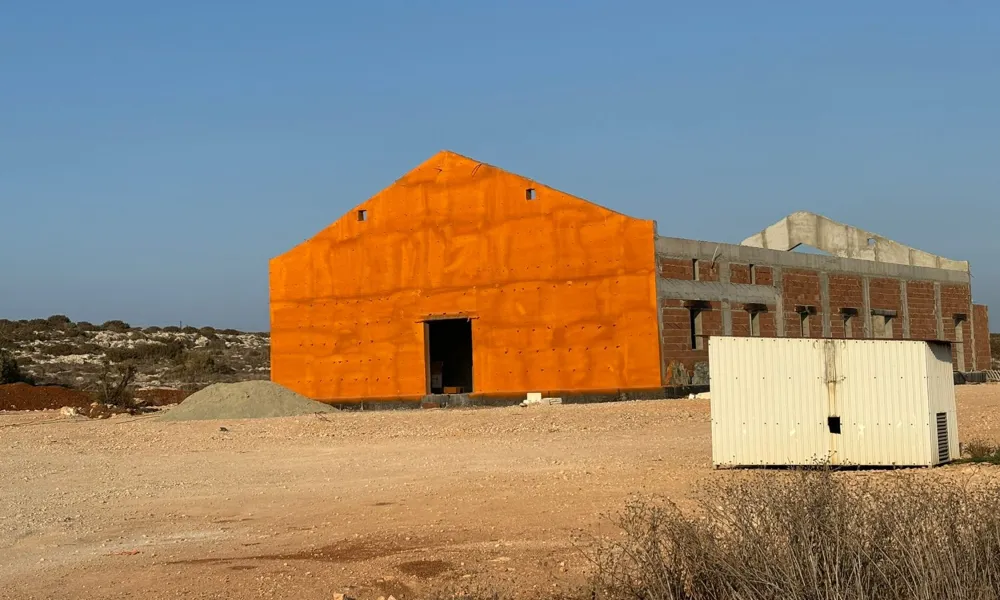

The environmental and planning controversy surrounding the possible legalisation of an unauthorised monastery development within the protected Natura 2000 area of Cape Greco has taken another turn, with the Council for the Examination of Planning Deviations (SYMEPA) postponing a meeting that had been expected to formalise a positive decision on the project.
According to information obtained by Politis, the council decided to defer its scheduled meeting, which was due to complete procedural steps and finalise its position on an application for a planning permit by way of exemption.
The postponement comes in the wake of public reaction to the council's 16 October vote, during which a majority of members supported the application. Four members voted in favour, while one voted against.
A source familiar with the matter told Politis that the meeting, originally scheduled to approve the minutes and complete the formal process, is now expected to take place sometime in November.
Possibility of a rethink
According to the same source, it is not impossible that new information could emerge before the council reconvenes, as has happened in other major and complex cases in the past.
Such developments could lead members to reconsider aspects of the recommendation that will ultimately be forwarded to the Council of Ministers, either by modifying conditions attached to the recommendation or by reversing their initial support for the application altogether.
Until a final decision is formally adopted, the source said, members' positions could still change substantially.
Only one meeting has so far been held regarding the monastery case.
The source noted that other large and complicated development applications examined by the council in recent months have required three or four meetings before a final position was reached because new information continued to emerge during the process.
Opposition from state departments
The decision by four of the council's five members to support the application runs contrary to the formally submitted positions of the relevant government departments, namely the Department of Environment and the Department of Town Planning and Housing.
The Cyprus Scientific and Technical Chamber (ETEK) also intervened following disclosure of the vote.
Through its president, Constantinos Constantinou, ETEK called for strict adherence to the law and for the demolition of the illegal structures.
The organisation warned that retrospective legalisation of unlawful developments undermines confidence in the planning system and urged both SYMEPA and the Council of Ministers to reject the application.
During the 16 October vote, only ETEK's representative opposed legalisation. The remaining four members, representing the Union of Communities, the Union of Municipalities, and two additional members, voted in favour.
Political reaction
The issue has also drawn political criticism.
AKEL issued a statement criticising the positive recommendation and raising broader concerns about Cyprus' planning model and the need to uphold equal treatment under the law.
The Ecologists' Movement - Citizens' Cooperation called for the immediate rejection of the exemption request and the implementation of previous decisions requiring demolition, stressing that the area enjoys strict protection under the Natura 2000 framework.
Following SYMEPA's recommendation, the final authority to approve or reject the application rests with the Council of Ministers.