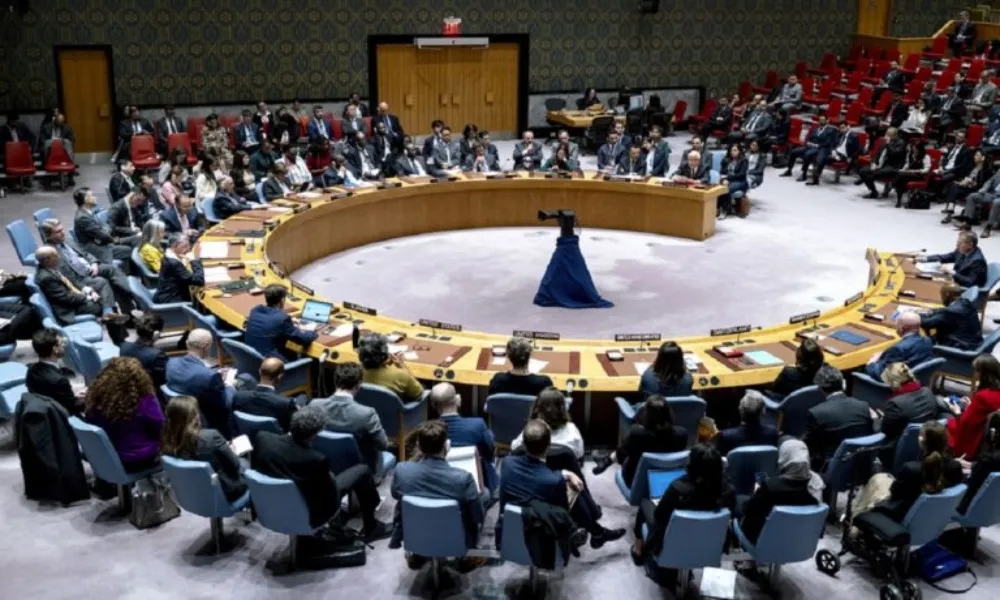

Ambassador Maria Michael, Cyprus' Permanent Representative to the United Nations has reiterated Cyprus' position that the 2019 Turkey-Libya maritime memorandum on maritime boundaries is "null and void," speaking during an open debate of the UN Security Council on emerging technologies and maritime security.
Addressing the Security Council, Michael thanked the Greek presidency for convening the discussion and referred specifically to the Turkey-Libya agreement, particularly following its recent ratification by Libya's House of Representatives.
"This purported agreement is null and void. It is incompatible with international law and, in particular, with the rules governing the conclusion of treaties, as well as the United Nations Convention on the Law of the Sea (UNCLOS)," she said.
'Geography cannot be changed'
Michael argued that sovereign rights cannot be disregarded through arbitrary maritime delimitations.
"Geography cannot be changed, nor can the sovereign rights of states be ignored through arbitrary maritime delimitations," she said.
She added that Article 121 of UNCLOS clearly defines the legal status of islands and their entitlement to maritime zones, stressing that island states and territories possess rights that must be respected under international law.
UNCLOS at the centre of maritime security
According to Michael, UNCLOS remains a cornerstone of maritime security, legal certainty and the peaceful settlement of disputes.
She noted that provisions of the convention which reflect customary international law are binding on all states.
"The Mediterranean is our common sea. Its security and stability depend on good neighbourly relations founded on respect for international law and the sovereign rights of all coastal states," she said.
AI offers opportunities and risks
Turning to the main theme of the Security Council debate, Michael said artificial intelligence has the potential to strengthen:
- Maritime surveillance
- Early-warning capabilities
- Crisis response operations
- Protection of critical maritime infrastructure
- Peacekeeping and humanitarian missions
- Monitoring of ceasefires and sanctions
At the same time, she warned that emerging technologies may also amplify existing threats, including cyberattacks and hybrid operations targeting ports, vessels, subsea cables and energy infrastructure.
Call for oversight and accountability
Michael stressed that the development and deployment of artificial intelligence must be guided by responsibility and ethical principles.
She called for:
- Meaningful human oversight
- Transparency
- Accountability
- Respect for international law
She also reiterated that technological progress must remain firmly grounded in the UN Charter and UNCLOS.
Importance of international cooperation
Concluding her remarks, Michael highlighted the importance of information-sharing, capacity-building and cooperation among states, international organisations and the maritime industry.
She also underlined the role of the UN Security Council in addressing the impact of emerging technologies on international peace and security.
"Our collective objective must be to ensure that emerging technologies strengthen maritime security while remaining firmly anchored in international law, human oversight and international cooperation," she said.
Source: CNA