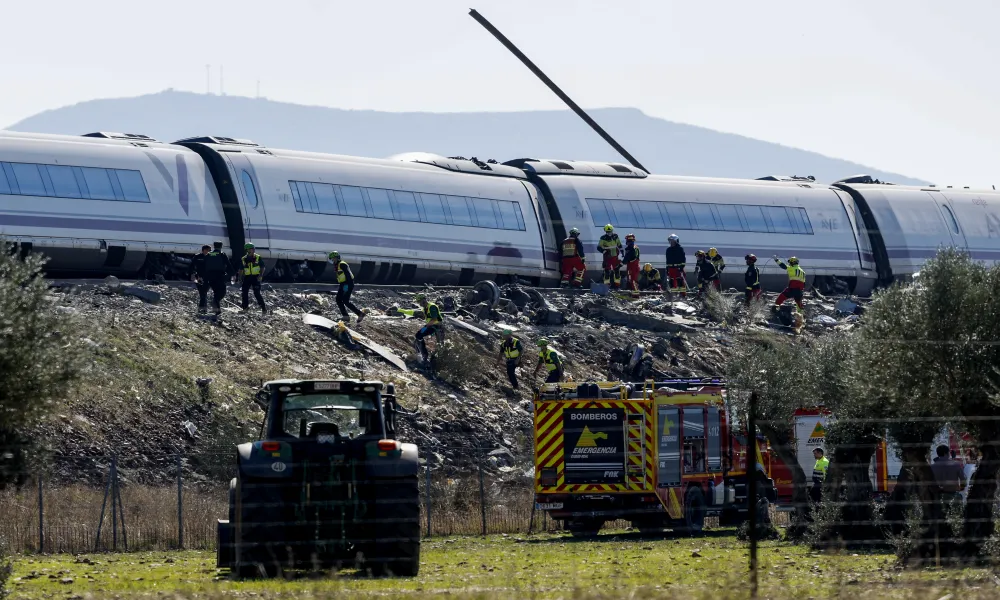

The collision of two high-speed trains near Urda, Toledo, which left 69 people dead according to the latest regional authorities' toll, has thrust railway safety to the centre of Spain's election campaign just one month before voters head to the polls on 29 November.
It is the second deadly high-speed rail disaster in Spain this year, following the collision in Adamuz, Córdoba, in January that claimed 46 lives.
Shortly before news of the crash emerged, Prime Minister Pedro Sánchez had posted on X that there were many reasons to be optimistic about the country.
The Spanish Socialist Workers' Party (PSOE), which according to El Mundo believed internal projections gave it a path to between 125 and 145 seats, immediately suspended its campaign. The People's Party (PP), Podemos and Frente Amplio followed suit.
The government declared three days of national mourning, which ends tomorrow.
The instruction that should never have been given
According to Transport Minister Óscar Puente, a communications failure at around 8:30am on Wednesday disabled the LZB safety system along a section of track approximately 63 kilometres long, automatically stopping trains operating on the route.
Traffic management was then taken over by the Adif control centre at Madrid Atocha Station.
At 8:36am, controllers authorised a Renfe AVE train to continue its journey despite a red signal and an occupied line.
The train travelled approximately 25 kilometres before colliding at 8:53am with a stationary Iryo train.
There were 397 passengers on board the AVE service and 147 passengers on the Iryo train.
Puente described the decision to authorise the train's movement as "inexplicable" and cleared both train drivers of responsibility, stressing that he was not assigning blame but merely presenting the known facts.
The Guardia Civil has already questioned the operator who issued the instruction.
Sánchez said he did not believe the year's two railway disasters were linked in terms of their causes and left the final conclusions to investigators.
Minister under pressure
The focus on possible human error has not eased pressure on Puente, one of Sánchez's closest political allies, who remained in office after the Adamuz accident earlier this year.
Asked whether he would resign, the minister declined to answer directly, saying his concern was uncovering the truth rather than discussing his personal future.
"His situation is now very complicated," a PSOE figure with government experience told El Mundo.
PP leader Alberto Núñez Feijóo stopped short of assigning blame but called for an independent review of Spain's entire railway network and greater transparency regarding maintenance spending.
Only the Vox party proceeded with a scheduled campaign rally in Valladolid, where leader Santiago Abascal rejected what he described as a period of mourning that would silence his party and linked the tragedy to corruption.
A new narrative for the Socialists
Before the accident, polling averages placed the PP at 31%, PSOE at 27.3% and Vox at 18.9%.
The Socialists are now attempting to shift the political debate towards the defence of public services and what they describe as the risks of spending cuts under a potential PP-Vox government.
Within PSOE, however, concerns have emerged that the train disaster, together with recent disturbances in Barcelona and Bilbao, may reinforce an opposition narrative depicting the country as experiencing broader instability.
Meanwhile, high-speed rail services between Madrid and Andalusia have not yet resumed.
Renfe has also suspended the sale of new tickets for the route until December.