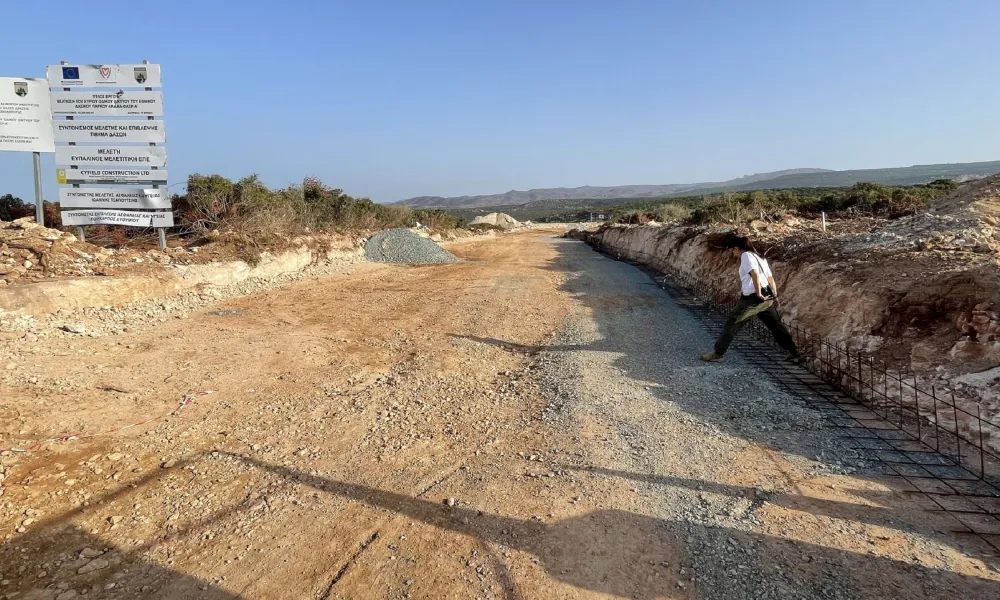

An amicable settlement has been reached between the state and contractor Cyfield, through the Law Office of the Republic, following the termination of the contract for the first phase of roadworks in the Akamas peninsula.
However, a disciplinary investigation into extensive breaches of legally binding environmental conditions remains before the Law Office, with no conclusion reached so far.
The investigation is being handled by an investigating officer from the Law Office, meaning the process has yet to be completed and the Council of Ministers, which has the relevant authority, has not been able to proceed with further action.
The developments were outlined to MPs by Costas Constantinou, Director-General of the General Directorate for the Environment at the Agriculture Ministry, during a parliamentary presentation of the ministry's 2027 budget by Agriculture Minister Christos Senekis.
The Akamas project was among several issues raised during the House Finance Committee's examination of the proposed budget. MPs also questioned officials on the recovery of livestock farmers affected by foot-and-mouth disease, efforts to resolve the dispute over halloumi production quotas, rising agricultural costs, delays to the Pay As You Throw waste scheme and opposition to a mobile desalination plant in Mazotos.
Agriculture Ministry budget rises to €532m
Presenting the proposed budget, Senekis said total expenditure would reach €532m in 2027, compared with €513.2m in 2026, representing an increase of €18.7m, or 4%.
Water-related expenditure is set to rise significantly, reaching €230m, equivalent to 43% of the ministry's total budget. This compares with €200m, or 39%, in 2026.
The minister highlighted an €26m increase in spending on water purchases, representing a rise of 18%. He attributed this mainly to the installation and operation of new mobile desalination units, as well as the purchase of recycled water.
Senekis also said planning for four permanent desalination plants, which are expected to provide more than 100% of daily water supply requirements, should be completed around 2030-2031.
Describing the budget as a reflection of the government's priorities, he said it aimed to safeguard water adequacy, support the primary sector, protect the natural environment and modernise public services.
He described it as an operational plan designed both to address immediate needs and to build more resilient infrastructure and productive sectors.
No date yet for livestock farmers' return after foot-and-mouth outbreak
The safe return to activity of livestock farmers affected by foot-and-mouth disease was another major issue raised during the discussion.
Senekis said the priority was to allow affected farmers to resume operations as soon as possible, noting that delays also had implications for public finances.
However, Veterinary Services Director Christodoulos Pippis pointed to delays caused by certain livestock farmers who, despite receiving fines, were failing to disinfect their premises as required.
He said this was holding back the return of operations, to the detriment of other farmers who were already ready to resume activity.
On compensation for lost income, Senekis said payments had been linked to the resumption of operations. An agreement had been reached with the Finance Ministry for 50% of the compensation to be paid when replacement animals were ordered, with the remaining 50% paid once the animals were installed on the farms.
The minister also referred to an initiative involving Cyprus, Greece, Bulgaria and Romania to launch discussions at EU level on relaxing regulations governing restrictions during animal disease outbreaks.
He said efforts would be intensified during Greece's presidency of the Council of the EU in the second half of 2027.
Talks aim to resolve halloumi PDO quota dispute
The Agriculture Ministry is also facilitating discussions between cheesemakers, cow farmers and sheep and goat farmers in an effort to reach a consensual solution to the proposed changes to the milk quotas governing Protected Designation of Origin (PDO) halloumi.
Senekis said the discussions had begun with the ministry acting as mediator.
He explained that European experts had found that, by 1 June 2029, sheep and goat milk production would not be sufficient to meet the requirement for at least 51% of the milk used in halloumi production, while maintaining existing export levels.
The government is therefore seeking an agreement between the different stakeholders to address the issue.
Support for farmers amid rising production costs
Addressing concerns over rising agricultural production costs, Senekis referred to two support schemes administered by the Department of Agriculture.
The first, worth €2.4m, is intended to help farmers cope with higher fertiliser and agricultural fuel costs.
A further €4.6m has been secured from the EU to address the consequences of the prolonged drought experienced in 2025.
The funds are expected to be distributed by February 2027 at the latest.
The minister acknowledged, however, that the available support would not fully resolve the difficulties facing the agricultural sector.
Pay As You Throw delays and waste management targets
The implementation of the Pay As You Throw scheme also came under scrutiny, with Senekis acknowledging delays but arguing that responsibility was shared between the ministry and local authorities.
He said discussions with local authorities were ongoing to establish how implementation could move forward as quickly as possible.
On waste management, the minister noted that the proportion of waste sent to landfill currently stood at 63.5%, significantly above the target of reducing it to 10% by 2035.
He referred to a broader strategy for integrated municipal waste management, based on a viability study expected to be completed in 2028.
Mazotos desalination plant prompts further discussions
Opposition in the community of Mazotos to the installation of a mobile desalination unit was also raised during the committee meeting.
Senekis said the ministry remained in open discussions with the community council over specific compensatory measures intended to address local concerns.
In defending the need for cooperation on infrastructure projects, he cited the example of residents of Alassa, in the Limassol district, whom he described as having made a greater sacrifice by agreeing to relocate their community to allow for the construction of the Kouris Dam.
The minister's comments came as MPs examined the competing demands facing the Agriculture Ministry, from water security and environmental protection to the financial sustainability of farming and the country's waste management system.