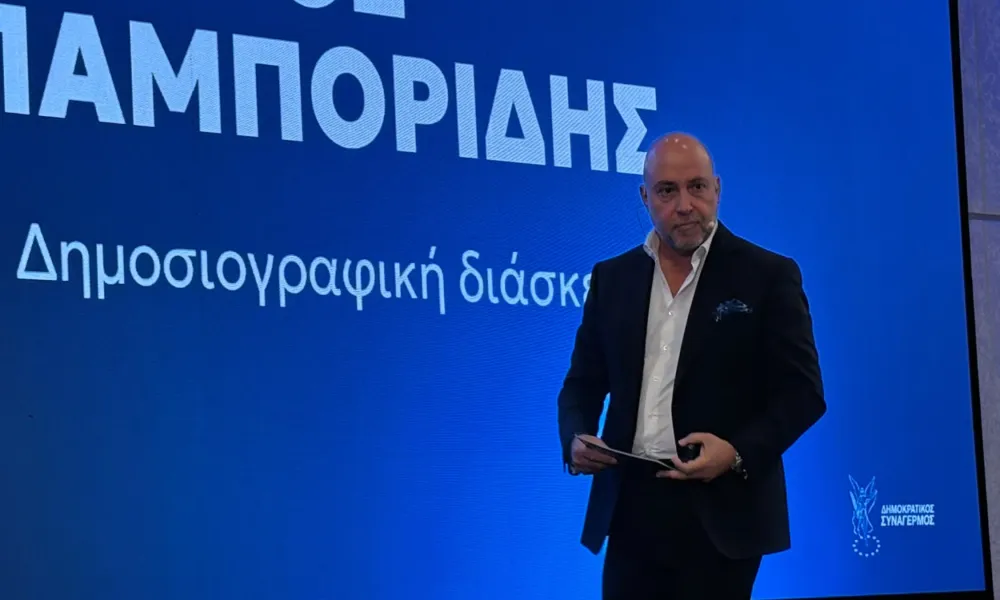

Giorgos Pamboridis has sought to give an ideological dimension to the internal leadership contest of the Democratic Rally (Disy), presenting his political platform as a form of “radical centre-right” politics and rejecting the argument that ideology has become irrelevant.
Speaking to Frixos Dalitis on the Phileleftheros podcast, in an interview published on Monday, the MP and former health minister dismissed claims that common sense alone should guide political decision-making. Such arguments might resonate on social media, he said, but would not prove sustainable in the long term.
Pamboridis argued that Europe's centre-right had increasingly become part of the problem rather than the solution for societies and needed to embrace more far-reaching policies and practices.
He also defended the principle of a free-market economy, arguing that its purpose should not be to generate wealth for a privileged few, but to encourage economic activity that benefits society as a whole.
Cyprus moving at ‘snail’s pace’
Pamboridis placed the Christodoulides administration within the same broader political direction, describing its approach as inherently conservative.
At a time when technological advances are transforming entire countries into innovation hubs, Cyprus is moving forward at “snail’s pace”, he argued, with what he described as almost fear-driven attitudes that prevent society from accessing emerging opportunities.
He reiterated his description of the government as managerial rather than transformative, arguing that the distinction was fundamentally ideological. One approach, he said, seeks to preserve established structures, while the other aims to challenge and dismantle them.
Ideological differences with Averof
Pamboridis also placed Averof Neophytou within what he described as the established political system, calling him, “with all due respect”, “part and parcel of the system” and a defender of entrenched interests.
As an example, he recalled their disagreements during his tenure as health minister, from 2015 until February 2018, when he was working to advance the implementation of the General Healthcare System (GESY).
He also cited differences over the Cyprus problem, the lifting of sanctions against Russia, the delimitation of maritime zones and the Exclusive Economic Zone (EEZ), the electricity interconnection project, and whether energy issues should form part of negotiations on the Cyprus problem.
Pamboridis insisted that these disagreements were political rather than personal. He illustrated the distinction through a comparison with the car market: he was advocating an electric vehicle, while Neophytou, given his long political career, represented the conventional and traditional option.
He was careful to clarify, however, that he did not mean outdated.
Keeps distance from Georgiades-Neophytou dispute
Asked about a letter sent by former finance minister Harris Georgiades to Disy leader Annita Demetriou, in which Georgiades said he would not participate in the party's election campaign if Neophytou became its candidate, Pamboridis declined to take sides.
He said only that a candidate who opposed the party's fundamental positions would ultimately harm both himself and the unity of the party. He also cautioned that Disy's 27% share of the parliamentary vote should not be taken for granted.
Pamboridis pledged to support Neophytou if he won the leadership contest, citing the need to respect the democratic process. He also called on his rival to demonstrate the same openness and commitment.
Neophytou had previously said, when submitting his candidacy, that he would support Pamboridis if the latter secured the party's endorsement.
On the 2023 presidential election, Pamboridis declined to reveal whom he had voted for. He said that, having distanced himself from the party in 2019 and acting as a private citizen, he could not support Neophytou, but had not worked against him either.
Polls and the challenge of party unity
Commenting on an EXPLORER poll published by Phileleftheros, which put Neophytou ahead with 51% against 28% for Pamboridis, the latter argued that opinion polls were overvalued and needed to be interpreted through a political lens.
He also highlighted his support among Disy voters who had backed Nikos Christodoulides in the first round of the 2023 presidential election, claiming to have secured 47% of that group.
Describing himself as an outsider competing against a politician who had been active in politics full-time for three decades, Pamboridis identified three key objectives.
These were to bring back the party's more distant and fragmented supporters, secure victory in the first round without a repeat of the 2023 dilemma between Neophytou and Christodoulides, and ultimately lead Disy to victory in the elections.
‘We are all responsible’
Addressing the party's current difficulties, Pamboridis said responsibility should be shared across the political spectrum and generations of leadership.
He attributed part of the blame to the previous party leadership, adding that he would even include the party's honorary president, as well as Christodoulides, the current leadership and himself.
His comments underscored his attempt to frame the leadership contest not simply as a contest between two individuals, but as a wider debate over Disy's political identity, its relationship with the establishment and the direction it should take in the years ahead.