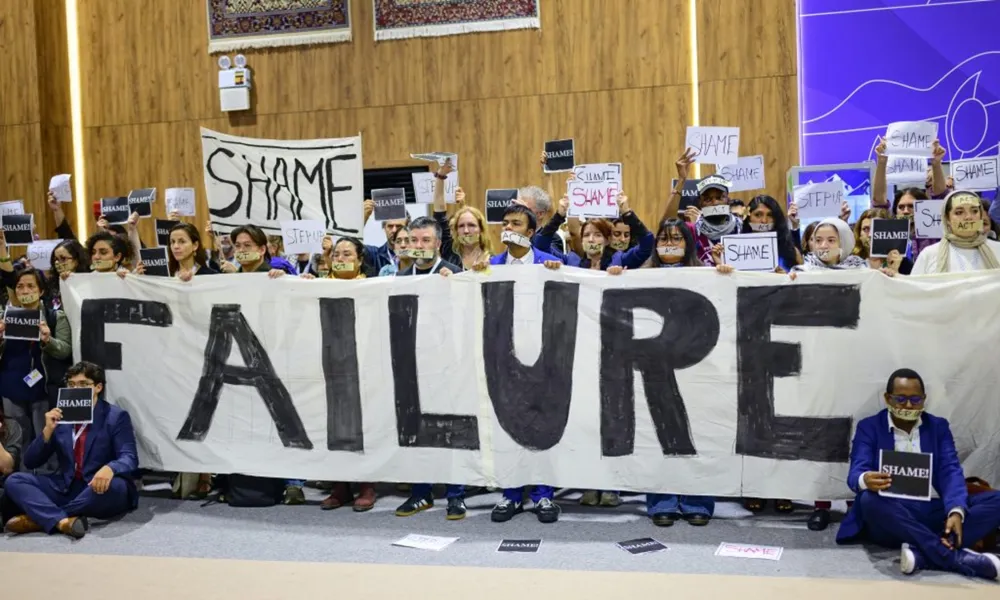

The UN climate summit COP31 in Antalya ended without an overarching agreement after the final draft deal, which made no mention of fossil fuels, was rejected. Turkish Environment Minister Murat Kurum, who co-chaired the summit with Australia, announced that no new draft would be put forward. The talks, the longest in the history of COP summits, had run about two days past their scheduled close. The final hours were described as chaotic. The European Union's refusal to back the draft proved decisive.
The EU's objection
Speaking on behalf of the EU, Irish Environment Minister Darragh O'Brien told the plenary: "It is unconscionable that we would have a climate pact that makes no mention of fossil fuels." He added: "We cannot endorse a decision that greenwashes fossil fuels." Panama and the Marshall Islands also opposed the draft.
A deal requires the agreement of nearly 200 nations. According to the Associated Press, a considerably larger number of countries said reaching a consensus on something was more important, and accepted the text, often reluctantly. According to Politis's sources, Russia and China supported leaving an explicit reference to fossil fuels out of the final deal. The Associated Press named Russia and Saudi Arabia as the main forces keeping fossil fuels out of the document.
"Hijacked" by oil producers
The EU's rotating presidency said the COP31 summit was being undermined by certain oil-producing states. It confirmed that the gap had not been bridged despite emergency talks with Saudi Arabia called by the summit's co-presidents, Turkey and Australia.
Saudi Arabia's representative Mohammed Ayoub said the Arab countries had continued to negotiate in good faith. He stressed that the 22 member states of the Arab League account for less than 2% of historical greenhouse gas emissions.
"No new attempt at consensus"
Kurum said negotiations had been held and that the presidency had listened patiently to everyone, before acknowledging the deadlock. He made clear there would be no new attempt to secure consensus with a new draft.
Earlier on Sunday, according to the Associated Press, Kurum had given negotiators only about three hours to raise objections or request changes before the draft was presented to the final meeting.
The confusion, with no clarity over whether delegations would remain in the hall to continue discussing the draft, led to unexpected moments. Kurum was caught on a hot mic telling UN climate chief Simon Stiell "to sit down", as Stiell tried to advise him on proceedings on stage.
Ghana's representative, speaking on behalf of the African Group of negotiators, also on an open microphone, accused the presidency of failing to show respect to a group of 54 countries.
Environmental groups said the text was not a climate plan but a licence to keep polluting.
The disputed "electrification" plan
Facing criticism over fossil fuels, Turkey and Australia argued that electricity is an ally in the fight against climate change. The draft included a target to raise electricity's share of energy consumption to 35% by 2035 and to expand "clean energy". According to the Associated Press, the proposal also included a specific goal for supporting technology that captures and stores carbon pollution, which is hotly debated and backed by the oil industry.
However, the draft did not explicitly require electrification to be powered by renewable energy. About a third of the world's electricity is generated from coal, and another fifth from fossil gas.
This year's COP is the first since the UN's environment agency confirmed in October that global warming is expected to exceed the 1.5°C limit. Countries agreed at the Paris climate conference, more than a decade ago, to try not to exceed this threshold, as the impacts of extreme weather intensify beyond it.
Jennifer Morgan, Germany's former climate envoy and a researcher at Tufts University, said that after the presidency ignored the views of 150 countries and presented a very weak text, the negotiations were on the edge of a cliff.
What happens next
According to the BBC, the options after the deadlock in Antalya are limited to two. The draft could be put back on the table at the interim global climate meeting, the "COP-bis" in Bonn, where the UN climate body is based. Alternatively, any decisions could be postponed to 2027 and the next summit, COP32, to be hosted by Ethiopia in Addis Ababa.
With information from Reuters, BBC, AFP, the Associated Press, Al Jazeera, The Irish Times and ERT