
Two cases, one in January 2025 and the other in October of the same year, quite literally rang the alarm bell at the Police, highlighting the need for immediate action on modernisation and better coordination, with particular emphasis on prevention. In recent months, Chief of Police Themistos Arnaoutis has presented to all levels of the Police the changes now being implemented, setting 2030 as the horizon for full implementation.
The Command, Control and Communications Centre will change the way frontline officers access information on people and incidents that is considered absolutely essential for either prevention or investigation.
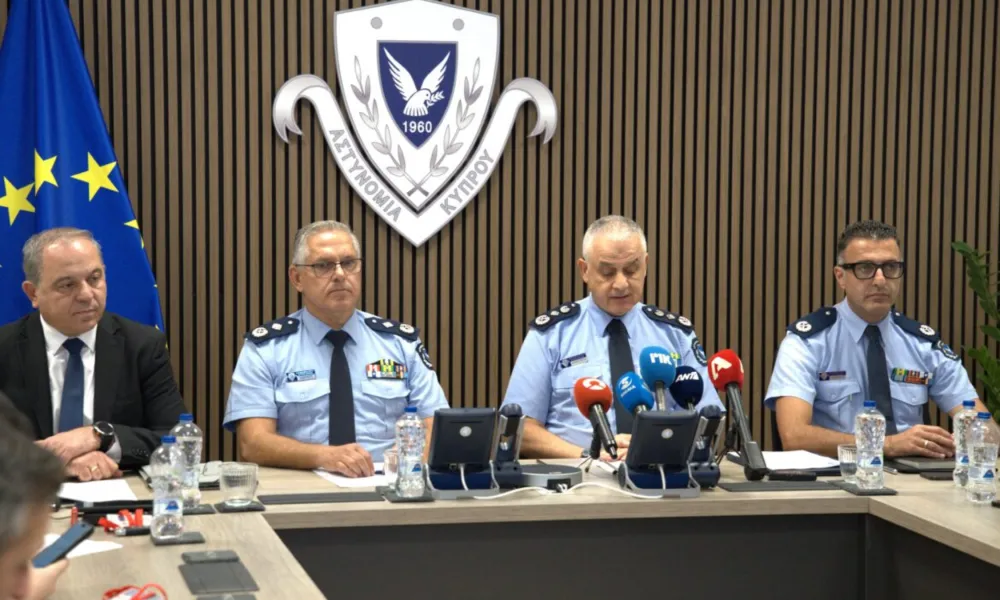
The Chief referred to the two cases himself when he presented the changes to media representatives. The first concerns the death of a foreign national in the incident at Potamia. Acting on information, police officers went to the Potamia area, where unknown persons were attempting to use vehicles to transport migrants from the north to the government-controlled areas. On seeing the officers, they drove their cars towards them with the intention of hitting them. The officers responded by firing shots. The incident took place in the evening. Later that same night, a foreign man was found dead in the Acropolis area of Nicosia. An examination of the scene followed, without establishing the cause of death. Five days later, the post-mortem found a bullet in his body. The Police were informed, and it was established that he had been a passenger in a vehicle involved in the incident and that the bullet had come from a police officer's weapon. As the Chief explained, it is inconceivable that the two incidents could not be linked, that is, the shooting at Potamia and the discovery of a body a few hours later at another location in Nicosia.
The second case concerns the murder of Stavros Demosthenous in Limassol. The gangland manner in which the perpetrators acted, the time of the killing and all the pieces that made up the puzzle of the case were the reasons additional measures against organised crime were decided. As the Chief himself revealed, after this case, and at a meeting he held with the President of the Republic, it was decided to create a special unit dedicated to organised crime.
These two cases led the Police leadership to radical changes. Although these should have been implemented long ago, their implementation has now begun, and the first tangible results are already visible.
C3 is the key
Perhaps the most important tool being integrated into the operational structure of the Police is C3, the Command, Control and Communications Centre. Once fully completed, it will provide a common operational flow for incidents, resources and coordination. The name C3 comes from the words Command, Control and Communications. The main goal is to radically change frontline officers' access to information on people and incidents that is considered absolutely essential for either prevention or investigation.
In recent months, Chief of Police Themistos Arnaoutis has presented to all levels of the Police the changes now being implemented, setting 2030 as the horizon for full implementation.
Until now, all relevant information has moved through different systems, and operational coordination has relied on manual procedures, which limits the ability to form a complete picture. C3 aims to create unified incident management, a common real-time operational picture and better deployment of resources according to the seriousness of each incident.
The Centre is part of a wider portfolio of changes. This includes Intelligence-Led Policing, the use of data for operational and strategic decision-making, upgraded information infrastructure and stronger cybersecurity. The technology plan also includes artificial intelligence applications. The Directorate for Combating Organised Crime (DAOE) is also part of the overall policing model, strengthening the Police's ability to tackle serious and organised crime with modern analysis methods, better coordination and targeted operational action.
Immediate access
As Themistos Arnaoutis explained, officers will access the data and information provided by C3 either through portable devices (such as tablets) or through desktop computers. If, for example, the Police are called to an incident, officers will have immediate access to information on the people involved, such as previous complaints and their nature, or whether they have a pattern of repeated offending.
Three pillars
The "Cyprus Police 2030" plan rests on three main pillars, which form the basis for the overall modernisation and transformation of the Police.
- The first pillar is operational capability. The aim is to make the Police more effective in managing critical incidents, by using intelligence and data (Intelligence-Led Policing), and to tackle serious and organised crime more effectively.
- The second pillar concerns human resources. It seeks appropriate staffing, modern management and appraisal, continuous skills development, stronger integrity and the active participation of members in the process of change.
- The third pillar is technology. It provides for modern and secure infrastructure, data interconnection and improved communication with, and service to, citizens.
The three pillars work in a complementary way, with the shared goal of a modern, flexible and effective Police focused on the safety of citizens and society.
Guidance from Europol
Europol played an important role in the modernisation effort and in moving the Police into a new era. Its views and recommendations, particularly on tackling organised crime, were incorporated into the final decisions of the Force's leadership.