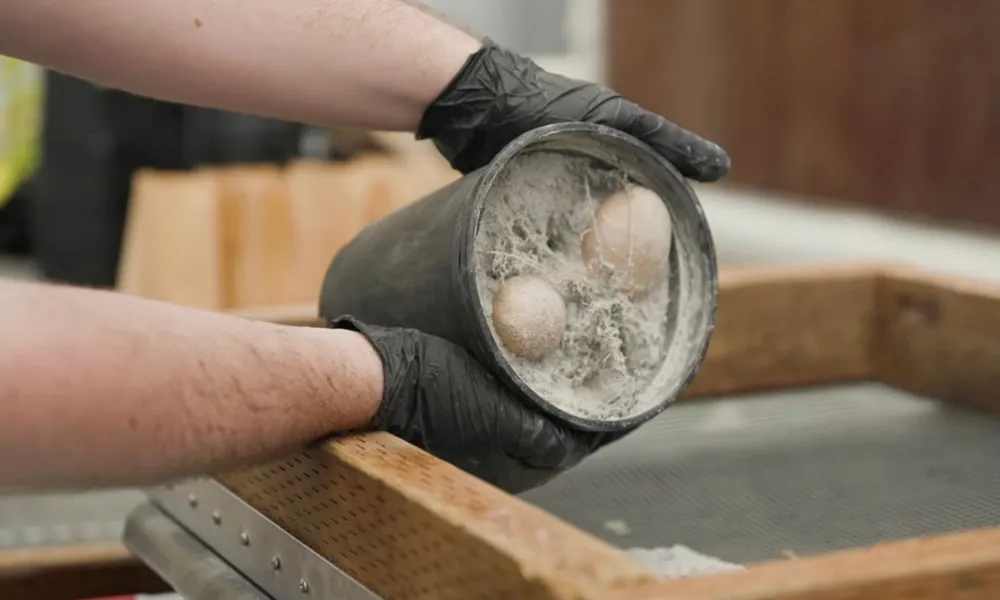

Scientists have grown potatoes that could one day feed the first people to live on the Moon, using simulated lunar soil.The NASA-funded research shows that the crop can perform as well as it does on Earth, provided the soil is enriched with the right amount of organic matter.
The study, published in the journal npj Microgravity, was carried out by researchers at Oregon State University. It was led by plant biologist Aymeric Goyer, with postdoctoral researcher David Handy, both of the university's Department of Botany and Plant Pathology. The scientists used the Modoc potato variety, which matures relatively quickly and has red skin and white flesh.
"We found that potatoes can complete their entire life cycle in simulated lunar soil when supplemented with organic matter," Goyer said in a statement. "That's an important step toward developing reliable food production systems that could support long-term human exploration of the Moon."
Why growing food on the Moon matters
Growing crops on the Moon is considered important for US and Chinese plans to establish permanent or long-term bases on its surface. Shipping all the necessary food from Earth would be extremely difficult and expensive. Producing food on site could reduce astronauts' dependence on constant resupply.
The material that made the difference
Lunar soil is very different from soil on Earth. Properly called lunar regolith, it is essentially crushed rock and dust, often sharp and glass-like, formed over billions of years by meteorite impacts. It lacks the organic matter and nutrients that plants need.
The team tested five different lunar regolith simulants, representing both the Moon's mare (basaltic plains) and highland regions. They compared them with fertile agricultural soil from Hermiston, Oregon, an area known for its high potato yields.
To tackle the problem, the researchers added different amounts of vermicompost, a nutrient-rich organic fertiliser produced when earthworms break down organic waste, to the simulated lunar soil.
The results were clear. Potatoes planted in regolith with no vermicompost produced almost no roots or tubers. With as little as 5% vermicompost, the plants began to form roots and tubers. At 30% vermicompost, the yield was identical to that of potatoes grown in Earth soil under the same conditions.
"Lunar regolith does not contain any nitrogen, so no crop would grow without supplementing it," Goyer explained.
The experiment was carried out in a greenhouse with natural and artificial lighting. The temperature was kept at 22°C during the day and 18°C at night.
Are they safe to eat?
Another problem with lunar soil is the presence of high concentrations of metals, such as copper, which can build up in plants and become toxic.
The research showed that adding organic matter limits the potatoes' uptake of these metals. "Without organic matter, potatoes take up too much heavy metals, which can become toxic for the plants. Organic matter helps make heavy metals less available to the plants, so plants do not overaccumulate them," Goyer said.
Laboratory analysis showed that the potatoes produced with the right soil mix were safe to eat. The scientists, however, have not tried them.
"Unfortunately, we have not tasted them yet. We used what we harvested for lab analyses," Goyer told Reuters.
The potatoes in the first experiment were also very small, generally less than 10 grams. According to the researchers, this was mainly because of the small pots used, as the potatoes grown in Earth soil were just as small.
In a second study now under way, the scientists used larger pots. "In this case, we obtained potatoes of size you typically see at the store," Goyer said.
Why potatoes
Potatoes offer major advantages for future space farming. "Potatoes provide more calories per land area than many other crops," Goyer said. They are rich in nutrients and could form a staple part of the diet.
"They are nutritious, they provide more potassium than a banana, are rich in vitamin C, have good proteins," Goyer said, adding that they are also very filling.
Potatoes are not the only food being studied for future farming beyond Earth. A study published in March looked at growing chickpeas in simulated lunar soil enriched with vermicompost. "People are also working with tomatoes, lettuce and legumes like alfalfa," Goyer said.
The research could also prove useful on Earth. According to biologist David Handy, who took part in the study, techniques developed for space farming could be used to produce food in arid regions or to improve degraded and contaminated soils.
From "The Martian" to real space farming
The idea of growing potatoes away from Earth is not new to science fiction. In the 2015 film "The Martian", the character played by Matt Damon grows potatoes on Mars to survive.
The new research does not mean astronauts are ready to grow potatoes on the Moon. The experiments took place in a greenhouse on Earth, using materials designed to replicate lunar soil rather than actual samples from the Moon. But it shows that one of the main obstacles, the lack of nutrients in lunar soil, can be overcome.
And if potatoes ever make it onto the menu at a lunar base, how might they be cooked? "It is a very versatile crop, so yes, all the above. In terms of ease of preparation, maybe microwaved," Goyer said.
With information from Reuters and Oregon State University