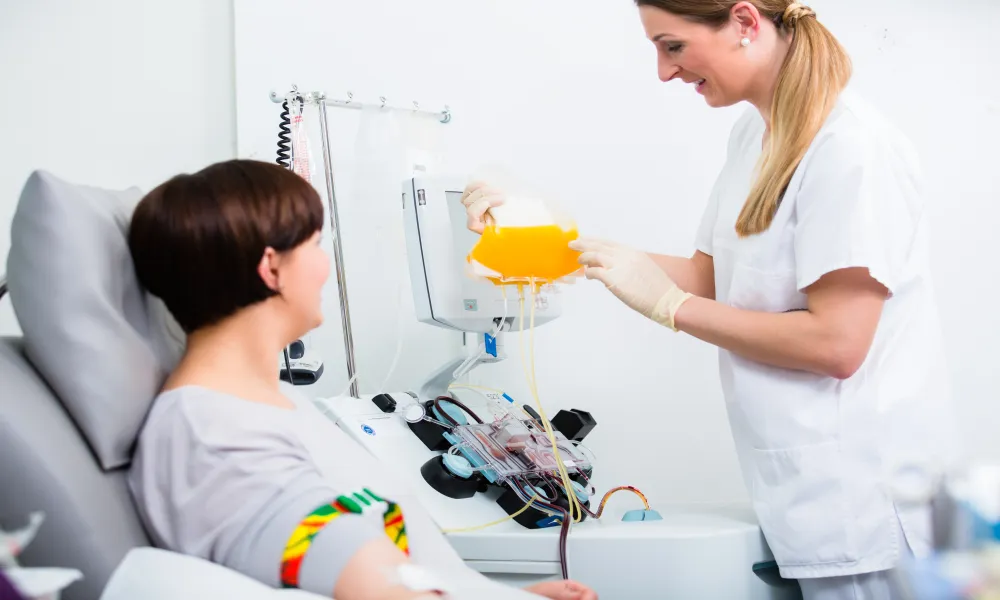

Five to eight plasmapheresis sessions, at a cost of €1,790 each, a full programme that may approach €20,000, and the possibility of starting treatment as early as October. This is the offer Politis received when it approached, as a prospective patient, the Larnaca centre that operates without the required licence and which, just a few weeks ago, was reported to the Police for the third time.
The complaints were made, the Ministry of Health carried out a surprise inspection and the Police are once again investigating the case, yet the centre's doors remain open. And, as Politis found this time through contact as a prospective patient, this is not simply a website that remains online. The centre accepts enquiries, schedules treatments and continues to offer H.E.L.P. Apheresis. Its website, in fact, still lists opening hours for "clinical treatments" from Monday to Friday.
€19,500 for treatment
Politis contacted the centre presenting the case of a patient suffering from Long COVID symptoms. The reply came in detail. The centre stated that it has, as it claims, helped patients from various countries and that the treatments it offers include H.E.L.P. Apheresis, Inuspheresis, hyperthermia and immunoadsorption. For most treatment protocols, according to the information we received, five to eight sessions of H.E.L.P. Apheresis are usually recommended, with two sessions per week. The cost of each session was set at €1,790, while for the full programme, including supportive therapies, we were given a range of €12,500 to €19,500. The prospective patient is essentially asked to plan a stay in Cyprus of around three to four weeks.
The process does not stop at treatment. We were informed that support is also available for arranging accommodation and travel to Cyprus, while the centre's website features testimonials from people in the United Kingdom, Germany, the US, Australia, South Africa and other countries who say they travelled to Larnaca for treatment.
Where is the doctor?
Politis followed up, asking for more information on exactly how the process begins. As it was explained to us, it starts with a video call with one of the two people presented as the centre's "health consultants". From the information we were given, there is no indication that they are doctors, nurses or other health professionals, nor does anything of the kind appear in their CVs.
The treatment plan, we were told, is not determined before arrival at the centre. The patient arrives at the centre, undergoes the necessary laboratory tests and the treatment programme is then drawn up. For the tests, the centre said it works with clinical laboratories and biomedical centres in Larnaca.
We asked specifically how soon treatment could begin and, above all, whether there would be contact with a doctor before the first visit, and of what specialty. We received no specific answer regarding the identity or specialty of the doctor who would take on the "patient". We were, however, informed that treatment could begin as early as October. The "health consultant", we were told, could also help with the practical arrangements for the trip. This point is particularly significant, as the centre appears to be aimed to a large extent at patients from abroad.
Why was there no seizure?
One further issue that highlights the gaps in the existing framework concerns the plasmapheresis machines found at the centre during the Ministry of Health's surprise inspection. The machines were not seized because, as a competent source explained to Politis, they were legally imported into the Republic of Cyprus and hold the necessary certificates.
And this is precisely where another problematic point lies. The legality of a machine's import is examined independently of whether the premises where it is used are licensed or whether the person operating it has the required professional training. As a result, the ministry can identify unlicensed premises and report them to the Police, but cannot remove the equipment or immediately suspend the activity.
The paradox is that when a legal private healthcare facility breaches the terms of its licence, the Ministry of Health has the power to seize equipment, impose sanctions or even suspend the centre's operation. In the case of unlicensed premises, however, the Ministry of Health's powers stop at a report to the Police.