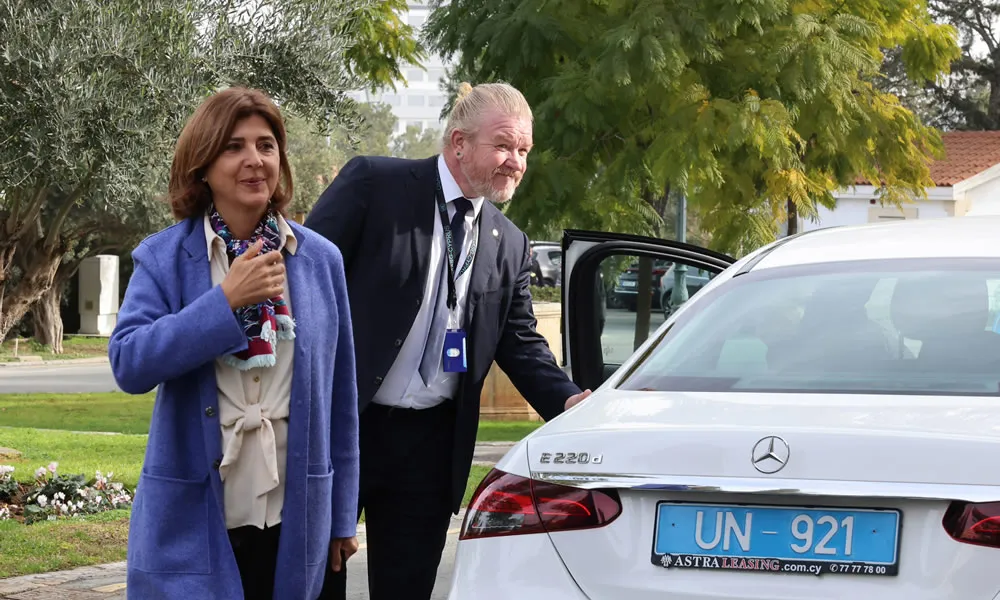
The UN Secretary-General’s Personal Envoy María Ángela Holguín – returning to the island after a four-month absence – will meet separately with the two leaders in Cyprus on Monday, 8 June.
Regional tour
Politis learns that the former Colombian diplomat will spend around 10 days in the region, meeting with all relevant stakeholders, first on the island and then in Athens and Ankara.
According to informed sources, with parliamentary elections over, Holguín aims to sound out the two leaders on the potential for a strategic agreement or at the very least a strongly-worded joint statement that could get the ball rolling for formal talks.
It is not yet clear what shape this strategic agreement would take, or whether a possible joint statement would go further than or depart significantly from the Anastasiades-Eroglu Joint Statement announced on 11 February 2014.
Diplomatic sources also note the possibility of discussing implementation of an agreement in phases.
One concern among observers appears to be the prospect of any new momentum falling prey to electoral cycles, hence the need for movement, based on solid ground.
Turkey and the Republic of Cyprus are due to hold elections in early 2028 though in Turkey’s case, there is a significant possibility of early elections, while the Turkish Cypriots will also likely go to the polls in the coming months.
Tete‑a‑tete talks under review
The UN envoy will arrive on 6 June, as Politis reported last Monday, to take stock of developments since her last visit to the island in January.
She will assess progress – if any – on core issues and confidence-building measures (CBMs) across leadership talks, technical committees and civil society, but her main task is to sound out the leaders on the potential for a dynamic next step.
Depending on how her bilateral meetings go with President Nikos Christodoulides and Turkish Cypriot leader Tufan Erhürman, Holguín does not rule out a trilateral meeting with both leaders – the last one having taken place on January 28.
In an opinion piece published last February, the personal envoy indicated she did not see the value in convening another trilateral unless it would be useful to move things forward.
Since then, the two leaders have met three times, agreeing on low-level trust-building initiatives, but failling to converge on a common negotiating framework – at least in public.
The anatomy of an 'initiative'
President Christodoulides has repeatedly stated that UN Secretary-General Antonio Guterres has launched a new initiative on the Cyprus issue that could see rapid developments taking place before the end of his term in office.
Turkish Cypriot sources have struck a more cautious tone, acknowledging that the UNSG wants to do something on Cyprus before leaving his post, but what exactly, remains to be seen.
The biggest issue facing the stunted effort is how to get formal negotiations started – on what basis and towards what final goal?
Building trust but no breakthrough
The bilateral leaders’ meetings are seen by some observers as an opportunity to get to know each other through a frank and honest exchange, while gradually build trust. In terms of substance, both leaders have their own ideas on how to get talks started – with four- and five-point plans – but there are no indications that their private meetings in Holguín’s absence have progressed towards a common starting point.
Core unresolved questions
The UN envoy’s return raises a number of questions on next steps:
1) Is a high-level CBM, like the opening of new crossing points, required to unlock a new ‘5+1’ meeting between the leaders and guarantor powers, or can the sides go straight to an enlarged meeting?
2) At the ‘5+1’ meeting, what conditions or framework will open the door to kickstarting formal negotiations? A strongly-worded joint declaration? A strategic agreement?
3) Will the UNSG propose a joint statement or some other document? Or is it down to the sides to figure that out, with a little encouragement?
4) Is Guterres’ initiative merely aiming to test the intentions of all sides one last time, in the hope of keeping the Cyprus issue alive, at the minimum, for his successor?
Diplomatic sources told Politis that the UN envoy wants to put something together with this latest effort, but it very much depends on what feedback she gets from the two leaders and guarantor powers. As for the Secretary-General, Guterres will do what he can to keep the process alive for as long as possible, but to move forward, he needs reciprocity from all sides. He cannot do it alone, they said.