


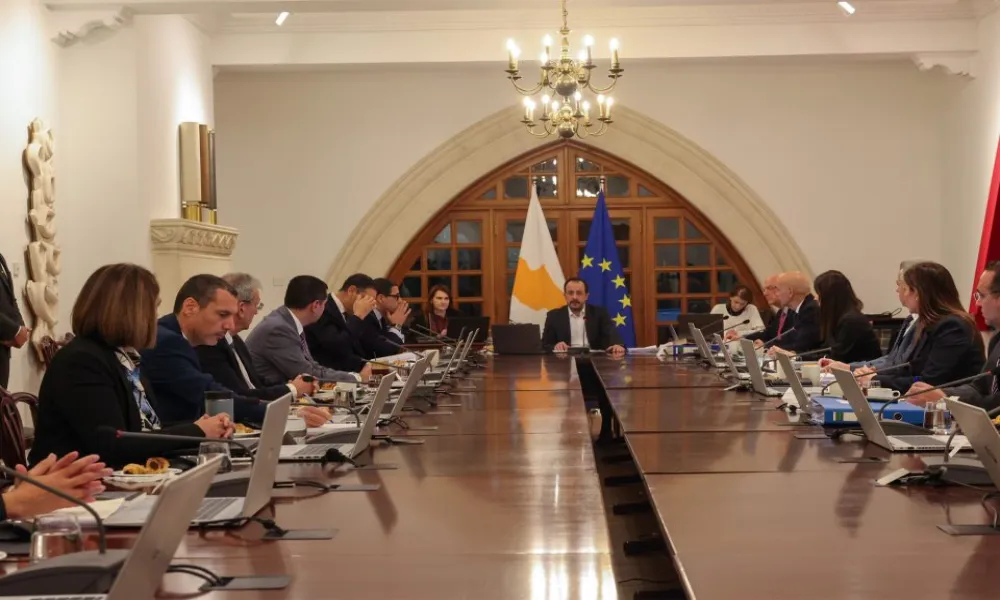

The participation of deputy ministers, the government spokesman, the deputy government spokesman and other Presidential officials in Cabinet meetings continues to raise constitutional questions, five years after draft laws were tabled to regulate the issue.
Under the Constitution of the Republic of Cyprus, these officials are not considered members of the Council of Ministers. In fact, the Constitution does not even provide for the establishment or operation of deputy ministries.
The Anastasiades administration, having already established deputy ministries with Parliament’s approval, attempted in 2021 to formalise the presence of deputy ministers and other officials at Cabinet meetings. It submitted a bill to amend the Constitution, alongside a second bill allowing other state officials to attend Cabinet sessions without voting rights.
Neither bill has ever been brought before the House plenary for a vote. Both remain pending before the House Legal Affairs Committee after raising serious constitutional concerns that effectively stalled their progress.
The draft laws
The two bills were approved by the Council of Ministers on 7 July 2021 and submitted to Parliament on 16 September 2021.
In the explanatory report, the Ministry of Finance argued that their adoption was necessary in light of modern governance needs and the creation of deputy ministries. It said it was essential for Cabinet meetings, convened by the President under Article 55 of the Constitution, to include participants beyond formal Cabinet members.
The proposed constitutional amendment, titled the ‘Thirty-Third Amendment of the Constitution Law of 2021’, sought to modify Article 55 to allow the participation of additional officials in Cabinet meetings without voting rights.
A parallel bill, titled the ‘Participation of Certain Officials in Cabinet Meetings Law of 2021’, listed those who could attend:
- Government Spokesperson
- Deputy Government Spokesperson
- Deputy Minister to the President
- Deputy Minister for Research, Innovation and Digital Policy
- Deputy Minister for Shipping
- Deputy Minister for Social Welfare
- Deputy Minister for Tourism
- Any other deputy minister to the President
- Any other officials
Why they were not passed
Article 46 of the Constitution clearly defines the composition of the Council of Ministers as the President, the Vice-President and ministers. There is no reference to deputy ministers or spokespersons.
For these officials to become formal members of the Cabinet would require a constitutional amendment. However, Supreme Court case law has established that fundamental constitutional provisions regarding the separation of powers can only be revised under exceptional circumstances through the ‘Doctrine of Necessity’.
Strict conditions must be met for invoking this doctrine: there must be an urgent situation, no lawful alternative, proportionality of the measure and a clear aim to preserve constitutional order. Based on these criteria, the bills have remained pending without further progress.
Attending Cabinet by invitation
Despite the legislative impasse, deputy ministers continue to attend Cabinet meetings at the invitation of the President. Their role is limited to presenting issues within their remit, submitting proposals and providing clarifications or answers to ministers’ questions.
The six deputy ministries
During President Anastasiades’ second term from 2018 to 2023, five deputy ministries were established: Research, Innovation and Digital Policy; Social Welfare; Shipping; Culture; and Tourism.
President Nikos Christodoulides later established the Deputy Ministry of Migration and Asylum on 29 February 2024, bringing the total to six.
The first to be created was the Deputy Ministry of Tourism, introduced by law in 2018 and operational from 2 January 2019. It was followed by the Deputy Ministry of Research, Innovation and Digital Policy on 1 March 2020.
In total, the creation of deputy ministries has resulted in 12 new senior posts in recent years: six deputy ministers and six directors-general.
According to data from the Republic’s Treasury, the total gross annual remuneration for these six deputy ministers and their six directors-general amounts to approximately €1.54 million.


