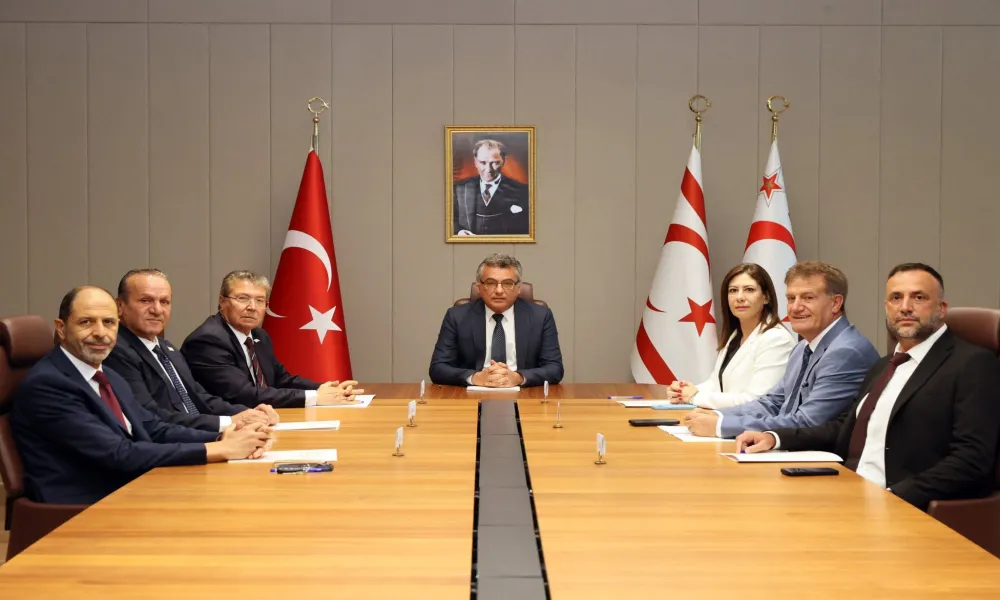
Political leaders in the north appeared divided over the prospect of a new Cyprus process after a meeting of the “council of political parties” with Turkish Cypriot leader Tufan Erhürman, with some seeing room for movement and others questioning whether there is any real basis for new talks.
Unal Üstel, head of the UBP and “prime minister” in the north, kept to his party’s established position in favour of a two-state solution, sovereign equality and equal international status. He said nothing concrete had yet been placed on the table and accused the Greek Cypriot side of acting in ways that deepen mistrust, including through policies he claimed damage the Turkish Cypriot economy. Without a change in approach, he argued, a settlement would remain out of reach.
The CTP took a more positive but cautious line. Party leader Sila Usar Incirli said the renewed UN activity was welcome, provided it did not turn into another process lasting for years without result. She backed Erhürman’s four-point methodology and said the Cyprus problem should now be understood not only as a bicommunal issue, but also as a wider regional security matter. The absence of a solution, she added, carries a cost for Turkish Cypriots, Greek Cypriots, Turkey, Greece and the region as a whole.
Fikri Ataoğlu, leader of the Democratic Party and “tourism minister” in the north, also warned against entering talks without a realistic prospect of success. He said negotiations could only begin if Erhürman’s proposed methodology created a basis for results, stressing that any process should be carried out in coordination with Turkey.
Erhan Arıklı, leader of the Rebirth Party and “transport minister” in the north, was more dismissive, saying he did not believe there was a basis for a 5+1 meeting. He suggested that any attempt by the UN Secretary-General to leave behind a Cyprus document before the end of his term would risk becoming another exercise in delay rather than a step towards settlement.
By contrast, TDP leader Zeki Çeler described the initiatives of the UN Secretary-General and his Personal Envoy as meaningful and positive. He said the process should no longer remain suspended and expressed support for Erhürman’s approach. Çeler also said more should be done to address the obstacles faced by the “immovable property commission”.
Kudret Özersay, leader of the People’s Party, said there was still no real Cyprus process under way, describing the current activity as an attempt to test public opinion. He argued that President Nikos Christodoulides may be seeking a new process for domestic political reasons ahead of the 2028 presidential election, while also pointing to the wider international and regional environment as a factor that would shape any next steps.
Özersay said his party supported a mutually acceptable comprehensive settlement, but opposed any document built on vague language about the form of a solution. Such ambiguity, he warned, could simply open the door to another fruitless process lasting for years.
Source: CNA