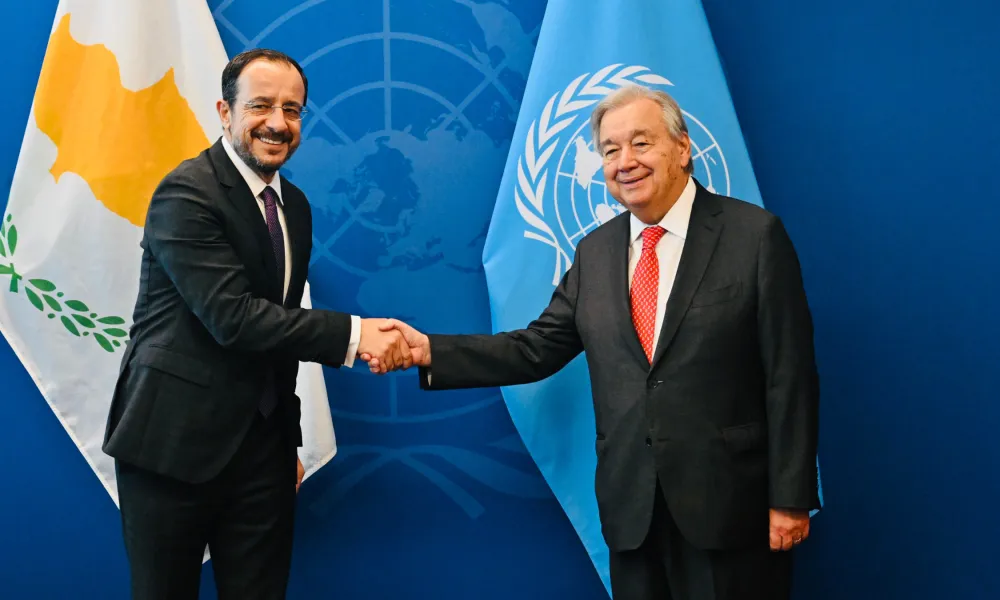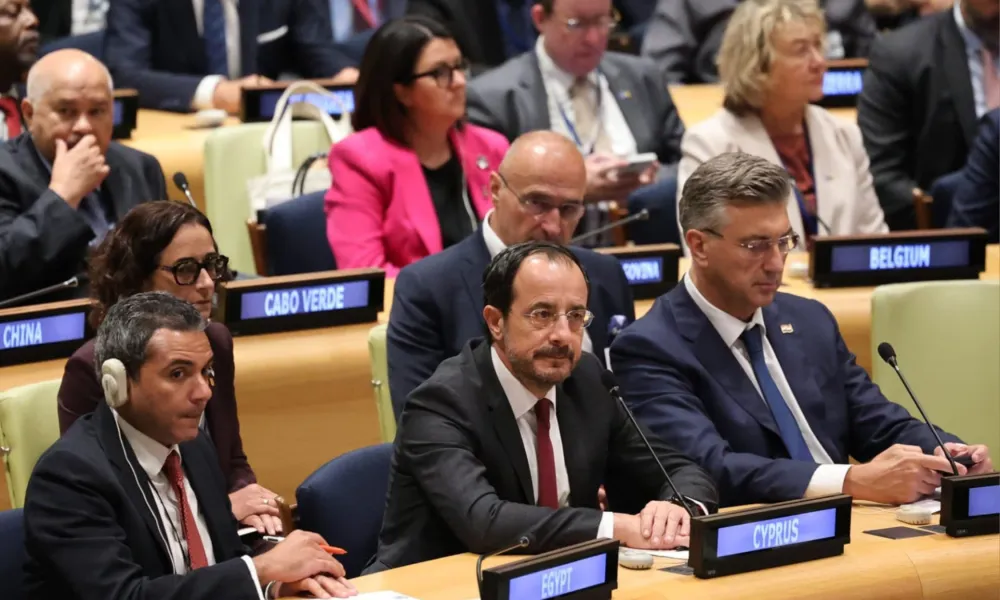

Every September, New York becomes the centre of international diplomacy as leaders of UN member states gather for the high-level week of the United Nations General Assembly.
For the Republic of Cyprus, participation in the process for more than six decades has provided an important platform for international representation and for presenting its positions on the Cyprus issue.
As the 81st UN General Assembly begins and President Nikos Christodoulides participates in its proceedings, Cyprus' history at the UN also highlights the role played by General Assembly debates and resolutions in shaping the international approach to the Cyprus problem.
The role of the General Assembly
The United Nations General Assembly (UNGA) is the organisation's main policymaking body.
Comprising all UN member states, it provides a forum for multilateral discussion across the broad range of international issues covered by the UN Charter. Each of the UN's 193 member states has one equal vote.
The General Assembly was created under the United Nations Charter, signed in San Francisco on 26 June 1945 and entering into force on 24 October 1945.
Its regular sessions run from September to December each year, after which meetings are convened as required. Specific issues are discussed through agenda items that can lead to the adoption of resolutions.
The Assembly also takes major institutional decisions, including appointing the UN secretary-general on the recommendation of the Security Council, electing non-permanent members of the Security Council and approving the UN budget.
The UN initially had 51 member states, consisting of the countries involved in its foundation. Its composition changed dramatically in subsequent decades as decolonisation after the Second World War brought independence to dozens of countries in Asia and Africa that subsequently joined the organisation.
From independence to international representation
The Republic of Cyprus joined the United Nations on 20 September 1960, shortly after independence, through General Assembly Resolution 1489 (XV).
Since then, Cyprus has participated as a full and equal member of the General Assembly, using it as one of its principal international forums for presenting its positions on the Cyprus issue, sovereignty, independence and territorial integrity.
Cypriot diplomacy has also used the Assembly to build international support and keep the Cyprus issue on the UN agenda.
Cyprus first participated in the General Assembly in 1960, when its Permanent Representative to the UN, Zenon Rossides, addressed the 15th General Assembly on behalf of the newly independent republic.
Rossides said Cyprus came to the debate with the hesitancy of a newcomer, but expressed hope that it could bring perspective and objectivity to the examination of global problems.
He also affirmed Cyprus' faith in the United Nations and its commitment to peace founded on justice and freedom.
Makarios' first UN address
The first official address to the UN plenary by a President of the Republic of Cyprus came on 7 June 1962, when Archbishop Makarios III spoke in New York.
Makarios said Cyprus had declared from the first moment of independence its unwavering faith in the United Nations and its commitment to the organisation's principles and objectives.
Among other issues, he supported the application of self-determination for all peoples under the UN Charter and peaceful measures towards eliminating colonialism.
Having itself emerged from foreign rule, he said, Cyprus felt a natural solidarity with peoples struggling for national independence.
Cyprus also supported measures for the rapid implementation of the Declaration on the Granting of Independence to Colonial Countries and Peoples, Resolution 1514 (XV).
Cyprus issue reaches the UN
On 14 October 1965, then Foreign Minister Spyros Kyprianou addressed the 20th UN General Assembly and accused foreign powers of undermining the Republic of Cyprus.
He said attempts had been made since December 1963 to keep the Cyprus issue outside the framework of the United Nations, but that the Cypriot government had ultimately succeeded in bringing the matter before the organisation despite pressure against doing so.
Kyprianou argued that the Cyprus problem should be resolved according to the wishes of the Cypriot people and the principles of the UN Charter.
Cyprus, he stressed, was a fully sovereign and independent state and an equal UN member whose sovereignty and independence could not legitimately be violated or restricted.
Makarios addresses UN after 1974 invasion
Three months after the 1974 Turkish invasion, Makarios addressed the 29th General Assembly in October.
He characterised the invasion as an international crime and appealed for international support for Cyprus' efforts to preserve its independence, unity and territorial integrity.
Makarios argued that a settlement should be based on implementation of the UN Charter and UN resolutions.
He also referred to Security Council Resolution 353 of 20 July 1974, which set out a framework for a peaceful settlement and called on the parties concerned to begin negotiations.
Although Turkey had accepted the resolution, Makarios argued that it had failed to respect its provisions.
General Assembly resolutions on Cyprus
The UN has dealt with different aspects of the Cyprus issue since 1963, with both the Security Council and General Assembly assuming important but distinct roles.
General Assembly resolutions have repeatedly emphasised principles including respect for the sovereignty, independence and territorial integrity of states.
In 1965, Resolution 2077 (XX) stated that the Republic of Cyprus, as an equal UN member, was entitled under the Charter to enjoy full sovereignty and independence without foreign intervention or interference. It called on all states to refrain from intervening against it.
Following the coup and Turkish invasion of 1974, the General Assembly adopted Resolution 3212 (XXIX), entitled Question of Cyprus, in November that year.
The resolution was approved by 117 votes in favour with none against.
It called on all states to respect the sovereignty, independence, territorial integrity and non-aligned status of the Republic of Cyprus and refrain from actions or intervention directed against it.
It also stated that refugees should be able to return to their homes in safety and called for urgent measures towards that objective.
Further resolutions follow
Resolution 3212 became a significant reference point in the General Assembly's approach to Cyprus.
It was followed by Resolution 3395 (XXX), which reaffirmed the urgent need to implement Resolution 3212 in full. The earlier resolution had also been endorsed by the Security Council through Resolution 365 (1974).
Resolution 3395 called on the parties to refrain from unilateral actions contrary to Resolution 3212, including changes to Cyprus' demographic composition.
Further General Assembly resolutions included 3395 (1975), 31/12 (1976), 32/15 (1977), 33/15 (1978), 34/30 (1979) and 37/253 (1983).
The General Assembly, however, does not have the same enforcement powers as the UN Security Council. Its resolutions primarily express political positions and recommendations.
Nevertheless, they carry significant political weight and can reaffirm both UN Charter principles and the broader international community's position.
Resolution 37/253
Resolution 37/253, adopted on 13 May 1983, was particularly significant.
It reaffirmed the right of the Republic of Cyprus and its people to full and effective sovereignty and control over the entirety of Cypriot territory and its natural and other resources.
It called on states to support the Cypriot government in exercising those rights.
The resolution condemned actions undermining their full exercise, including the illegal issuing of property titles, and called for the immediate withdrawal of all occupation forces.
It also called for respect for the fundamental rights and freedoms of all Cypriots, including freedom of movement, freedom of settlement and property rights, as well as measures allowing the voluntary return of refugees to their homes in conditions of safety.
Missing persons also addressed
The General Assembly also dealt with the issue of missing persons.
Resolution 3450 (1975) asked the UN secretary-general to make every effort, in close cooperation with the International Committee of the Red Cross, to assist in investigating and determining the fate of people missing as a result of the armed conflict.
Further resolutions followed, including 33/172 (1978), 36/164 (1981) and 37/181 (1982).
UNFICYP and the Security Council
The Security Council played the central role in establishing the United Nations Peacekeeping Force in Cyprus (UNFICYP) through Resolution 186 (1964), as well as in mediation and peacekeeping efforts on the island.
The General Assembly's role has been different, focusing mainly on formulating and reaffirming the UN's fundamental principles and political positions regarding Cyprus.
Through its resolutions, the Cyprus issue remained on the wider international political agenda and the principles associated with it received greater international legitimacy.
Cyprus' UN role extends beyond the national issue
Cyprus' participation in the General Assembly is not confined to the Cyprus problem.
The Republic participates in broader UN discussions covering peace and security, development, international law, climate change, human rights and other global challenges.
High-level week also offers smaller countries such as Cyprus an opportunity to conduct bilateral meetings with leaders and ministers with whom regular contact through other diplomatic forums may be more difficult.
The UN's modern challenges
Despite its institutional and political importance, the General Assembly faces significant challenges.
A central question concerns the effectiveness and implementation of its decisions.
The Assembly represents 193 states with widely varying political systems, interests and geopolitical priorities, making broad consensus difficult to achieve.
Many General Assembly resolutions are also recommendatory rather than legally binding, meaning their implementation depends heavily on the political will of individual states.
UN faces financial pressure
Financial pressures facing the United Nations represent another major challenge.
UN Secretary-General António Guterres said this year that the organisation faced an “imminent financial collapse” because of unpaid contributions from member states, forcing substantial budget cuts.
In a letter to all 193 member states earlier this year, Guterres called on governments either to meet their mandatory financial obligations or reconsider the organisation's financial rules to prevent a collapse.
The move followed the United States' refusal to contribute to regular and peacekeeping budgets, as well as its withdrawal from several organisations. A number of other member states have also fallen behind on their payments.
During 2026, efforts to reform the UN and reduce costs are continuing through the UN80 initiative, as funding becomes increasingly important to the organisation's ability to respond to international crises.
The challenge for the General Assembly, therefore, is not merely to maintain its operations but to demonstrate that it can remain an effective institution in a world facing growing global risks and increasingly complex geopolitical divisions.
Source: CNA