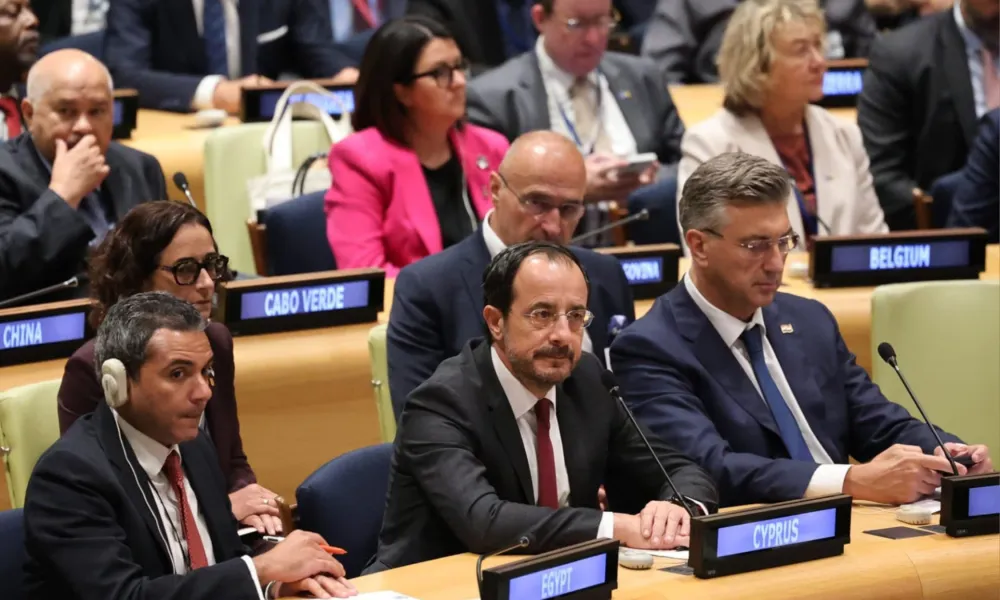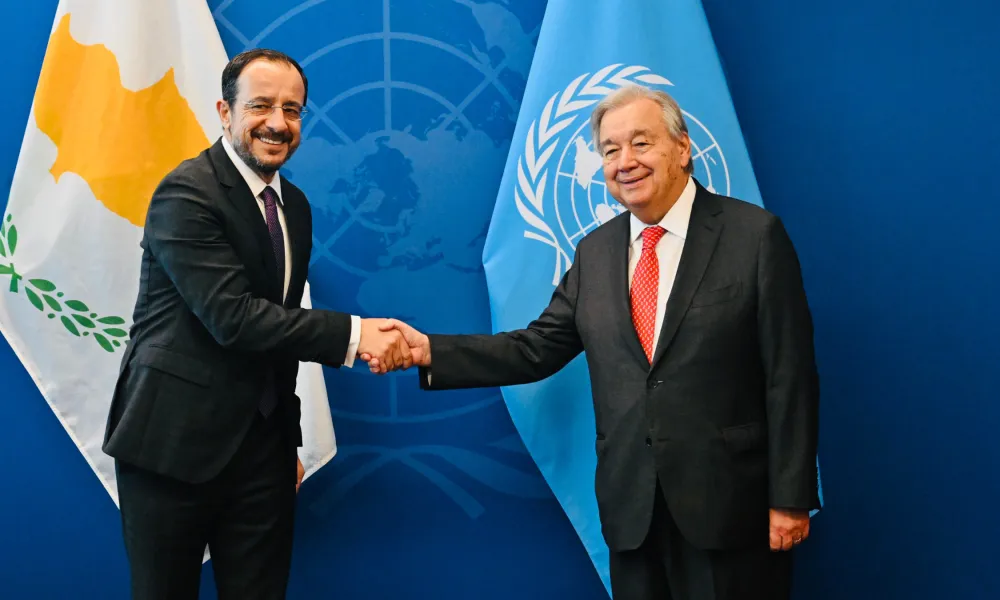

The contrast between the concrete terms in which UN Secretary-General António Guterres describes the state of negotiations on the Cyprus issue and the ease with which President Nikos Christodoulides expresses optimism about their prospects reveals an unusual, almost surreal relationship with reality.
When the UN chief openly states that the two sides have failed to meet the minimum conditions required for progress and that he currently sees no prospect of convening a five-party meeting on Cyprus, the President chooses instead to repeat that “significant developments could take place soon”.
Communication over substance
Christodoulides persists in constructing an approach driven by communication strategy.
In essence, this amounts to a communications manoeuvre and a deliberate strategy of shifting responsibility. The President does not accept responsibility for the lack of progress, instead positioning himself so that, should no steps forward be made, responsibility can be attributed elsewhere.
Statements and predictions about “significant developments”, without any current basis for such expectations, therefore become part of a political communications game with an obvious objective.
If those developments fail to materialise, the negative outcome can be attributed to the other side or even to the Secretary-General.
If, on the other hand, even the slightest indication of movement emerges, the President can present it as a “personal success”.
The concern is that his priority as a leader appears not to be how the Cyprus problem can be solved, but how he can minimise the responsibility placed on his own shoulders, even as the country moves closer to permanent partition.
The President must explain his plan
Instead of engaging in predictions and speculation about developments emerging from nowhere, Christodoulides should clearly explain what he intends to do.
He should tell both the public and the Secretary-General how he plans to meet the conditions set out by Guterres.
That includes moving beyond the “theory of reciprocity”, even on relatively straightforward matters such as the opening of additional crossing points, as well as addressing the consequences of his own political choices.
The policy of cost-free optimism and simply seeing where events lead has reached its limits.
The UN has sent a message to both sides that political manoeuvring will not be tolerated, regardless of which leader is responsible for it.
Cyprus issue cannot be a communications exercise
Rather than calculating political points through communication management ahead of 2028, the President must recognise that the Cyprus issue is not a field for political gamesmanship.
The protection once afforded by silence and expressions of hope has run its course.
Words designed merely to create a favourable immediate impression no longer carry the same value.
The reason is simple: at the United Nations, and in Europe, they have understood what is happening.