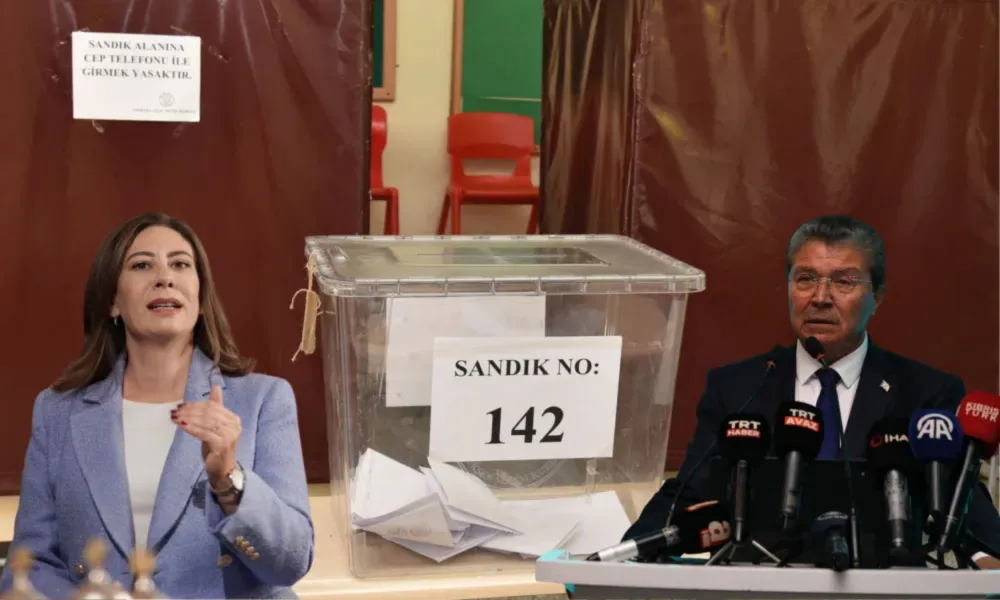

The Turkish Cypriot community is entering a new political phase following changes to the electoral system and against the backdrop of the billions being channelled by Ankara into projects, loans and financial assistance. The “government” and “opposition” are now upping the ante, with the “elections” of 6 December less than two months away. The “parliamentary” and “local elections” will be held on the same day, following a decision by the so-called parliament on 10 September. At the same time, the voting system is undergoing a substantial change, with the abolition of the mixed vote, a system that had been in place for years and allowed voters to select candidates from different parties.
The election campaign is unfolding alongside a series of economic and development initiatives funded by Turkey. Hospitals, schools, roads, energy projects, fibre-optic networks, social housing and sports facilities are being combined with new low-interest loan programmes for businesses, farmers and other productive sectors. Ankara and the current “government” of Ünal Üstel present these initiatives as part of a broader development strategy. Their timing, however, inevitably places them at the centre of the election campaign, with the Turkish government showing, at least for the time being, that it supports the forces of the National Unity Party (UBP).
25 billion lira from Ankara
Turkey is seeking to create a new economic reality in the north. At the heart of this effort is the 2026 economic agreement, signed in Ankara on 10 April by Ünal Üstel and Turkey’s Vice-President, Cevdet Yılmaz. The initial value of the package was announced at approximately 23 billion Turkish lira, while, according to Üstel, additional contributions expected during the year will bring the total amount close to 25 billion Turkish lira.
The funding is not limited exclusively to public infrastructure. The programme includes long-term, low-interest loans for tourism businesses, construction companies, industries, small and medium-sized enterprises, traders and farmers, as well as new financing instruments for women, young people and entrepreneurs.
Üstel has described 2026 as a “year of completion and inaugurations”, following two years during which, he says, the foundations were laid for major projects. The timing means that several of these investments are becoming more visible just weeks before voters go to the polls. The UBP, for its part, incorporates the projects into its political narrative of “stability, projects and services”, with Üstel highlighting, among other things, projects in the health sector, the new “presidential” and “parliamentary” complex, as well as road infrastructure.
At the same time, it was announced that the so-called government had decided to provide pensioners with an allowance of 40,000 Turkish lira at the beginning of November.
Battle over the “mixed vote”
The major change ahead of the “elections”, however, concerns the abolition of the mixed-vote system. The relevant amendment had initially been approved by the so-called parliament but was referred back for reconsideration by Turkish Cypriot leader Tufan Erhürman. On 29 September, the “parliament” convened in an extraordinary session and reapproved the provision by 28 votes to 10. Under the new system, voters will no longer be able to cast mixed ballots by selecting candidates from different political parties in the “parliamentary elections” and elections for “municipal councils”.
Üstel and his UBP party supported the change, as did Erhan Arıklı, president of the Rebirth Party (YDP), who had been dismissed from the so-called government amid the backlash over the Filo Jet crash off Kyrenia. Üstel argued that the system was complicated and that its abolition would make voting easier for voters. He also rejected criticism that the electoral system was being changed too close to the elections, pointing out that the proposal had been known since 2023.
Arıklı, for his part, argued that the YDP had been calling for the abolition of the mixed vote for years, going so far as to describe the practice as a “betrayal of democracy”. He further argued that practices of political bargaining had developed around the system, referring to “middlemen of the mixed vote”.
İncirli raises the temperature
On the other side of the political spectrum, the president of the Republican Turkish Party (CTP), Sıla Usar İncirli, is seeking to shift the debate beyond the “electoral system”, placing issues of transparency, accountability and the functioning of institutions at the centre of the discussion. İncirli launched a fierce attack on Üstel’s “government”, arguing that in recent years allegations of corruption, irregularities, favouritism, discrimination and bribery have, in her view, reached unprecedented levels.
At the same time, she accused the “government” of using “state” resources for its own benefit ahead of the “elections” and warned public officials to be particularly careful about orders they are asked to carry out. These statements constitute political allegations made by her and her party. The CTP president is essentially seeking to build her election argument around the need for a change in the way the north is governed. She argues that a simple change of parties in power is not enough, but that a different approach is required “to the functioning of the state, meritocracy and accountability”.
Her criticism of the abolition of the “mixed vote” forms part of the same argument. The CTP does not reject the change to the system in principle, but considers that it should not be applied to the forthcoming “elections”.
At the top of the CTP agenda
Beyond its confrontation with the UBP, İncirli is also seeking to provide an initial outline of the CTP’s priorities should it take over the “government”. One of the first steps, she said, would be to conduct a comprehensive population census. She believes that without a clear and reliable picture of the actual population in the north, meaningful planning cannot take place in key areas such as health, education, transport and security.
According to İncirli, the CTP has already drawn up a relevant plan and estimates that the census could be completed in around a year and a half. The aim, she said, would then be to incorporate the data into a digital database that would be continuously updated.
The issue of undeclared work and residence also forms part of this framework. İncirli referred to a significant number of people living or working without being registered and argued that better oversight of foreign labour is needed, along with a closer link between the foreign workforce and the actual needs of the labour market. As she explained, the CTP is planning a mechanism in which employers and universities would have a role, with the aim of improving the recording of workers and limiting undeclared work and residence.
The two political narratives
As the election campaign enters its final stretch, two clearly different political narratives are now taking shape. Üstel’s “government” is presenting Turkey’s economic support, investments, infrastructure projects and financing initiatives for the private sector as the outcome of a period of stability and delivery. Üstel himself says that the UBP is approaching the “elections” without concern and has publicly expressed his belief that his party will come first.
The CTP, on the other hand, is seeking to shift the focus of the election debate towards “the functioning of institutions, accountability, economic management, and the timing of both the economic interventions and the changes to electoral legislation”.
CTP leads in the polls
At the same time, the findings of the latest CMIRS poll, conducted in the north in September 2026, are also of interest. The survey was carried out through face-to-face interviews with a sample of 500 people, who were asked which party they would vote for if the elections were held the following Sunday.
According to the results, the Republican Turkish Party (CTP) recorded 47.28%, while the National Unity Party (UBP) followed with 21.73%. The TDP received 4.63%, while the YDP recorded 3.62% and the DP 3.02%. They were followed by TAM Parti with 2.21%, HP with 1.61%, Bağımsızlık Yolu with 1.01% and MDP with 0.20%.
The proportion of undecided voters stood at 6.84%, while 3.22% of respondents said they would not go to the polls. It should be noted that the survey was conducted before the mixed-voting system was changed.