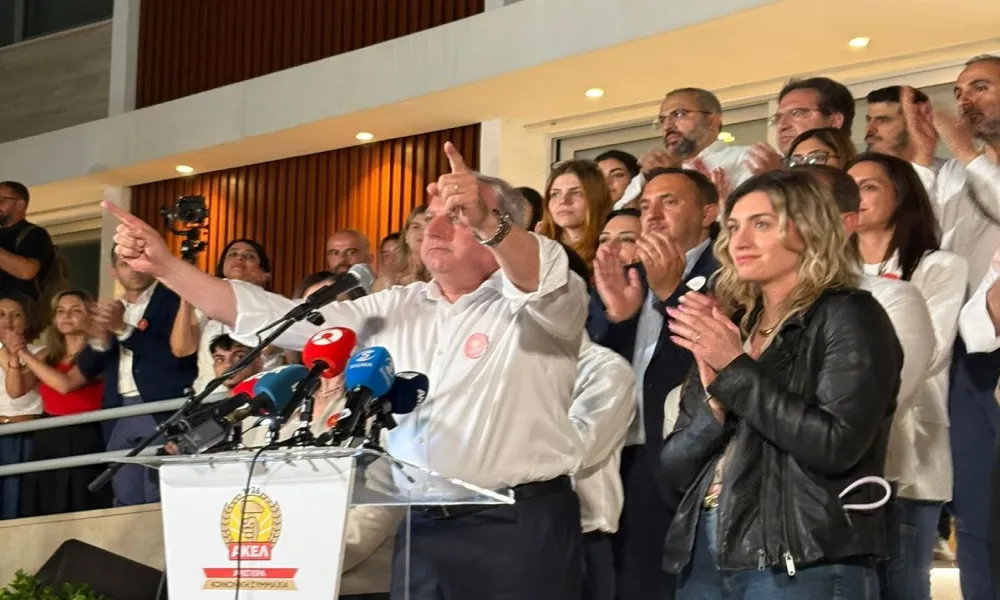



Akel will first seek policy convergence and allies, and only then the person to express them, general secretary Stefanos Stefanou made clear last week, as the party chooses to move towards the 2028 presidential elections with slow and measured steps. Disy has already entered an internal contest for its nomination, and Andreas Mavroyiannis has set his own timetable. Out of power since 2013, when Demetris Christofias’ five-year term came to an end, Akel must now decide what role it wants to play in the years ahead, whether to remain the dominant pole of the opposition or to seek government again, accepting the compromises that governing requires. The three paths being discussed within the party, a run with a purely party candidate, a repeat of the 2023 formula and a new face with broader appeal, each offer their own answer to that question.
Time as a choice
The process the leadership has designed is a long one. The Central Committee will first set the political framework and objectives. Assemblies of the party’s grassroots groups and gatherings of its social alliance will follow, at which, as a party official explains to Politis, thousands of members and friends will discuss the party’s political direction while the leadership sounds out other political forces. A proposal on a candidate will take shape only at the end of this process, will go back to the grassroots and will be ratified by the Pancyprian Electoral Conference, with around 1,000 delegates, in the first quarter of 2027. Stefanou rejected criticism that the party is dragging its feet, countering that others rushed ahead and opened the campaign more than 16 months before the ballot. Time, however, is about more than procedure. Party sources believe Akel needs it so that the Christodoulides government wears down further and the public demand for change matures. The measured approach can also be read as a sign that the party prefers steady lines, at a pace it sets itself rather than one dictated by the moves of other political forces.
From Makarios to Christofias
Stefanou himself set out the historical dimension of the dilemma on Wednesday, at the presentation of a volume marking 100 years of the Communist Party of Cyprus (KKK) and Akel. He described the party’s relationship with power as a journey that began in 1962 with its support for Makarios without seeking a share in government, passed through the Minimum Programme with Spyros Kyprianou in 1983 and the backing of George Vassiliou in 1988, continued with participation in the government of Tassos Papadopoulos and culminated in 2008 with Demetris Christofias’ victorious, independent candidacy. That chapter, he said, remains open, since experience showed that a government of the Left struggles to face its dilemmas without the unity of progressive forces. An analyst who spoke to Politis sees in this retrospective the key to the present. In his assessment, Akel has learnt to make choices beyond its own programme, knowing that in an EU member state, and through coalitions, the policies implemented will differ from its declarations. Christofias was the only exception, and his term, which ended in the midst of an economic crisis, left a mark that makes a new purely left-wing candidacy harder today.
The cohesion option
The first scenario, which Stefanou did not rule out when speaking on Monday to Politis 107.6 radio, is a purely party candidacy by the general secretary himself, following the precedent of 2008. Within the party, it is the most reliable option, and it is the one favoured by one school of thought in its ranks. It could potentially win over those who put a solution based on a bizonal, bicommunal federation first, including right-wing voters who backed the “Yes” vote in the 2004 referendum, given that no such candidacy exists under any other party. Political analysts, however, believe that Cypriot society is fundamentally centre-right and that this tendency is strengthening, with recent elections reflecting a broadening of that political identity. In such an environment a left-wing party candidate would struggle to prevail, and if the general secretary’s candidacy is not accompanied by alliances, it could end in a dignified defeat, with a share of around 40–45% in the second round. Such a result would preserve cohesion but would leave the party where it stands today. Sources warn that an opposition identity cannot be sustained indefinitely, since it breeds disillusionment and disengagement, and that only a return to government can change Akel’s image.
The tested formula
The second scenario carries the weight of a result. In 2023, Mavroyiannis won 29.60% in the first round, eliminating Averof Neofytou, and 48.03% in the second, in the most closely fought presidential contest since 1998. Between the two rounds he added around 72,000 votes, many of them from the Disy pool, something the leadership acknowledges, saying Akel still values the Disy voters who backed it, without this implying any deal with Neofytou. The logic of this option rests on precisely that audience. The former negotiator of the Anastasiades government, whose positions on Crans-Montana at points coincide with the former president’s narrative, keeps a distance from Akel’s base and its hard line on the previous administration. That distance, however, allows him to reach centre-right voters who favour a solution and a more conservative audience within Diko, Edek and Dipa, whom Akel struggles to reach on its own. As one analyst notes, his candidacy was not a Vassiliou-style scenario and did not put in a difficult position a base the party has trained to accept difficult circumstances.
The questions, nonetheless, are many. The 2023 performance rested to a great extent on the internal crisis in Disy at the time, which may not be repeated, and repeating a tested but unsuccessful choice needs a convincing justification. Analysts doubt whether Mavroyiannis has the necessary momentum today, at a time when the party’s aim is for its candidate to reach the second round. He has already set his own timetable, with an announcement in January at the latest. “It would be highly desirable for them to come and support us. But we will not wait for Akel to decide before taking our own decisions,” he said, while leaving open the possibility of withdrawing if his momentum weakens. A practical difficulty adds to this, since Alma, one of the parties Akel is seeking contacts with, has said it will not support him.
The gamble on a new face
The third scenario is the most ambitious and the most demanding. It envisages a homo novus, a new technocrat, possibly from the centre-left, who could speak to wider society and, through the standing of their expertise, lend credibility to a formation capable of bringing together forces such as Alma with Akel. An economic profile would further strengthen the Left’s chosen candidate. This is, in essence, a return to the 1988 model, when Akel backed a non-party businessman and helped get him elected. The obstacle is time. A relatively unknown figure needs months to become known, for their candidacy to be worked through with the opposition parties and to build momentum of their own. That others are also looking to this space became clear last week, when it emerged that Direct Democracy leader Fidias Panayiotou had been sounding out party leaders, including Akel’s, putting names forward and exploring the possibility of a joint candidacy.
A variation of the same scenario, with a more right-leaning profile, is a cross-party choice such as Christos Stylianides, who has recently had contacts with Akel members in the course of visits. Such a candidacy, if it reached the second round, could attract Disy voters who backed the “Yes” vote, but his political roots would reasonably raise questions among the base. Here the analyst identifies the critical question of profile, namely whether the candidate will be a Vassiliou-type centre-leftist with appeal beyond the Left, or more centre-right, in which case they would inherently speak to a more right-wing audience.
Alliances as the key
Whoever the candidate turns out to be, there is agreement within Akel on one point, even among those who disagree on everything else. The party, as a source tells Politis, must not stand alone from the outset, even if the candidate comes from the Left. It needs at least one other party, because without one victory is out of reach and because only then can it claim to represent something broader than itself. Stefanou spoke of building “a great majority current of progressive change” and named Alma, the Ecologists and Edek, which is heading for a congress in December, as interlocutors. Diko remains the major difficulty. Stefanou did not rule out dialogue, but noted that the party is a key pillar of the government and that its current leadership has, in his assessment, taken significant steps to the right. Analysts agree, noting that in three and a half years Diko’s only substantive disagreement with the government concerned the Great Sea Interconnector, and that its officials make up a large part of the government line-up, making a convincing exit shortly before the elections difficult.
The breadth of support does not count only in votes, since the more forces line up behind a candidate, the stronger the perception that they can win, a perception that, analysts explain, influences a significant number of voters. On the other side, the lines have already been drawn. Annita Demetriou said she shares Nicos Anastasiades’ concern about preventing a victory for the Left, after the former president proposed a pre-election agreement between Disy and Christodoulides ahead of the second round, while the internal contest in Disy revolves around criticism of the president and attacks on Akel.
Opposition or power
The choice ultimately comes down to the goals Akel sets itself for the years ahead. If it seeks to consolidate its role in opposition, with internal cohesion, a clear voice and specific policies that will not translate into real change for as long as it does not govern, a Stefanou candidacy serves that purpose. If, on the other hand, the aim is victory, a government with a positive record and shedding the stigma of its previous experience, then options such as Mavroyiannis or possibly Stylianides, combined with the turmoil and introspection within Disy, could deliver the result. A renewal of the current of change around a new technocrat could achieve the same, something Akel has shown in the past it is capable of building. Either way, an Akel that wants to become a party of government again will have to embrace the identity of a broad-based party, tolerant of ideas and approaches that are not its own, as it did in the Vassiliou era. Stefanou himself recalled as much in his statement, when he said that the party’s ability to shape an agenda with broader goals, in tune with the feelings and mood of society, “constitutes the objective basis for cooperation”.