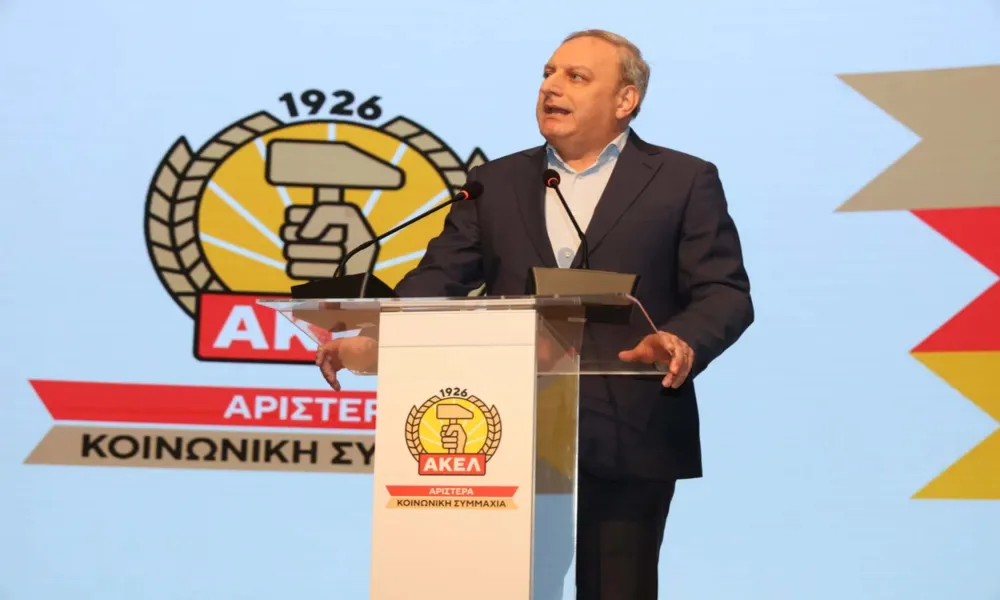



The Left must prove in practice that there is an alternative to the current system, AKEL General Secretary Stefanos Stefanou said on Saturday, addressing an international symposium organised by the party in Nicosia to mark 100 years since the founding of the Communist Party of Cyprus, which evolved into AKEL in 1941.
Welcoming delegations from left-wing parties and movements abroad, Stefanou said their presence reflected the internationalism and solidarity that characterise the Left's work.
“At AKEL, we strongly believe in the unity of the forces of the Left, despite the diversity that characterises its parties and organisations, as well as any disagreements that may exist, even on various issues,” he said. He added that unity must be based on a common political agenda guided by the Left's fundamental values and positions.
TINA logic
A central theme of his speech was challenging the TINA logic (“There Is No Alternative”). He said powerful economic and political interests seek, through the economy, the media and technology, to present it as self-evident that there is no other way to organise society. He also noted the revival of the “end of history” theory, although its originator, Francis Fukuyama, had revised key aspects of it.
“The Left must step forward and prove that ‘There is alternative’,” Stefanou said. He described an alternative that includes policies for peace and a fairer distribution of wealth; directing resources towards social policies and public infrastructure rather than arms and wars; strengthening democracy, transparency and accountability; defending individual and collective freedoms and rights; and confronting the far right and its racist, intolerant and warmongering policies.
He said this could be achieved through two interconnected pillars: a political programme to address problems, and the Left's vision for Europe and the world.
Describing the international environment, he spoke of intensifying geopolitical rivalries, an increase in armed conflicts and the prevalence of the logic of power at the expense of international law. He attributed inequality, insecurity and social exclusion to the neoliberal model of managing capitalism, which, he said, had dominated for almost four decades. According to him, wealth is becoming concentrated in fewer hands, labour rights are under pressure and the welfare state is being weakened.
Concerns over far-right
The AKEL general secretary said the neoliberal promise of prosperity through the dominance of markets had been disproved. The discussion about moving beyond capitalism, he added, was not a theoretical pursuit but a “timely political and social necessity”. He also warned that the rise of the far right and neo-fascist forces was among the most dangerous developments of the era, as it exploits insecurity and anger and diverts discontent away from its real causes.
Stefanou stressed that the Left is judged by its actions, not only by its theoretical work. Its mission, he said, is difficult: defending its ideas is not enough; it must also convince people that those ideas offer a realistic response to society's needs. “The Left must, in the present, build the future it envisions,” he said.
He added that international cooperation was becoming more important, as big capital had entrenched its dominance in international organisations such as the IMF, the World Bank and the WTO, while in Europe this dominance was institutionalised through EU policies.
In conclusion, he said what was needed was a Left that was “combative and modern, with deep roots in society, ideological self-confidence and political credibility”; one that would be at the forefront of struggles, cooperate on matters that unite it, and discuss disagreements with honesty and respect. He declared the symposium open, expressing confidence that its discussions would strengthen the shared struggles.
Source: CNA