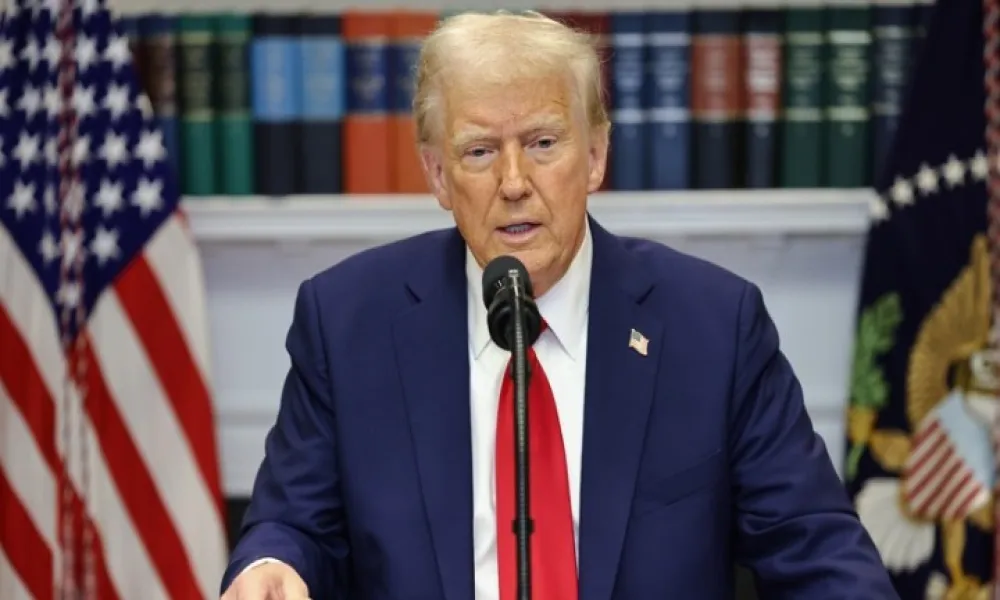

US President Donald Trump warned on Wednesday that American bombing of Iran would resume at a far greater intensity if Tehran fails to honour an emerging agreement, as Washington simultaneously paused its military operation to escort ships through the Strait of Hormuz pending the outcome of negotiations.
"Assuming Iran agrees to give what has been agreed to, which is, perhaps, a big assumption, the already legendary Epic Fury will be at an end, and the highly effective Blockade will allow the Hormuz Strait to be open to all, including Iran," Trump wrote on Truth Social. "If they don't agree, the bombing starts, and it will be, sadly, at a much higher level and intensity than it was before."
Project Freedom paused
Trump announced that Project Freedom, the US operation to escort commercial vessels through the Strait of Hormuz, would be paused "for a short period of time" to allow space for a final agreement to be reached with Iran. The pause was announced following what Trump described as "great progress" toward a "complete and final agreement" with Iranian representatives, and came at the request of Pakistan and other countries involved in mediation efforts. The blockade, however, remains fully in force.
The announcement came hours after Secretary of State Marco Rubio had told reporters at the White House that Project Freedom, which launched on Monday, was the next phase of the war. Rubio also announced that the United States would put a new draft resolution before the UN Security Council to "defend freedom of navigation" in the Strait of Hormuz, calling on Iran to cease attacks, mining and tolling, and to disclose the location of sea mines it has laid. Bahrain, Saudi Arabia, the UAE, Kuwait and Qatar co-authored the resolution, which is expected to be put to a vote within days.
A fast-moving diplomatic track
The diplomatic timeline has accelerated rapidly in recent days. On 29 April, Trump rejected Iran's initial proposal, saying he wanted guarantees on the Iranian nuclear programme before lifting the blockade. On 1 May, sources told CNN that Iran had sent a new proposal to Pakistani mediators, which Trump described as unsatisfactory, saying his options were to try and make a deal or "go and just blast the hell out of them." On 2 May, a senior Iranian military official said renewed conflict was "possible." By 3 May, the US had responded to Iran's latest proposal and Trump announced the launch of Project Freedom, saying his representatives were having "very positive discussions" with Tehran.
On 4 May, Iran warned that any foreign military force approaching or entering the Strait of Hormuz would be attacked, and US Central Command confirmed that American and Iranian forces had exchanged fire in the waterway. On 5 May, Defence Secretary Pete Hegseth insisted the ceasefire was "not over," while Rubio said the US combat operation launched in February against Iran had formally ended.
Iran's Revolutionary Guards Navy said on Wednesday that safe passage through the Strait of Hormuz was possible under "new procedures" following the pausing of Project Freedom, in what appeared to be Tehran's first public response to the suspension of the US operation.
The content of any prospective agreement has not been officially disclosed by either side. The terms Trump referred to as having been "agreed to" remain unconfirmed, and the status of the ceasefire, the blockade and the nuclear dimension of negotiations continues to shift by the hour.