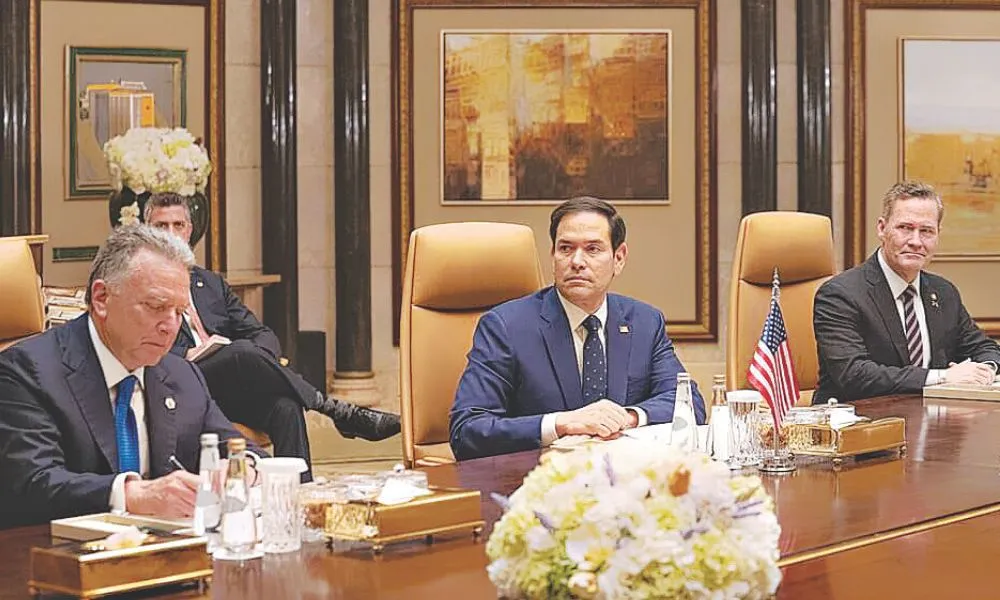
The agreement “has been largely negotiated” and “will be announced soon”, Donald Trump said via Truth Social on Saturday. A few hours later, he lowered expectations: “it has not been fully negotiated”, he stressed. US Secretary of State Marco Rubio, speaking from New Delhi, took the same contradictory line: “We will give diplomacy every opportunity to succeed,” he said, adding that if it fails, Washington “will find another way.”
The framework
The architecture of the memorandum, as leaked to US and British media, provides for two phases. In the first, Iran would gradually allow the reopening of the Strait of Hormuz, proceed with demining the sea route and restore shipping to pre-war levels within 30 days of signing. During this period, no fees would be imposed on commercial vessels. In return, the US would lift the naval blockade of Iranian ports and begin releasing frozen Iranian assets. International partners are expected to contribute to demining operations: London has already announced the deployment of vessels and naval personnel.
In the second phase, lasting 60 days, negotiations on the nuclear programme will begin. Iranian foreign ministry spokesman Esmail Baghaei underlined that “at this stage nuclear issues are not being discussed” and that the memorandum focuses exclusively on ending the war. According to Iranian sources speaking to Reuters, in later stages “realistic formulas” could be found for highly enriched uranium stockpiles, including dilution under the supervision of the International Atomic Energy Agency.
Points of friction
Three issues remain unresolved. The first concerns frozen Iranian funds. Iran has around $6 billion held in Qatar and is demanding their release as a condition for any signing. For this purpose, chief negotiator Mohammad Bagher Ghalibaf, Foreign Minister Abbas Araghchi and Central Bank governor Abdolnaser Hemmati travelled to Doha on Monday. A US source told CNN, however, that the release will only take place once the Strait has reopened.
The second outstanding issue is the Lebanon front. Tehran insists that the ceasefire must apply “on all fronts”, including Lebanon. Despite the 16 April ceasefire, Israeli troops remain in the south of the country and Israeli forces continue air strikes against Hezbollah targets, while the group continues launching drones towards northern Israeli cities.
The third and most sensitive issue remains the nuclear programme. Tehran refuses to include it in the current memorandum. Trump has repeatedly said he wants Iran to surrender “so-called nuclear powder” and made clear he will not return to the JCPOA agreement: “The deal will either be great and substantial, or there will be no deal,” he wrote on Truth Social.
With open cards
Israel has largely remained outside the negotiations. According to two Israeli officials who spoke to Reuters, Netanyahu has told close associates he has “limited ability” to influence Trump. The two leaders have spoken by phone at least three times over the past week. After the first call, Trump told journalists: “He is a very good man, he will do whatever I tell him.” After their third conversation, Netanyahu publicly set out his position for the first time, stating that any final agreement must “mean dismantling Iran’s uranium enrichment facilities”. He also said Trump “reaffirmed Israel’s right to defend itself on all fronts, including Lebanon”, a condition that directly contradicts Iranian demands and could derail any agreement.
Markets vote “yes”
While awaiting signature, markets have already delivered their verdict. Brent crude fell by 5.2% to $98.15 per barrel, breaking below the psychological $100 threshold for the first time in weeks. Asian markets moved higher, following European and US futures. Investors are betting on the reopening of the Strait of Hormuz, through which, under normal conditions, one-fifth of global oil and gas flows.
Inside Iran, fatigue is evident. “The situation of neither war nor peace is much worse than war itself,” said Sarzand, 39, from Tehran, speaking to AFP. Iran is also awaiting the restoration of internet access, which has been cut throughout the war, subject to final approval by President Masoud Pezeshkian.