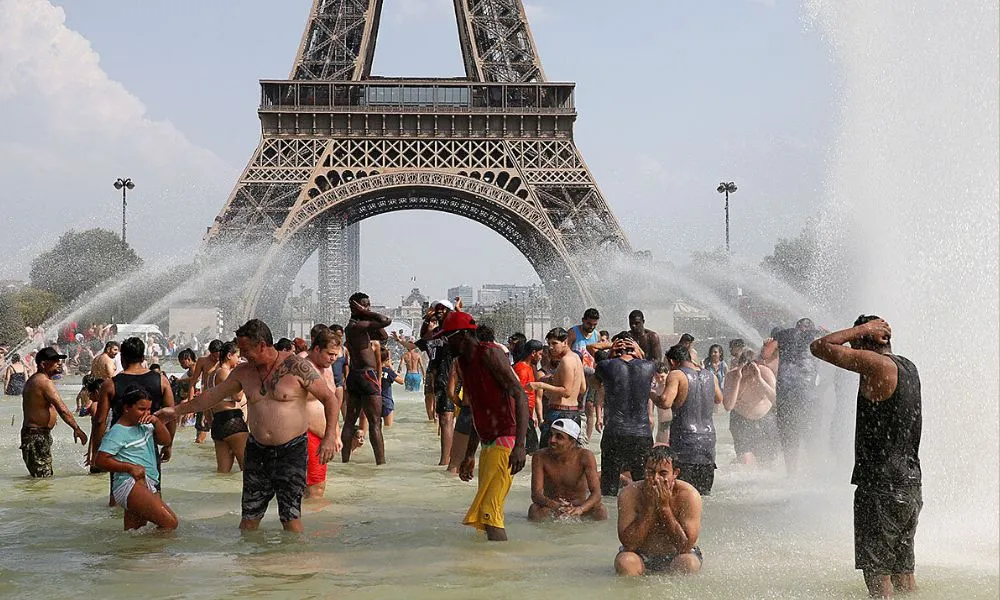
France is facing a new wave of intense heat, with health authorities warning of the serious effects that high temperatures can have on the human body, particularly among older people and those with underlying health conditions.
“At every heatwave there is an impact on the health of the population,” said Catherine Le Gall, head of emergency services at Argenteuil hospital near Paris. As she explained, the most serious effects usually appear after several days of sustained heat, when the body begins to struggle to cope.
In 2003, a historic heatwave in France caused around 15,000 deaths, mainly due to heatstroke, hyperthermia and dehydration.
The normal operating temperature of the human body ranges between 36 and 38 degrees Celsius. To maintain this balance, the body activates thermoregulation mechanisms when temperatures rise, such as dilation of blood vessels in the skin, sweating and reduction of heat production.
According to Pierre Hausfater, head of emergency services at the Pitié‑Salpêtrière hospital in Paris, sweating is the most effective mechanism for releasing heat, as the evaporation of sweat removes thermal energy from the body. However, for this mechanism to function properly, adequate blood circulation and good heart function are required, something that is often more difficult in older people or those taking certain medications.
Why dehydration is particularly dangerous for the elderly
Dehydration is one of the main risks during extreme heat, particularly for older people, who often do not feel a strong sensation of thirst even when their bodies have already lost significant amounts of fluids. For this reason, the French authorities recommend regular water consumption throughout the day, even in the absence of thirst.
Doctors classify heat-related conditions into different stages. Sunstroke is considered the mildest form, while heatstroke is the most dangerous condition and can be fatal.
There are two main types of heatstroke: that caused by prolonged exposure to high temperatures, mainly affecting older people during heatwaves, and exertional heatstroke, which occurs more often in athletes or military personnel under extreme conditions.
“Heatstroke occurs when the sweating mechanism is no longer sufficient to eliminate heat and, at the same time, high temperature begins to directly affect cells, particularly the brain,” Hausfater explains. As he notes, when body temperature approaches or exceeds 41 degrees, the nervous system begins to malfunction seriously.
Symptoms of heatstroke
Symptoms may begin with headache, confusion, dizziness or slowed reactions and can progress to seizures or even coma. Experts stress that any change in a person’s behaviour or mental state during a heatwave should be treated as a warning sign.
In such cases, doctors recommend immediate removal from the hot environment, transfer to an air-conditioned space and gradual cooling of the body using cool or wet cloths.
Specialists warn that early intervention is critical, as once heatstroke becomes fully established the condition becomes very difficult to reverse.
“When body temperature exceeds 40 degrees and neurological disorders occur, it is difficult to reverse the situation,” Hausfater stresses. According to the data he cites, mortality among older people who suffer heatstroke can reach as high as 40% to 50%.
Even those who survive may be left with permanent health problems or serious neurological damage.
In cases of exertional heatstroke, overheating of the body is caused by the combination of high ambient temperature and intense muscular activity. Doctors compare the phenomenon to a car engine running excessively under a closed bonnet.
However, because such cases occur mainly in sports events or military exercises, there is usually faster medical intervention. In some cases, athletes are even immersed in cold water to rapidly reduce body temperature.
Beyond heatstroke, high temperatures can also significantly worsen respiratory conditions such as asthma or chronic obstructive pulmonary disease.
Pulmonologist Frédéric Le Guillou explains that dehydration causes dryness in the bronchial tubes, which may lead to worsening symptoms. At the same time, heatwaves are often accompanied by increased levels of ozone and air pollution, further burdening the respiratory and cardiovascular systems.
The European Copernicus service recently warned of extremely high ozone levels across much of western and southern Europe during warm periods, heightening concerns about the effects of increasingly frequent heatwaves on human health.