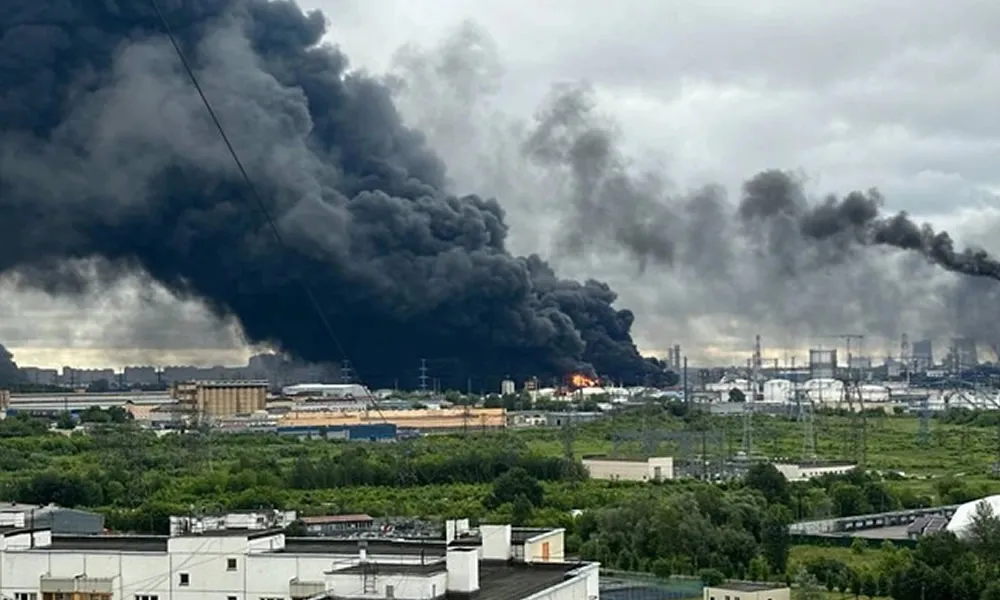



Ukrainian drones struck Moscow's oil refinery for the second time this week on Thursday, while Russia fired ballistic missiles into Kyiv, as President Volodymyr Zelenskyy sought support from the United States and Europe for a deal to end the war. Moscow Mayor Sergei Sobyanin said on Telegram that air defences had intercepted more than five dozen drones over the capital in what he called a "massive" attack, adding that "several" had managed to reach the refinery in the southeastern district of Kapotnya. A Reuters witness saw flames and plumes of smoke rising over the site, and video circulating on social media appeared to show a large explosion and fire.
Sobyanin said a shopping centre in southeast Moscow also suffered minor damage from falling drone debris, while Moscow region governor Andrey Vorobyov said another drone struck an apartment building in the town of Zhukovsky, damaging part of a fire escape, and that a high-rise residential building, an industrial facility and several private houses elsewhere in the region were also hit. Sheremetyevo, Moscow's busiest airport, suspended flights and evacuated some people to the car park, the airport said in a statement, adding that the restrictions were later lifted.
Targeting Russia's energy industry
Tuesday's strike on the same refinery had already halted its operations, industry sources said, adding to a wave of damage to Russian energy facilities that has pushed the country, the world's third-biggest oil producer, towards importing fuel by sea this month to manage a growing gasoline shortage. Zelenskyy confirmed Thursday's attack in a post on X, sharing video of the aftermath and writing that "targets were also struck in the Rostov region and in temporarily occupied territories of Ukraine."
Kyiv has stepped up strikes on Russian energy facilities in recent months in what Zelenskyy has described as a "just" campaign of "long-range sanctions" against Moscow, targeting refineries, terminals and depots. Last week, he said Ukrainian forces had struck the Kuibyshev refinery in Russia's Samara region as well as two oil infrastructure facilities in the Vladimir region.
Kyiv came under its second air attack this week as Russia unleashed ballistic missiles on the Ukrainian capital early on Thursday, city officials said. "The enemy is attacking the capital with ballistic missiles. Stay in safe places until the air raid alert is over," Tymur Tkachenko, head of Kyiv's military administration, said in a Telegram post. A Reuters witness heard explosions in the city, and authorities in the northeastern city of Sumy said one person was killed in a separate drone attack, with air raid alerts issued across most of Ukraine's territory.
Earlier this week, a major Russian attack badly damaged the Kyiv-Pechersk Lavra, a 1,000-year-old monastery complex that symbolises Ukraine's spiritual and cultural heritage, and killed 10 people nationwide, drawing condemnation from European leaders. Russia denied striking the monastery.
Russia carried out its own attack on Ukraine's energy sector on Wednesday night, hitting an infrastructure facility in the Poltava region, regional authorities said. Further strikes on an industrial facility and a business in the same region left one person injured, according to the Poltava regional administration. Zelenskyy said Russia had fired 1,920 attack drones, 1,790 guided aerial bombs and 17 missiles at Ukraine over the past week.
Elsewhere, one person was killed in the Ukrainian city of Enerhodar, home to most staff of the Russian-held Zaporizhzhia nuclear plant, the Russian-appointed mayor said. In Russia's Belgorod border region, officials said a Ukrainian drone strike killed a man in his car, while a Ukrainian drone attack in the southern Russian region of Rostov killed one person and started a fire at two commercial facilities. On Wednesday, Moscow accused Ukraine of attacking a bus carrying Belarusian children, an accusation Kyiv called "false". Russia and Ukraine both deny deliberately targeting civilians in the war, which began with Russia's full-scale invasion in 2022.
Isolating Crimea
Ukraine's Defence Minister Mykhailo Fedorov said Kyiv is deliberately cutting Russian-occupied Crimea off from supplies and, ultimately, from Moscow's control. "Crimea is being isolated by drones. In the near future, it appears that the Crimean peninsula will turn into an island," Fedorov said in an interview on Wednesday. "And this could lead to very unexpected consequences for the Russians. I can't say anything more," he added.
Fedorov said Kyiv had secured 300% more medium-range strike drones in the first four months of 2026 than in the whole of 2025. The drones, which have a range of 20 to 200 kilometres, allow Ukrainian forces to operate close to the front line and to hit logistics routes supporting Russian troops along the Sea of Azov coast, where the supply lines to annexed Crimea run.
A railway bridge in Russian-occupied Crimea was struck in a drone attack on Thursday, sparking a fire, according to monitoring channels on the messaging app Telegram. A day earlier, Ukrainian forces struck a road bridge over the North Crimean Canal near the village of Stavky and another bridge near Voinka in the occupied Kherson region, Ukraine's General Staff confirmed.
Fedorov said Kyiv had launched what he called a "logistics lockdown" programme, funding military units directly so they can rapidly buy and deploy medium-range strike drones. "For the Russians, hell is beginning, one that's very hard to deal with," he said. "Logistics are being cut off. Crimea is being isolated."
Crimea is linked to Russian-occupied southern Ukraine by a narrow land corridor across the Perekop isthmus and a network of roads and rail lines through parts of the Kherson region that have been under occupation since 2022, the route Moscow uses to move troops, ammunition and fuel to the peninsula. Russia supplies its forces there with petrol, diesel and aviation fuel by road and rail tankers over the Kerch Bridge, by sea, and via overland routes through occupied southern Ukraine. As Ukraine has increasingly targeted these links, the peninsula has faced its worst fuel crisis since Russia's illegal annexation in 2014, with long queues reported at petrol stations in Simferopol and the Kremlin acknowledging the scale of the problem.
Refat Chubarov, chairman of the Mejlis of the Crimean Tatar People, urged Russian citizens who have settled in Crimea since the annexation to leave the peninsula immediately. In a video address, he said Ukrainian forces had been carrying out "precise and effective" strikes on Russian military facilities there for weeks and that the intensity would only increase. Ukrainian officials estimate that between 500,000 and 800,000 Russians have illegally relocated to Crimea since 27 February 2014. "Your presence in occupied Crimea with forged Russian property documents is illegal under both Ukrainian national law and international law," Chubarov said, adding that "Crimea has finally become a frontline area, and its liberation from Russian occupation forces is inevitable." He urged Russians to leave while they still could "avoid inevitable punishment", warning that "every day that the Kerch Bridge remains operational is your chance to leave Crimea safely and voluntarily" before it is "demolished and the land corridor is finally cut off."
Diplomacy on two tracks
The fresh strikes came as Zelenskyy tried to increase pressure on Russia to negotiate an end to the four-year war. He said he had spoken to US President Donald Trump and French President Emmanuel Macron, along with other leaders, on the sidelines of a Group of Seven summit in France, describing it as a "coordinating conversation" aimed at ending the war. Trump said on Wednesday that Russia was losing more soldiers than Ukraine, after suggesting that both Russian President Vladimir Putin and Zelenskyy seemed open to making progress on the war. The Kremlin said this week that Putin had not discussed the possibility of a meeting with Zelenskyy during his latest phone call with Trump, while Russia maintained that Ukraine was losing.
Zelenskyy had arrived in Brussels on Wednesday, where he met NATO Secretary General Mark Rutte to discuss the alliance's Prioritised Ukraine Requirements List, a mechanism for procuring military equipment for Ukraine, as well as his talks with G7 leaders earlier in the week. After the G7 meeting, Zelenskyy said leaders had agreed on "additional strengthening of Ukraine's air defense" and new measures against Moscow.
At the same time, Putin was hosting leaders from across Southeast Asia at the ASEAN-Russia summit in Kazan, with representatives from 11 countries, including Cambodia, Thailand, Vietnam and Singapore, expected to discuss strategic partnerships and new areas of political, economic and humanitarian cooperation.
Sources: Reuters, Euronews