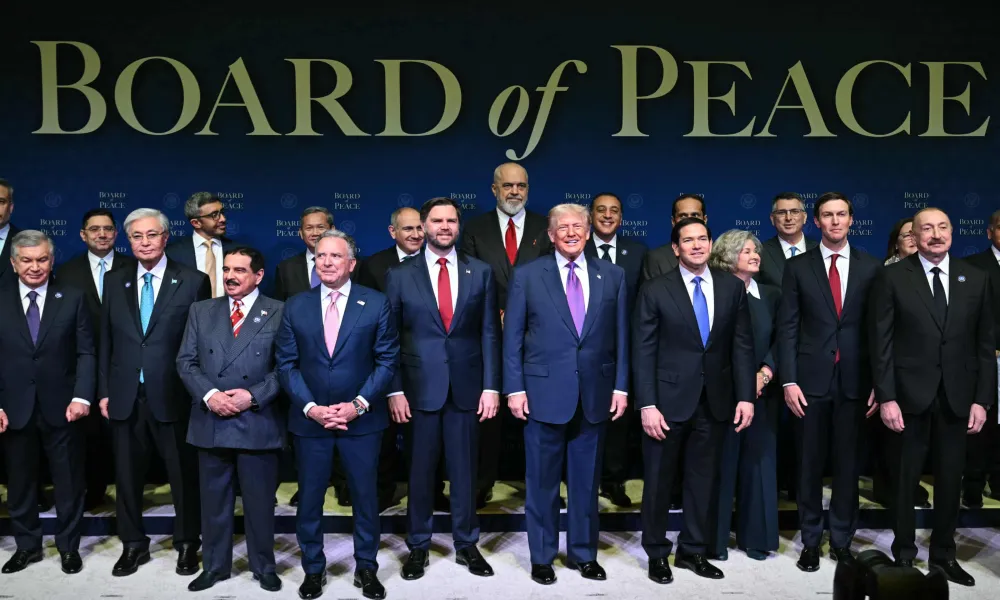

Board of Peace officials and technocrats meet in Cyprus on Tuesday and Wednesday to discuss next steps in implementation of US President Donald Trump’s 20-point peace plan for Gaza.
With the US-Israeli war with Iran tentatively over, attention is slowly turning back to the small strip of land – 365 square kilometres in size – meant to house over two million people.
Government spokesman Konstantinos Letymbiotis confirmed last week that the Board of Peace itself decided to convene the meeting in Cyprus, and that the Cypriot government was not involved, though some visiting delegates would take the opportunity to meet with Foreign Minister Constantinos Kombos.
One of the participants, former British Prime Minister Tony Blair, was due to meet President Nikos Christodoulides yesterday but had to cancel due to a delayed flight. According to sources, the two men will instead hold a discussion via phone during Blair’s stay on the island.
Blair sits on the Board of Peace’s executive board and is also involved in the ‘Gaza executive board’ which comprises figures such as Turkish Foreign Minister Hakan Fidan, Steve Witkoff, Jared Kushner, and real estate investor Yakir Gabay.
Turkish Foreign Ministry spokesperson Öncü Keçeli was quoted saying that neither Fidan nor any other Turkish representative will take part in the meeting in Cyprus. Keçeli clarified that this was not an official session of the Board of Peace but a technical one focused on internal coordination.
The Board of Peace was established to implement plans for peace, stability and reconstruction in Gaza, as mandated by UN Security Council Resolution 2803. The Board did not release an official list of participants of the Cyprus meeting, though it is believed, in addition to Blair, the Board’s High Representative for Gaza Nickolay Mladenov will be here, along with Palestinian technocrats from the National Committee for the Administration of Gaza (NCAG).
The NCAG is meant to be responsible for day-to-day governance in Gaza during a transitional phase, while Mladenov will be the on-the-ground link between the Board of Peace and the technocratic committee.
However, it remains to be seen when and how reconstruction can start in Gaza, given continuing security concerns in the Strip, Israel’s gradual expansion of its area of control and Hamas’ refusal to disarm under current conditions.
The entry and establishment of the International Stabilisation Force (ISF) is also key to implementation of the plans for Gaza – with Kosovo, Kazakhstan, Morocco, Indonesia, and Albania named as contributing countries – but so far, there is no timeline for boots on the ground inside the Strip.
Diplomatic sources told Politis last week that there remains the issue of funding as many countries that had pledged billions in financial resources earlier this year have yet to meet those commitments.
Delegates in Cyprus will likely discuss a roadmap for the way forward, linking financial pledges to corresponding funding channels, as well as reviewing the planning and progress of various projects and phases related to the 20-point plan.