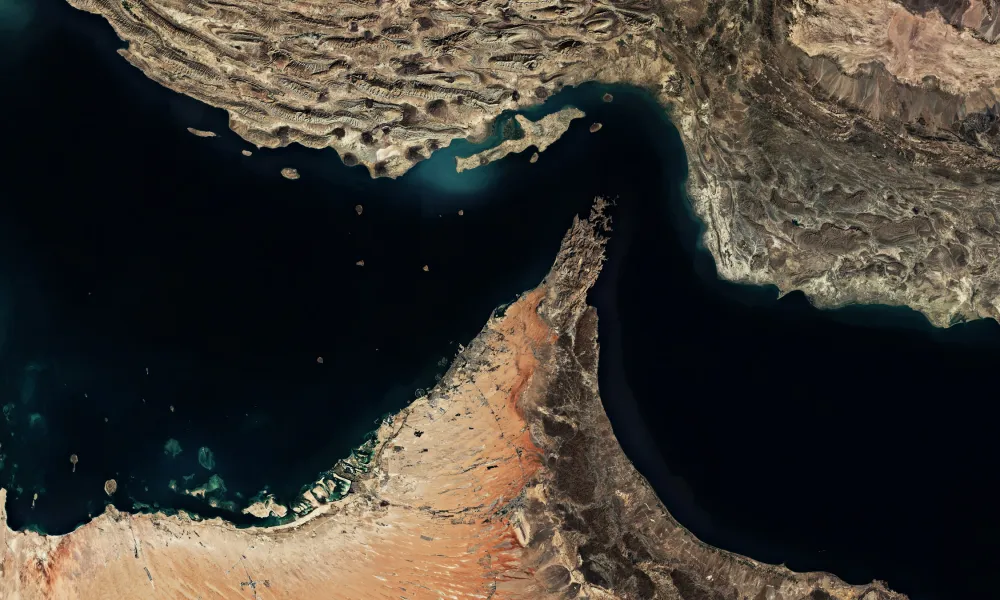



US forces carried out a third consecutive day of strikes against Iran, with US Central Command saying the five-hour operation targeted military sites across Bushehr, Chah Bahar, Jask, Konarak, Abu Musa and Bandar Abbas, aimed at degrading Iran's ability to attack civilians and commercial shipping in the Strait of Hormuz. Iranian state media reported explosions through the night along the country's southern coast, including in Bandar Abbas and on Kish and Qeshm islands, as well as in the town of Jam in Bushehr province. A local official in Hormozgan province said three people had been killed in a US strike, according to earlier reporting, though the Fars news agency later said a projectile that struck western Bandar Abbas caused no casualties. US Central Command also said it used submersible unmanned Corsair-type vessels for the first time, in an attack on the naval base at Bandar Abbas.
Tankers hit in the Strait of Hormuz
Iran responded with a wider retaliatory campaign across the Gulf. Two oil tankers operated by ADNOC L&S, a subsidiary of the UAE's state oil company, the Mombasa B and Al Bahyah, were struck by Iranian cruise missiles while transiting the Strait of Hormuz within Omani territorial waters. The UAE said one Indian crew member was killed and eight others wounded; ADNOC L&S described the damage as significant and condemned the attack on ships and sailors. India's Ministry of External Affairs lodged a formal protest with Tehran. In a separate incident off Oman, the Norwegian chemical tanker Stolt Magnesium, operated by Stolt-Nielsen, struck an unidentified explosive device and caught fire, though no casualties were reported.
Strikes spread to Kuwait, Bahrain and Jordan
Iran also struck US military targets well beyond the strait. Its army said it carried out a drone attack on a US Patriot missile system, fuel tanks, a watchtower, an ammunition depot and communication systems in Kuwait. The Revolutionary Guard said it targeted weapons storage depots, a satellite communications centre and a building housing US forces at al-Juffair base in Bahrain, as well as hitting the US Fifth Fleet with missiles and drones, triggering air raid sirens across the kingdom four times on Tuesday. Jordan's army said it shot down four missiles fired from Iran, after which the Revolutionary Guard said it launched ballistic missiles at US forces and facilities at an airbase in Jordan, insisting in a message to the Jordanian public that the strike targeted the American military presence rather than Jordan itself.
Trump reimposes the blockade
President Donald Trump reimposed a naval blockade on Iranian vessels and their customers, a measure confirmed by the US Navy-led Joint Maritime Information Centre and due to take effect at 8pm GMT on Tuesday, covering Iran's ports and terminals along its entire southern coastline. Trump said the Strait of Hormuz would remain open to vessels from other countries, subject to a 20% fee on cargo passing through. Writing on Truth Social, he said the United States would now be recognised as the guardian of the Strait of Hormuz and compensated for providing security along the route. Speaking to reporters in the Oval Office on Monday, Trump said Iran's offensive capabilities were being dismantled but that he still believed a deal was possible. He also threatened to strike Kuh-e Kolang Gaz La, known as Pickaxe Mountain, a suspected nuclear site near the Natanz enrichment facility, prompting an Iranian security source to warn of a devastating response should the US follow through.
Iran's Foreign Minister Abbas Araghchi rejected Trump's blockade plan, describing Tehran as the strait's longstanding guardian and calling the proposed 20% fee excessive. Ebrahim Azizi, head of the Iranian Parliament's National Security Committee, said a bill on managing the Strait of Hormuz and the Persian Gulf had been formally introduced in parliament, adding that Iran remained committed to defending its red lines over the waterway. German shipping group Hapag-Lloyd rejected the US blockade plan as fundamentally flawed, while the European Union Aviation Safety Agency has advised airlines to avoid airspace over Bahrain, Kuwait, Qatar, the UAE and part of the Gulf of Oman until 29 July.
Oil prices surge
The renewed hostilities have unravelled the interim US-Iran agreement reached last month, which had aimed to reopen the strait and pause fighting for 60 days of negotiations. Oil prices rose sharply, with Brent crude climbing more than 9% to around $81 a barrel, its highest level since mid-June. Shipping tracking firm Kpler said crossings through the strait fell by around 52% between 10 and 12 July compared with the previous week, with vessels increasingly reverting to Iranian and unmonitored routes rather than those authorised by the International Maritime Organization. The conflict has also spread to Yemen, where the Iran-aligned Houthi movement struck Saudi Arabia with missiles, ending a ceasefire that had held since 2022, following accusations that Saudi Arabia had bombed Sanaa airport.
Sources: Reuters, Al Jazeera