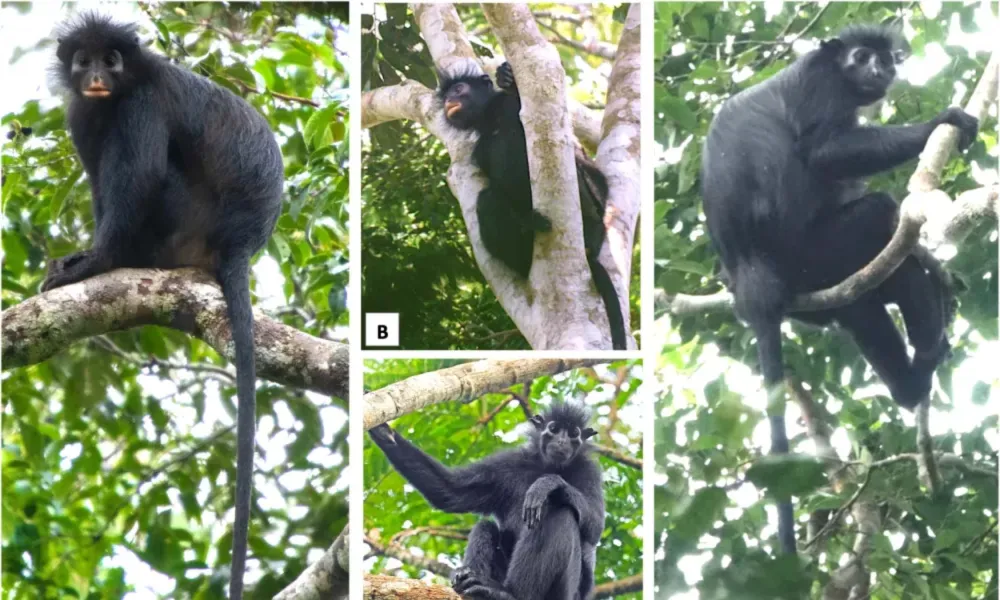

An international team of researchers has identified a new monkey species in the Democratic Republic of Congo, distinguished by its jet-black fur and striking orange-cream markings around its mouth.
According to Florida Atlantic University, it is only the fifth new monkey species to be recognised in Africa in the last 75 years.
@bbcnews The monkey, known locally as 'Likweli', was first reported back in 2008. #Monkey #DemocraticRepublicOfCongo #DRCongo #Nature #BBCNews ♬ original sound - BBC News
The newly identified colobus monkey inhabits the upper canopy of forests in the Congo Basin and is known to local communities as Likweli.
Kate Detwiler, associate professor at Florida Atlantic University, described the monkey as a particularly remarkable animal.
"The Likweli monkey, the new species we identified, is a colobus monkey that lives high in the forest canopy of the Congo Basin in the Democratic Republic of Congo. It is a remarkable monkey. It is completely covered in black fur, with an orange-cream outline around its mouth that is truly beautiful when it calls."
The discovery was made on the eastern bank of the Lomami River. On the river's western bank, researchers identified another monkey species in 2012, Cercopithecus lomamiensis, commonly known as the Lesula.
"We discovered the Lesula monkey in 2012 on the western bank of the Lomami River. On the eastern bank of the same river we now have this new colobus species," Detwiler said.
"It is like a beacon lighting up on the map, showing us that this is a place where we really need to focus our efforts to discover and protect biodiversity. Having a new species enter science and conservation efforts in 2026 is something very significant."
The international research team formally presented the species in a study titled Likweli: A Remarkable New Species of Colobus Monkey from Lomami National Park in the Democratic Republic of Congo, giving it the scientific name Colobus congoensis.
According to the study, researchers recorded 114 sightings between 2018 and 2022 across an estimated range of 1,700 square kilometres.
The rare and elusive monkey is found in east-central Democratic Republic of Congo and mainly inhabits dense forests with tall, closed canopies, deep clay-rich soils and forest islands that are not subject to seasonal flooding.
The small-bodied primate is covered in black fur and features "a striking orange-cream marking around the mouth."
Source: Reuters