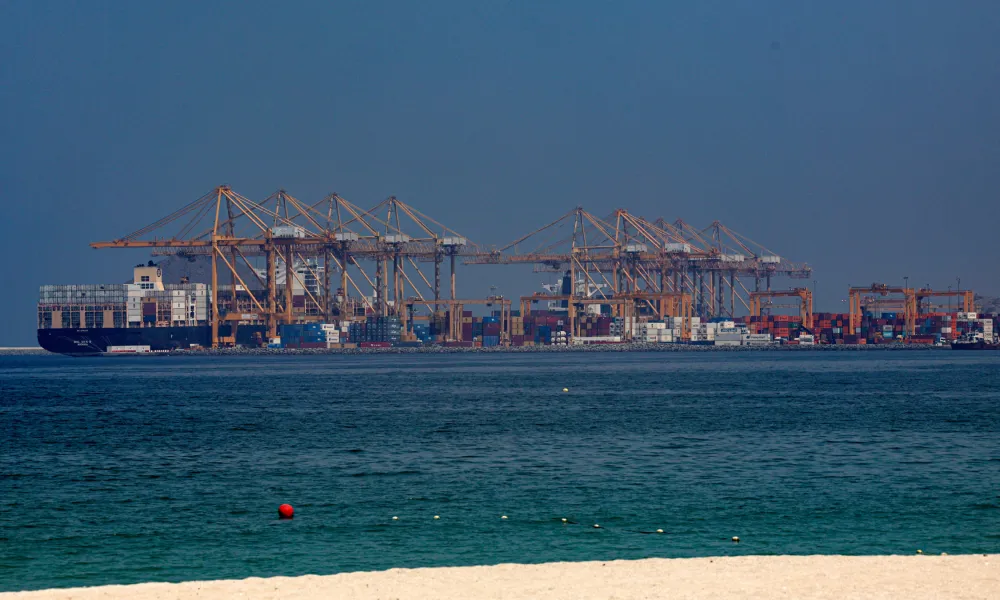

The Strait of Hormuz will remain closed until Washington accepts all of Tehran’s conditions, Iran’s Revolutionary Guards have said, further weakening hopes of a swift resolution to the conflict.
While US President Donald Trump insists economic pressure will ultimately force Iran to compromise, Tehran says no formal negotiations are taking place and describes the current contacts as an exchange of messages through intermediaries.
Iran sets terms for reopening the strait
The Strait of Hormuz has become the central point of contention in the Middle East conflict after Iran closed the passage, which is vital to the global energy trade.
The Revolutionary Guards described the strait as “a theatre of war, not merely a maritime route” and said their current strategy was to keep it closed until the United States accepted all of Iran’s demands.
Tehran’s conditions include a permanent end to US military action against Iran and its allies in Yemen and Iraq, the lifting of the blockade on Iranian Gulf ports, the removal of economic sanctions and the unconditional release of frozen Iranian assets.
Several of these measures were included in a memorandum of understanding signed by the US and Iranian presidents in mid-June. The agreement briefly allowed the strait to reopen and oil prices to fall, but the wider process subsequently broke down.
Reopening the passage has become Trump’s immediate priority, overtaking concerns about Iran’s nuclear and missile programmes that Washington had cited when the US-Israeli offensive began in late February.
Trump relies on economic pressure
Trump played down Tehran’s demands in an interview with Axios on Sunday, saying the United States was remaining discreet while observing Iran’s worsening economic situation.
He claimed inflation was surging and that the country’s financial difficulties could eventually prevent it from paying its armed forces.
The United States reimposed a blockade on Iranian Gulf ports in July, a move Trump said had intensified the pressure on Tehran.
“It will work. It always works,” he said, describing the confrontation as being “like a game of chess”.
Trump has repeatedly claimed that talks over reopening the strait were progressing well and that an agreement could be reached quickly. However, the latest Iranian conditions appear to have pushed the two sides towards another prolonged stand-off.
Tehran denies formal negotiations
Iranian Foreign Minister Abbas Araghchi again rejected claims that Tehran and Washington were engaged in direct negotiations.
“I would not call it negotiation. I would call it an exchange of messages,” he said, adding that talks could not resume while what Iran considers US violations of the Islamabad memorandum continued.
Iran says it is holding discussions only with Oman, located across the strait, on the future routes vessels could use. Araghchi said those talks were in their final phase.
Trump, meanwhile, told Axios that the two countries were “half-negotiating”.
Tehran has also ruled out returning to the pre-war status quo and intends to impose service fees on vessels passing through the strait, despite explicit US opposition.
Israel maintains focus on Iran’s nuclear programme
Differences between the United States and Israel over the direction of the war have also become increasingly visible.
Israeli Prime Minister Benjamin Netanyahu maintained his focus on Iran’s nuclear programme on Sunday, saying that, “with or without an agreement”, the Islamic Republic would not be allowed to acquire nuclear weapons.
US strikes have been suspended for more than a week. Trump had made the pause conditional on reaching a rapid agreement to reopen the Strait of Hormuz.
Houthis attack Saudi targets
Tensions have also escalated again in the Red Sea, where Yemen’s Ansar Allah movement, commonly known as the Houthis, said it had attacked a Saudi Aramco refinery with drones on Sunday.
Saudi Arabia said a fire at the facility had been brought under control but did not clarify its cause.
The Houthis also said they had launched ballistic missiles and drones at Saudi forces and weapons depots near the port of Mocha in southern Yemen. A medical source said at least 11 people, including military personnel and civilians, were killed.
Hostilities resumed in July after four years of relative calm, opening another front in the regional conflict that followed the US-Israeli offensive against Iran on 28 February.
The Houthis subsequently announced a blockade of Saudi vessels and ports in the Red Sea, which has become even more important to the energy trade following the closure of the Strait of Hormuz.
They have also carried out repeated attacks against Saudi Arabia for the first time since the UN-brokered ceasefire of 2022. The truce had continued to be observed despite formally expiring.
Saudi Arabia, a US ally that has also been targeted by Iran during the conflict, signed a mutual defence agreement with Pakistan and Turkey on Friday.
Source: Athens-Macedonian News Agency