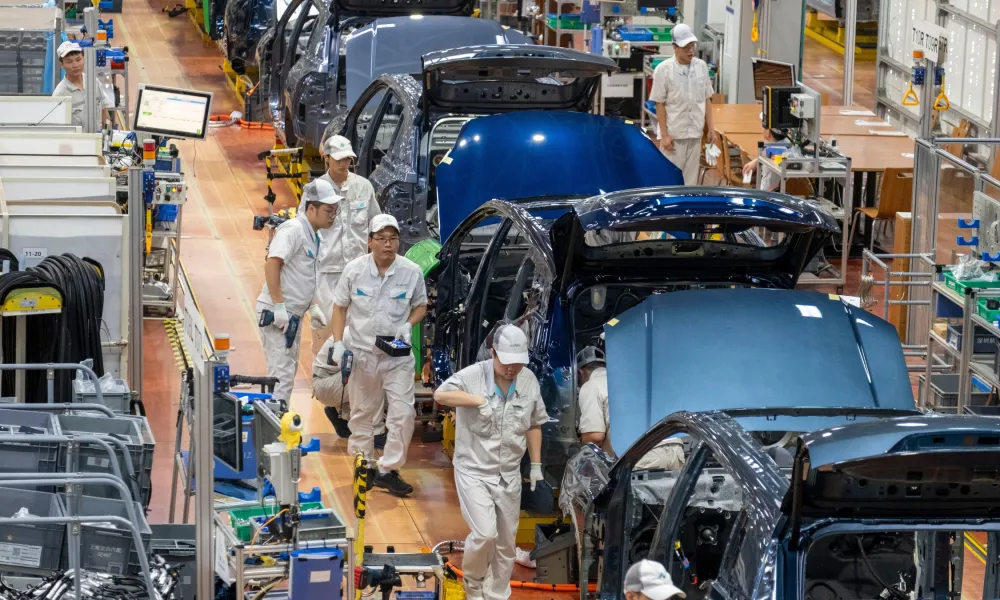

Faced with excess production capacity and a prolonged slowdown at home, Chinese carmakers are relying increasingly on overseas markets to sustain growth. Their expansion across Europe and Southeast Asia is intensifying pressure on established manufacturers such as Toyota Motor and Volkswagen, Reuters reports.
Weak consumer demand and years of fierce price competition have left the world’s largest car market struggling to absorb everything its factories produce. For major groups such as BYD, Geely and Chery, international expansion is therefore becoming more than a long-term ambition.
Exports surge as domestic sales fall
Car sales in China dropped by one fifth year on year to 1.47 million vehicles in July, marking the 10th consecutive month of decline, according to the China Passenger Car Association.
Exports moved sharply in the opposite direction, rising by 88% to 923,000 vehicles.
The figures include foreign brands that manufacture vehicles in China. However, the broader pattern remains the same among domestic producers: double-digit declines at home alongside double-digit export growth.
Cui Dongshu, head of the China Passenger Car Association, attributed the latest weakness to higher fuel prices, which affected demand for petrol-powered vehicles, and continued sluggishness in the entry-level saloon segment.
During the first half of 2026, domestic car sales fell by 2.3 million vehicles compared with the previous year, a decline of 20%. That reduction alone was equivalent to all new-car registrations in Japan, the world’s fourth-largest car market, during the same period.
Chinese vehicle exports, meanwhile, increased by 71% in the first half of the year.
Global expansion becomes a necessity
“Chinese carmakers have excess capacity, highly competitive supply chains, increasingly sophisticated products and a strong economic incentive to find growth outside China,” said Bill Russo, chief executive of Shanghai-based consultancy Automobility.
For China’s leading manufacturers, he added, globalisation “is becoming a strategic necessity”.
The automotive sector reflects the wider pressures affecting the world’s second-largest economy. Strong factory output and exports continue to support growth, while the weak property market and reduced consumer spending limit domestic demand.
Chinese policymakers are grappling with an economy that produces more than it can sell at home. Overseas markets are consequently becoming an increasingly important outlet for the country’s carmakers.
HSBC analyst Yuqian Ding said domestic demand could stabilise and potentially begin recovering between late August and September, as manufacturers accelerate the launch of new models.
BYD offsets losses through overseas growth
BYD recorded a 35% decline in domestic sales during the first seven months of 2026. Over the same period, its overseas sales increased by 79% year on year.
Brazil and the United Kingdom have emerged as BYD’s two largest markets outside China this year.
Despite the overall contraction in the Chinese market, domestic brands continue to dominate and gain market share, while German and Japanese manufacturers lose ground.
China challenges Japan’s export position
China has been the world’s largest vehicle exporter since 2023, overtaking Japan, which held the position for decades.
“Japan’s rise as an automotive exporter was built on manufacturing efficiency, quality and fuel economy,” Russo said.
China’s competitive advantage is broader, he added, covering electrification, batteries, software, intelligent features, supply-chain scale and rapid product development.
“That combination could make China’s globalisation significantly more disruptive,” he said.
Chinese brands reach 16% of Europe’s market
The pressure from Chinese manufacturers is already visible in several major overseas markets.
Japanese carmakers held approximately 12% of Europe’s passenger vehicle market during the first quarter of 2026, little changed from four years earlier, according to Counterpoint Research.
Over the same period, Chinese manufacturers increased their share from just 3% to 16%. Registration figures indicate that some of those gains came at the expense of European, South Korean and American competitors.
The gap is even more pronounced in the electric vehicle market. Chinese brands now account for almost one quarter of electric vehicle shipments in Europe, while Japanese manufacturers hold slightly less than 5%.
Counterpoint Research forecasts that Chinese brands will capture more than 20% of Europe’s overall passenger vehicle market and 29% of its electric vehicle market by 2030.
Source: AMNA