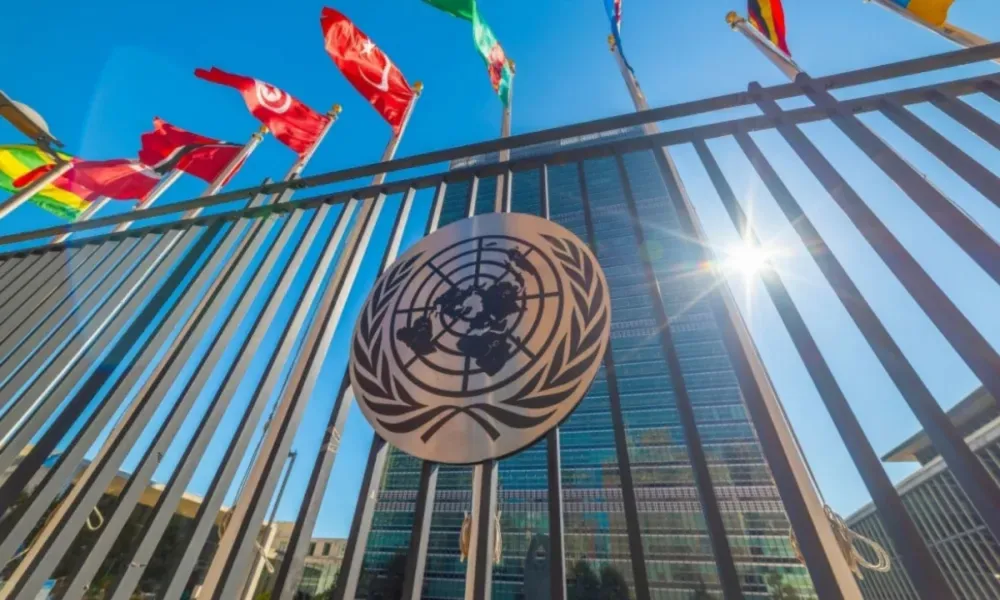

The United States and Russia have launched unusually sharp criticism of UN General Assembly President Annalena Baerbock, accusing her of exceeding her mandate in the process to select the next UN secretary-general.
Both countries argue that Baerbock is attempting to assume responsibilities that belong exclusively to the UN Security Council, which plays the central role in recommending a candidate to succeed António Guterres, whose second term ends later this year.
Succession battle sparks tensions
The dispute centres on the role being played by the former German foreign minister in the race to choose the next head of the United Nations.
Eight candidates are currently seeking the post.
Under UN procedures, the Security Council conducts closed-door deliberations and selects a preferred candidate, who is then formally appointed by the General Assembly.
Moscow and Washington voice concerns
Russia's UN ambassador, Vasily Nebenzya, said Moscow was concerned about the role Baerbock was attempting to play in the process.
His remarks echoed criticism made a day earlier by US ambassador Jennifer Locetta, who accused Baerbock of exceeding her authority and displaying what she described as hypocrisy.
Push for a more open process
Baerbock has repeatedly argued that the selection of the next secretary-general should be "transparent, inclusive, structured, timely and credible".
As part of that effort, she organised public dialogues with candidates and sent letters to Security Council members regarding the process.
Informal poll triggers backlash
Particular controversy was generated by a public event held on 23 July, during which Baerbock organised an informal audience poll on the candidates.
The initiative drew strong criticism from several member states.
Locetta described the poll as "improper, opaque and unprecedented", stressing that those participating had no formal role in choosing the next secretary-general.
She also criticised what she called Baerbock's "irresponsible" actions.
Dispute over candidate participation
Another source of disagreement was Baerbock's suggestion that the Security Council should disregard candidates who did not participate in General Assembly discussions.
The US ambassador rejected that view, arguing that the Security Council has the authority to consider any candidate it chooses.
Locetta further suggested that Baerbock appeared to see herself as a "superstar diplomat" and was implicitly challenging the methods used by the Security Council.
"The actions of the president reveal hypocrisy and do not reflect well on the work of the General Assembly more broadly," she said.
High-stakes selection process
The rare alignment between Washington and Moscow highlights growing tensions over how the UN should select its next leader.
While Baerbock has promoted greater transparency and broader participation, critics insist that the established process gives the Security Council the decisive role in determining who succeeds Guterres.