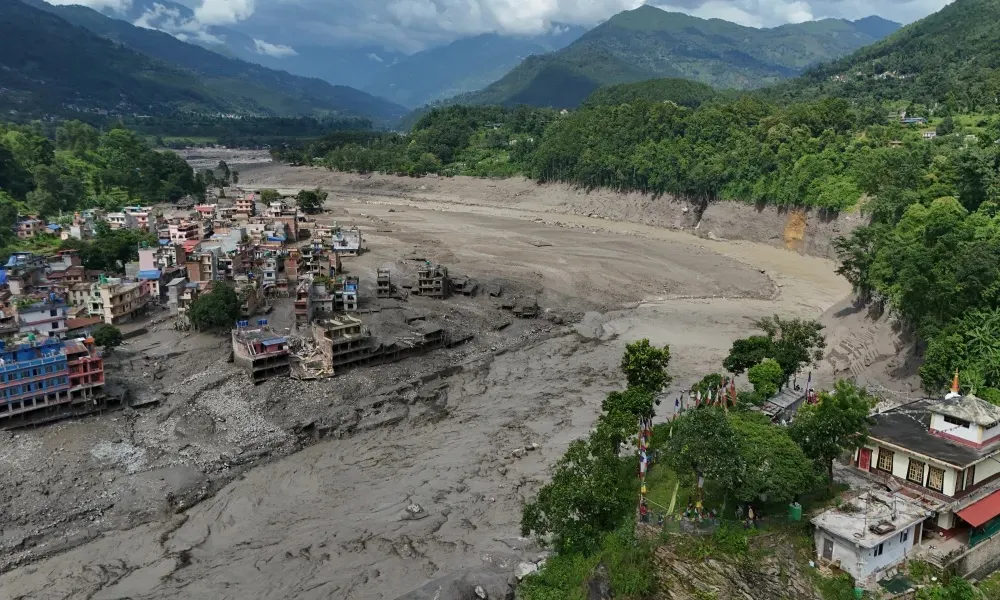

The death toll from devastating floods in Nepal has risen to 616, while about 2,500 people remain missing on both sides of the Nepal-China border, authorities said on Saturday.
Police said 2,301 people have been injured and are receiving hospital treatment or medical care, while tens of foreign nationals, including US citizens, are among those unaccounted for.
Search and rescue operations entered a fourth consecutive day, with severe weather and extensive damage to roads, bridges and communications networks hampering access to some of the worst-affected areas.
Poor weather conditions grounded helicopters involved in rescue efforts on Saturday, while many communities remained isolated because of damaged transport links.
Authorities said more than 3,700 people have been rescued so far.
Searches are also continuing for foreign visitors who were in the region for trekking, mountaineering or religious purposes when the disaster struck.
More than 100 trapped in tunnel
One of the most challenging rescue operations is under way at the Upper Trishuli-1 hydropower project in Rasuwa province, where more than 100 people are believed to remain trapped inside a tunnel filled with mud.
Rescue teams are operating under extremely difficult conditions, with mud reaching depths of up to 1.5 metres in some sections.
Access is being achieved using ropes, baskets and drones because vehicles cannot reach many areas and helicopter landing options remain limited.
Floodwaters have caused widespread destruction across the border region, severely damaging roads, bridges, homes and hydropower facilities, while communications infrastructure has also been affected.
Authorities are closely monitoring lakes formed after ice and rock collapses in the Himalayas amid fears of further flooding.
One of the lakes overflowed on Friday, forcing a temporary suspension of rescue operations, while another remains under continuous surveillance.
Nepal seeks specialised international support
Facing the scale of the disaster, Nepal's government has appealed for international assistance in specialised technical areas, while stressing that foreign rescue teams are not currently required for general search-and-rescue operations.
Foreign Minister Shisir Khanal told Reuters that Nepal needs expertise and specialised equipment for tunnel rescues, victim identification and DNA testing, as well as the restoration of transport and communications networks.
Kathmandu has also requested prefabricated Bailey bridges from India and China to reconnect areas where about 20 bridges have been destroyed.
The country's healthcare system is also under growing strain.
Khanal told Reuters that many bodies have been transported far from the disaster zone and that some hospitals lack sufficient facilities for their storage and identification.
More than 90,000 people need assistance
Humanitarian needs are continuing to grow as authorities assess the full extent of the disaster.
According to the Red Cross, more than 90,000 people have been directly affected and require assistance.
UNICEF estimates that about 17,000 children are in immediate need of humanitarian aid.
Dozens of schools have been destroyed or seriously damaged, while healthcare facilities have also been affected.
The extent of the destruction, combined with the difficulty of reaching mountainous and remote communities, is complicating both relief efforts and damage assessments.
Reconstruction bill could reach $5 billion
Initial estimates suggest reconstruction costs will be substantial.
Finance Minister Swarnim Wagle told Reuters on Saturday that rebuilding and recovery efforts following the floods are expected to cost between $4 billion and $5 billion.
The estimate remains preliminary as damage assessments continue.
The final cost will depend on the extent of destruction to roads, bridges, homes, energy infrastructure and other critical facilities across the country.