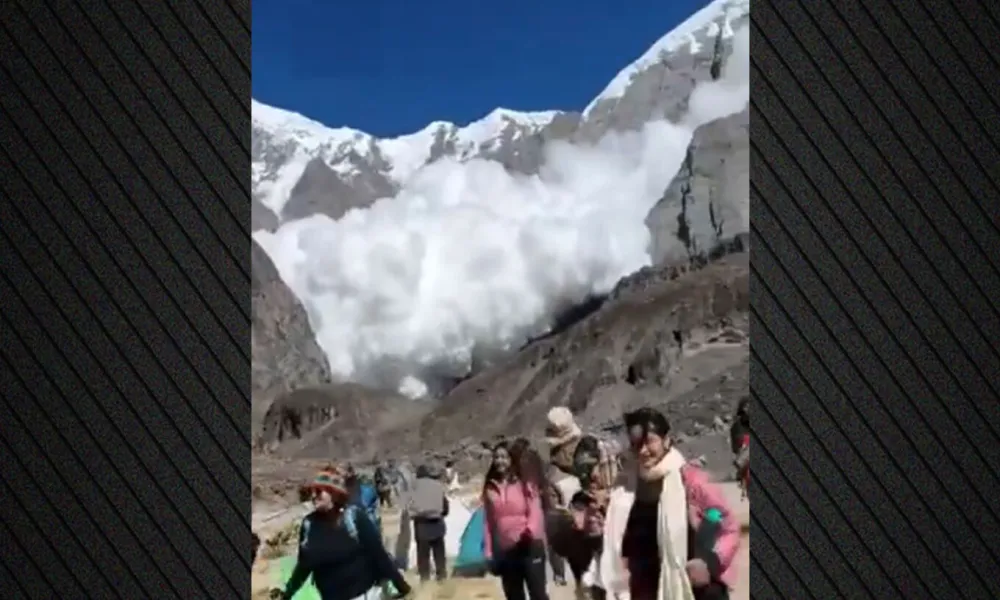

The head of the UN climate change agency and Nepal’s foreign minister have warned of the growing threat posed by climate change to the Himalayas, after a glacier collapse triggered devastating floods in the region.
Simon Stiell, executive secretary of the UN Framework Convention on Climate Change, said on Saturday that global warming was making disasters such as the latest floods “much more likely, frequent and severe”.
“The warming of the climate, caused by humanity’s burning of colossal amounts of coal, oil and gas, is making tragedies like this, and others around the world, much more likely, frequent and severe,” Mr Stiell said in a statement.
Nepal’s Foreign Minister Shishir Khanal said the country contributed less than 0.01% of global greenhouse gas emissions but was nevertheless among those most severely affected by climate change.
Hundreds killed and thousands missing
Extremely severe floods and landslides struck an area on the Nepal-Tibet border on Wednesday, leaving around 700 people dead and 3,000 missing, according to the latest figures from authorities in the two countries.
The US Geological Survey said the disaster was caused by a glacier collapse, followed by torrents of water and debris.
Stiell described the sudden glacier collapse and flooding as a stark reminder of the vulnerability of mountain environments. He noted that scientists and local communities had warned for years that high-altitude areas of the Himalayas were increasingly threatened by climate change.
Scientists urge caution over climate link
While several experts have already linked the disaster to climate change, others have urged caution, saying it is too early to establish a definitive connection.
“It is still too early to determine the cause with certainty,” US climatologist Zeke Hausfather wrote on the Climate Brink website. He noted, however, that such collapses can occur when mountains warm rapidly in valleys where ice is already approaching melting point.
The glaciers of the Himalayas provide a vital source of water for almost two billion people. They are melting at an accelerating rate as global temperatures rise, increasing the risks faced by communities across the region.
The loss of ice can also destabilise mountain slopes, potentially increasing the risk of landslides and other hazards.
Nepal calls for international action
Khanal called on the international community to work together to protect the Himalayan ecosystem.
“We call on the international community to unite to protect the ecosystem of the Himalayas,” he said on Saturday.
Earlier, he told reporters that Kathmandu would intensify research to better understand the changing dynamics of the Himalayan ecosystem and the risks facing Nepal, the landlocked country situated between India and China.
The threat, Khanal said, concerned not only Nepal and its people but also “our northern neighbour, China”.