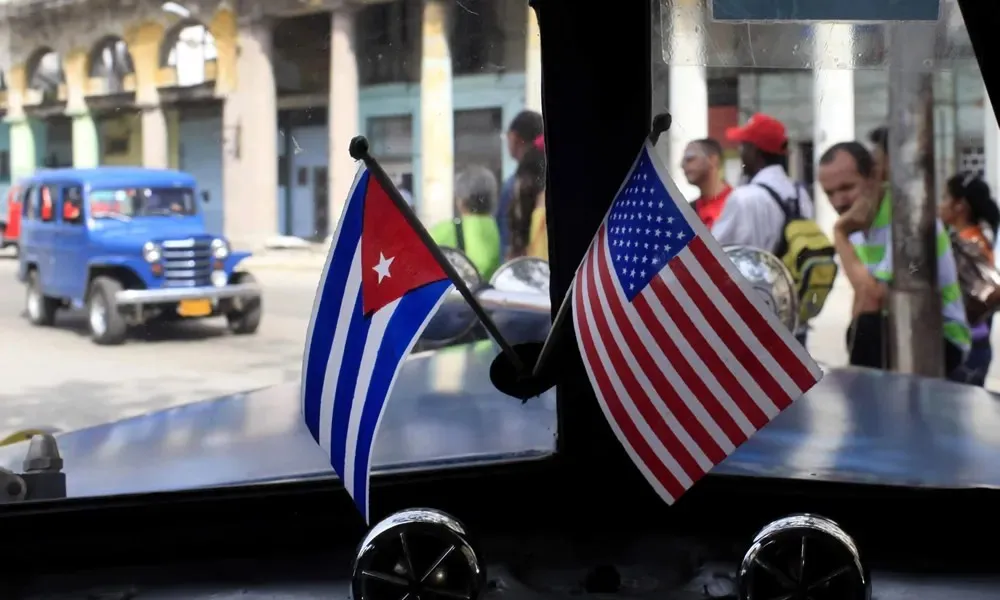

Cuban President Miguel Díaz-Canel said Cuba will "never" become a colony or neo-colony again after US President Donald Trump shared a map on Truth Social depicting the island as part of US territory.
The map showed Cuba, alongside Mexico, Canada, Greenland and Iceland, coloured in the design of the US flag. The post prompted a strong reaction from Havana, where officials reiterated the country's commitment to national sovereignty and self-determination.
Cuban president responds
Speaking on Tuesday, Díaz-Canel said Cuba had a long history of resisting foreign domination.
"Cuba, which knows well what it means to be a colony and a neo-colony of two empires, says clearly that it will never again become one of any empire," he said.
Although he did not explicitly reference Trump's post, his remarks came after the publication of the map on the US president's social media platform.
Sovereignty at centre of dispute
Díaz-Canel said Cubans had paid a high price for independence and would continue to defend it.
"The blood shed for independence, national sovereignty and self-determination was not shed in vain. We will defend it to the end," he said.
Historical context
Cuba was a Spanish colony for approximately 400 years before Spain lost control of the island during the Spanish-American War in 1898.
The island remained under US military occupation until 1902, when it became a republic, although it retained close economic and political dependence on Washington.
That period continued until the 1959 Cuban Revolution led by Fidel Castro.
Relations with Washington deteriorate
According to the report, relations between the United States and Cuba have become increasingly strained since the beginning of the year.
Trump has argued that Cuba represents an "extraordinary threat" to US national security and has repeatedly threatened to take control of the island.
The report also states that Washington has imposed a de facto oil blockade on Cuba since January, contributing to the country's ongoing economic and energy difficulties.
Source: CNA