
Opinion polls in the north show the Republican Turkish Party (CTP), from which Turkish Cypriot leader Tufan Erhürman comes, in the lead ahead of the so-called "parliamentary elections" on 6 December. The surveys show the CTP, led by Sıla Usar İncirli, ahead of the National Unity Party (UBP) of current "prime minister" Ünal Üstel. Beyond first place, attention is of course also turning to post-election coalitions. With an outright majority still uncertain, the strength of the smaller parties takes on particular importance, as they compete for the role of kingmaker in forming the next "government".
The pre-election debate centres on high prices, corruption, the economy, relations with Ankara and the Cyprus problem. The result is expected to redefine the political balance within the Turkish Cypriot community and to decide which "government" Tufan Erhürman will have alongside him. At a time of renewed movement in the efforts to restart talks, the stance of the next "government" will be an important factor in the political balance on the Turkish Cypriot side.
UBP: Military service and Varosha
The National Unity Party (UBP), under "prime minister" Ünal Üstel, is prioritising support for young people, reform of military service and the promotion of projects, with particular emphasis on the Varosha area. One of Üstel's main pledges concerns widening the option to buy out military service, with a commitment that the relevant bill will be tabled as a priority in the new "parliament". According to Üstel, the buy-out amount will be set in relation to the minimum wage.
İncirli's central narrative is that the Üstel "government" has led the north into economic and social decline. She claimed the past five years have been marked by scandals, mismanagement and a constant erosion of citizens' purchasing power, and pledged that, if her party takes over "governance", it will carry out audits and hold those responsible to account.
Varosha also features prominently in Üstel's pledges. He is promoting a new town-planning scheme for the existing area aimed at its redevelopment, "improving access to the beaches and assessing the seismic adequacy of buildings". He claimed that more than 90% of the area's buildings are not earthquake-resistant, presenting safety as a key priority of the plan.
At the same time, he repeated the Turkish position that Varosha falls under the flag of the North, and claimed that the area belongs to Turkish religious foundations (vakıf).
CTP: High prices and corruption
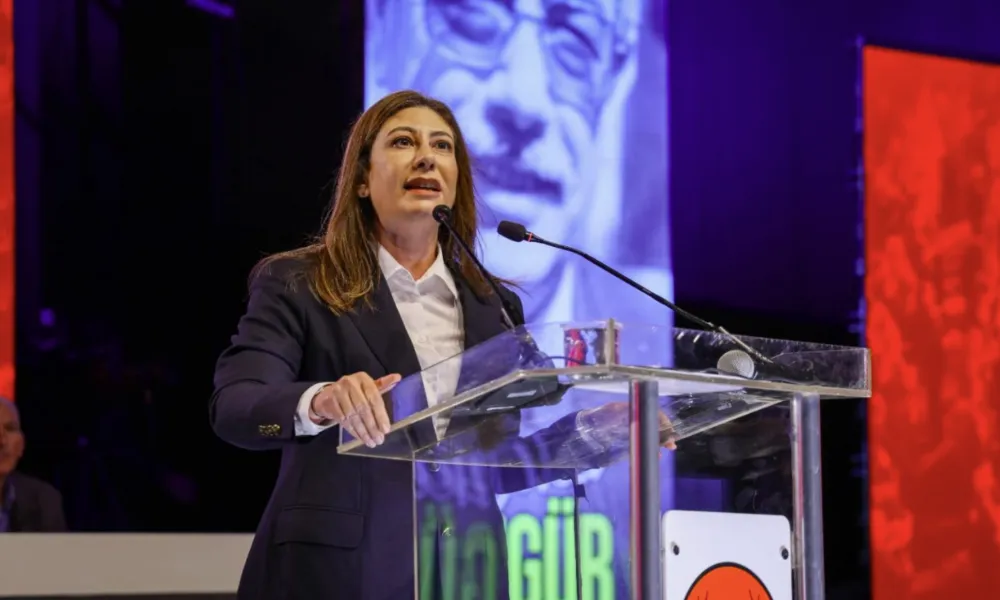
By contrast, the Republican Turkish Party (CTP), led by Sıla Usar İncirli, is focusing on fighting corruption, tackling high prices and restoring citizens' trust in institutions. Speaking in Nicosia, İncirli launched a strong attack on the outgoing "government", accusing it of mismanagement and saying it has led the north into economic and social decline. The CTP leader presents the 6 December contest as an opportunity to change the way "governance" is exercised. She argues that public discontent with the current "government" has strengthened the demand for political change. At the heart of the CTP's programme is "the creation of an anti-corruption authority, greater transparency in public contracts, tenders and state spending, and the introduction of merit-based procedures for public sector recruitment".
On the economy, the CTP proposes "lower VAT rates, VAT refunds for purchases of basic goods by credit card and measures to support domestic production, with the aim of reducing the cost of living". It is also promoting "a four-year economic programme providing for a gradual reduction of the fiscal deficit, lower borrowing needs and securing resources for investment".
The battle for third place
The battle for third place is also of particular interest, as the smaller parties seek to strengthen their presence in the new "parliament" and gain a decisive role in post-election coalitions. At the centre of the competition are the Rebirth Party (YDP), which has been associated with settlers from Turkey and is led by Erhan Arıklı, and the Communal Democracy Party (TDP), considered politically close to the CTP and led by Zeki Çeler. The rivalry between the two parties has already become strongly personal, with their leaders trading barbs over their real electoral strength and their ability to influence the formation of the next "government". Erhan Arıklı fired the first shot: speaking at a campaign rally in Kyrenia, he claimed that the YDP will secure at least nine seats and emerge as the kingmaker in the new "parliament".
A total of 227,642 people are eligible to vote, and they will be called on to elect the 50 representatives of the new "parliament".
Also taking part in the contest is the People's Party (HP) of Kudret Özersay, which focuses on fighting corruption, modernising public administration, public health, education and security. The Democratic Party (DP), like the other smaller groupings, is also seeking representation in the new "parliament". A total of eight parties are taking part in the "parliamentary elections", and the 5% electoral threshold is a decisive factor in the allocation of seats.
The importance of third place is therefore not merely symbolic. If no party has an outright majority, the smaller groupings that win seats will be able to take part in negotiations to form the next "government".
Complaints over ballot papers
The campaign was also marked by complaints about the printing of ballot papers. On 18 November, reports in the Turkish Cypriot newspaper Yenidüzen brought to light information about the alleged involvement of unauthorised persons in the printing process, prompting reactions and an investigation. The relevant "electoral commission" announced that no leak of ballot papers had been found. Nevertheless, it was decided to replace the white ballot papers with yellow ones as an additional precaution. Tufan Erhürman also intervened, stressing the need to safeguard the credibility of the "electoral process".
A total of 227,642 people are eligible to vote, and they will be called on to elect the 50 representatives of the new "parliament". Voting will take place at 998 polling stations in six electoral districts.
The Cyprus problem
The two largest parties take different positions on the Cyprus problem. The UBP insists on a two-state solution, in full alignment with Ankara. In statements on 7 November, following the visit of Turkish Foreign Minister Hakan Fidan, Üstel made clear that the goal is for "the two states on the island to live side by side, on the basis of sovereign equality". On 14 November, he repeated that the two-state policy will not be abandoned.
The CTP says it remains committed to a bizonal, bicommunal federation with political equality. At her meeting with the UN Secretary-General's personal envoy, María Ángela Holguín, on 4 November, İncirli stressed the need for an immediate resumption of substantive, results-oriented negotiations, based on United Nations resolutions, parameters and convergences.
Ankara's role
Despite their differences on the Cyprus problem, the two parties converge in seeking to maintain and develop relations with Turkey, without openly questioning the decisive role Ankara plays in the north. Üstel presents close cooperation with Turkey as a key pillar of his policy, particularly on economic support, infrastructure projects and strategic choices. İncirli, for her part, also supports stronger relations with Ankara, placing greater emphasis on "institutional cooperation and mutual respect".
The battle for third place is also of particular interest, as the smaller parties seek to strengthen their presence in the new "parliament" and gain a decisive role in post-election coalitions.
Opinion polls
In the most recent survey, attributed to Demo Ajans and conducted from 28 October to 2 November 2026, the CTP stands at 37.14% and the UBP at 32.79%, after the proportional distribution of undecided voters. The Rebirth Party (YDP) is in third place with 12.25%, while the Communal Democracy Party (TDP) has 6.12%.
A different picture emerges from the ARIMA survey, whose results were published on 22 and 23 October and cover successive measurements from May to September. In the latest measurement, in September, the CTP stands at 39.7% and the UBP at 31.2%, a gap of 8.5 points. They are followed by the Democratic Party (DP) with 5.1%, the People's Party (HP) with 4.3% and the YDP with 4.1%. According to the published figures, the gap between the CTP and the UBP has narrowed from 25.6 points in May to 8.5 in September.
The day after
As journalist Yusuf Kanlı notes in an analysis for the Turkish news agency ANKA, the critical question in the "elections" is not only which party comes first, but also which smaller groupings will clear the 5% threshold, affecting the ability to form a "government". Columnist Mert Mapolar, in an analysis in the Turkish Cypriot newspaper Kıbrıs Postası, focuses on the importance of undecided voters and on how vote shares translate into seats.
Meanwhile, an analysis by the Turkish website Uluslararası Politika Akademisi highlights the political significance of the contest for the Cyprus problem, noting that the make-up of the next "government" may affect its relationship with Tufan Erhürman and the Turkish Cypriot side's stance towards efforts to restart talks.