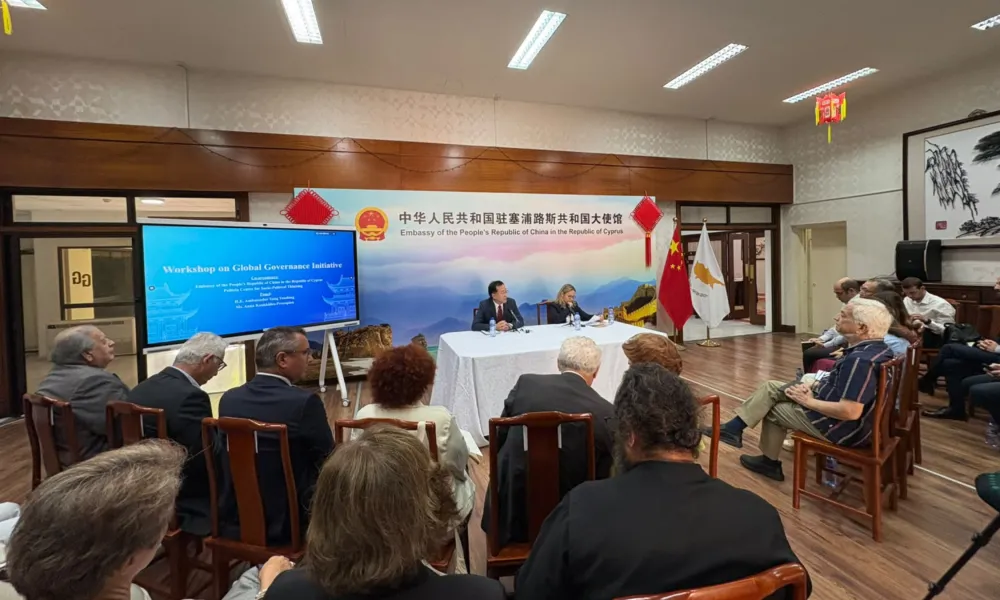



China's newly unveiled vision for global governance could offer a template for resolving the Cyprus problem, the Chinese ambassador to Cyprus told an audience in Nicosia on Wednesday, at a workshop co-organised by the Politeia Centre for Socio-Political Thinking on Beijing's Global Governance Initiative (GGI). The event drew officials from the Ministry of Foreign Affairs alongside academics and civil society representatives.
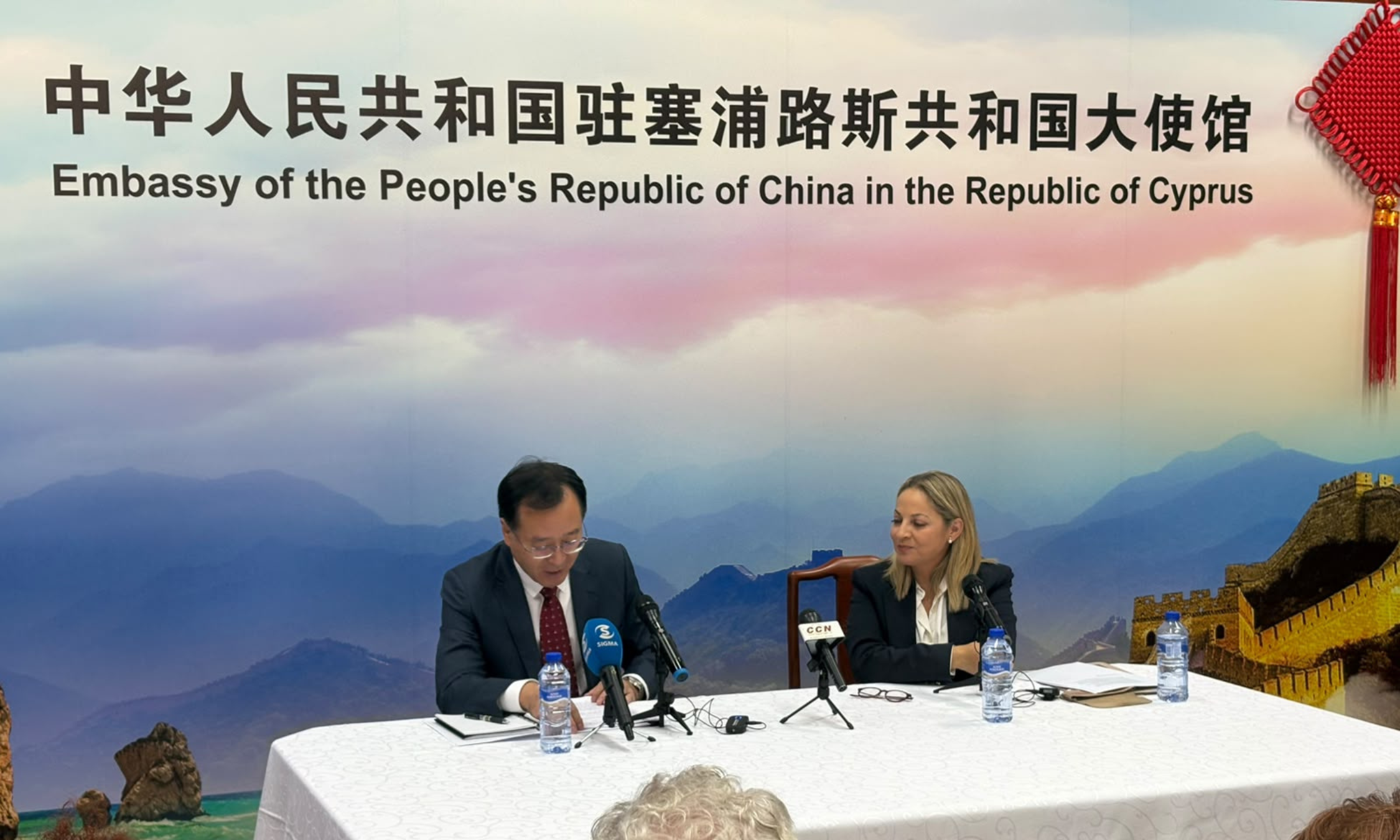
Ambassador Yang Yundong, who presented his credentials to President Nikos Christodoulides in July, told the gathering that the initiative's five core principles, sovereign equality, international rule of law, multilateralism, a people-centred approach and a focus on tangible action, could offer what he called inspiration for a comprehensive and just solution to the Cyprus problem.
A blueprint for reordering global governance
Chinese President Xi Jinping proposed the Global Governance Initiative on 1 September 2025 at the Shanghai Cooperation Organization Plus meeting in Tianjin, describing it as the fourth in a series of major Chinese-led global initiatives, following the Global Development Initiative in 2021, the Global Security Initiative in 2022 and the Global Civilization Initiative in 2023.
Ambassador Yang told the attendees that nearly 160 countries and international organisations have welcomed the initiative, with more than 60 joining what Beijing calls the Group of Friends of the Global Governance Initiative. He cited UN Secretary-General António Guterres as having said the initiative's core concept aligns closely with UN values, an initiative Guterres' spokesperson described as anchored in multilateralism and supportive of an international order centred on the UN.
The Ambassador pointed to two institutions China has already established under the initiative's banner: the International Organization for Mediation, headquartered in Hong Kong, and the World AI Cooperation Organization, signed into existence by 29 countries in Shanghai in July. He also referenced a white paper Beijing published in June setting out the initiative's principles in detail, and announced that China will host the inaugural Xiong'an Global Governance Forum this autumn in Hebei province, the first edition of what is intended as a recurring platform for the initiative.
Cyprus and the missing pieces of reunification
The Ambassador reiterated Beijing's longstanding position that, as a permanent member of the UN Security Council, China backs a comprehensive and just settlement of the Cyprus problem based on UN resolutions and a bizonal, bicommunal federation with political equality, framing this explicitly within the language of the GGI and arguing that a settlement grounded in sovereign equality and international law was consistent with the initiative's broader aims. Pressed from the floor on how far these principles translate into practice, he addressed funding, sanctions and Europe's place in the initiative in turn.
Asked whether the GGI implies concrete funding commitments from participating states, the Ambassador said funding remains a matter for individual countries and noted declining US willingness to fund multilateral bodies. He pointed to China's own record, noting that Beijing's share of the UN's regular budget stood at around 1% in the early 2000s and has since risen to 20%, making it the organisation's second-largest funder after the United States, and said China planned to take on further responsibility going forward. Asked for his view on the use of sanctions, he said unilateral sanctions produce no results and that disputes are better resolved through diplomacy. And asked what had formally been put to the EU on the initiative, the Ambassador pointed instead to the Shanghai Cooperation Organisation, where Xi has proposed extending support for the GGI among member states, and said he hoped for more concrete outcomes benefiting the EU and Cyprus specifically.
A fraying order, Politeia's president warns
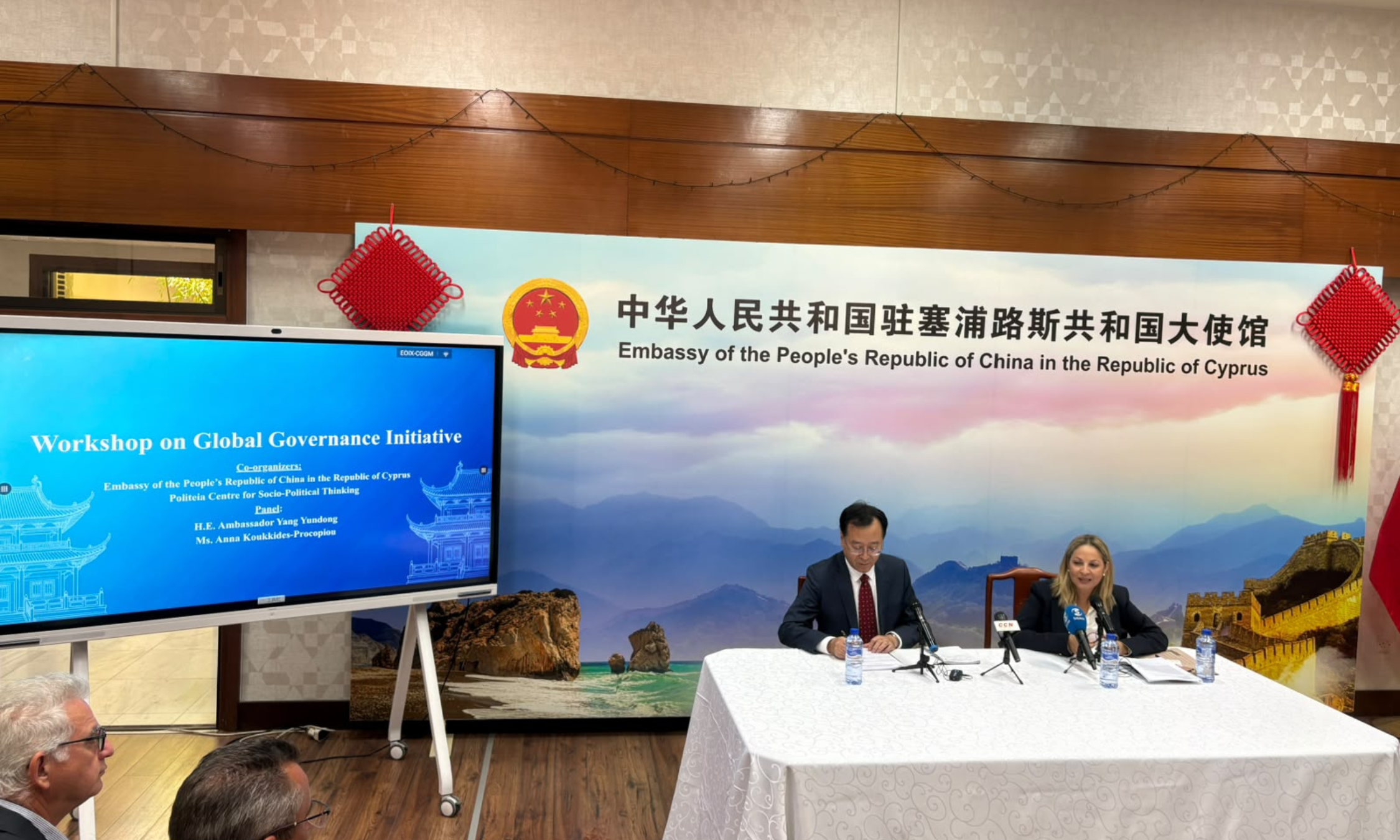
Opening the workshop, Politeia president Anna Koukkides-Procopiou set the wider context, arguing that the postwar international order, built on dialogue, interdependence and a delicate balance of power among major states, is under growing strain. She pointed to the rise of institutions such as BRICS and the Shanghai Cooperation Organisation, which she said together represent 60% of global economic output, as evidence of a shift in power that existing institutions have failed to reflect.
She also argued that the EU has struggled to act as a unified geopolitical actor given internal disagreement on foreign and security policy, contrasting this with China's role in brokering the 2023 rapprochement between Iran and Saudi Arabia. Koukkides-Procopiou welcomed China's continued support for a Cyprus settlement and its backing for the Committee on Missing Persons, and noted that China has contributed police officers to the UN peacekeeping mission in Cyprus since 2015.