
Israel’s national election was marked by exceptionally high voter turnout, mounting political tensions and disputes over election procedures on Tuesday, as Prime Minister Benjamin Netanyahu and his opponents fought for support in a contest that could determine the country’s political direction.
By 4 p.m., 55.7% of eligible voters had cast their ballots, the highest turnout recorded by that hour, according to The Times of Israel. Participation continued to rise, reaching 66.7% by 6 p.m., as political parties intensified their efforts to mobilize supporters ahead of the scheduled close of polling stations.
The election is widely viewed as a referendum on Netanyahu’s leadership following the Hamas-led October 7, 2023, attack and the subsequent regional conflicts. Security, the government’s handling of the aftermath of the attack, relations with the Palestinians and the future of Israel’s political leadership have featured prominently in the campaign.
Election authorities reject request to extend voting hours
Tensions escalated during the evening after Netanyahu’s Likud party and allied parties requested an extension of voting hours beyond the scheduled 10 p.m. closing time.
The Central Elections Committee rejected the request, saying that the high turnout demonstrated strong public participation and that there was no justification for extending voting nationwide.
An exception was made for the Jewish settlement in Hebron, where voting hours were extended until 10 p.m. following a power outage. Election officials also clarified that voters who arrived at polling stations by the deadline would be allowed to cast their ballots, even if queues delayed the process.
The dispute added to concerns about election integrity, with political rivals trading accusations over the conduct of the campaign and the handling of voting procedures.
High turnout puts focus on Arab voters
Participation among Arab citizens emerged as a significant factor in the election, with observers noting that increased turnout in Arab communities could influence the balance of power between political blocs.
Arab voters have raised concerns about crime, public safety and what they view as years of government neglect. These issues have contributed to calls for political change, while the participation of Arab-led parties could prove important if no major bloc secures enough parliamentary support to form a government independently.
Ra’am leader Mansour Abbas also accused Netanyahu of using allegations of electoral misconduct to mobilize right-wing voters. The accusations reflect the increasingly confrontational tone of the campaign as both sides seek to influence the final outcome.
Netanyahu faces a critical political test
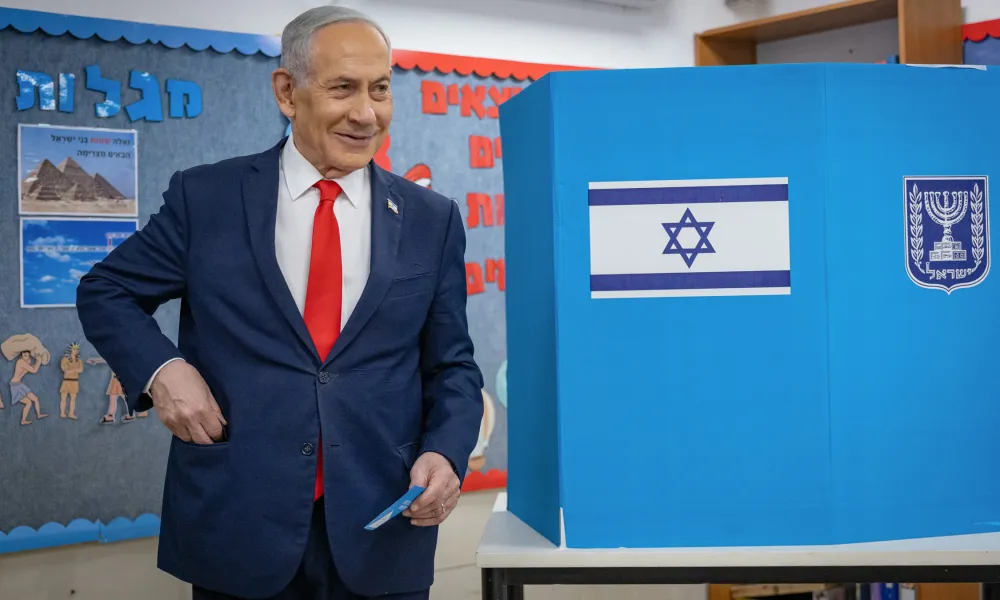
Netanyahu urged Israelis to vote after casting his ballot in Jerusalem alongside his wife, Sara. His campaign has emphasized national security and leadership amid continuing regional threats.
His principal challenger, former military chief Gadi Eisenkot, has sought to capitalize on public dissatisfaction with the government and concerns about its handling of national security and the consequences of the October 7 attack.
The election has also brought longstanding disagreements over judicial reform, exemptions from military service for ultra-Orthodox men, relations with the Palestinians and the future of settlements in the West Bank back into focus.
In the United States, New York Governor Kathy Hochul said her job would be easier if Netanyahu lost the election, while stressing the importance of Israeli security and the possibility of a safe Palestinian state.
Coalition negotiations could shape the next government
Even after voting concludes, the political outcome may remain uncertain. Under Israel’s parliamentary system, the party that wins the most seats does not automatically secure the right to govern; the decisive factor is whether a candidate can assemble a coalition with sufficient support in the Knesset.
If neither the governing coalition nor the opposition secures a clear path to a parliamentary majority, negotiations among smaller parties could determine who becomes prime minister and which policies the next government pursues.