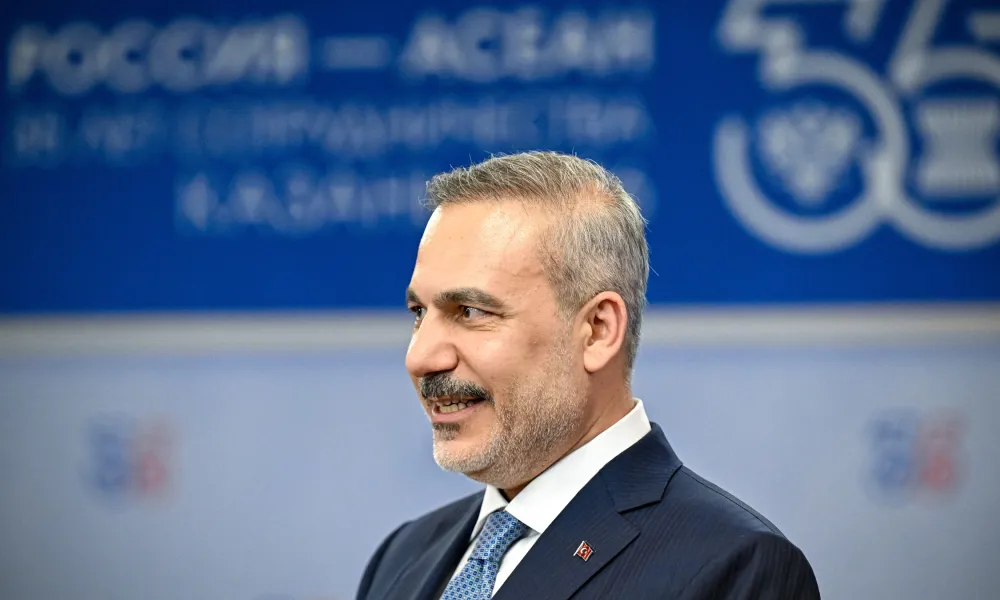

Turkish Foreign Minister Hakan Fidan has outlined Ankara's conditions for the advancement of the Great Sea Interconnector (GSI), saying Turkey is not opposed to the project provided the existing status quo in the relevant maritime areas is not altered.
According to a report in Greek newspaper Ta Nea, Fidan said Turkey wants research vessels involved in the project to provide written notification detailing the activities to be carried out and the coordinates of the planned surveys.
Speaking after an appearance at the European Policy Centre in Brussels on Tuesday, Fidan said verbal notification is not sufficient from Turkey's perspective.
Written notice required
Fidan argued that the requirement is intended to prevent the creation of new faits accomplis that could affect what Ankara considers the existing framework in the region and lead to additional disagreements between Greece and Turkey.
His comments come as work on the electricity interconnection project is expected to resume, with Ankara continuing to link survey activities in the Eastern Mediterranean to its wider maritime claims in the region.
While presenting Turkey's position as supportive of the project in principle, Fidan's remarks underline Ankara's insistence on establishing procedures for activities in maritime areas it regards as disputed.
Turkey proposes alternative electricity supply
According to Ta Nea, Fidan also revealed that the issue has been discussed at the highest political level, including by Greek Prime Minister Kyriakos Mitsotakis and French President Emmanuel Macron.
Referring to a previous meeting between Turkish President Recep Tayyip Erdoğan and Mitsotakis in New York, Fidan said Erdoğan had described the interconnector as a worthwhile project but had suggested direct electricity supplies from Turkey as an alternative.
Turkey argues that its geographical proximity to Cyprus would allow electricity, natural gas and water to be supplied over shorter distances and at different costs than those associated with the planned undersea cable.
Fidan suggested such an arrangement could benefit both Greek Cypriots and Turkish Cypriots, effectively presenting Turkey as an alternative energy supplier for Cyprus.
Comments on casus belli and 'Blue Homeland'
The Turkish foreign minister also addressed broader Greek-Turkish issues, including the longstanding casus belli declaration.
According to the report, Fidan argued that the 1995 decision by the Turkish parliament was a political declaration rather than a law and related specifically to any Greek extension of territorial waters to 12 nautical miles without a prior settlement of disputes with Turkey.
He described maintaining the current status quo in the Aegean as a means of preventing tensions and called on Athens to make use of what he said was President Erdoğan's willingness to resolve bilateral disagreements.
On the "Blue Homeland" doctrine, Fidan said there is no related legislative proposal before parliament and added that the issue of a planned marine park has not yet been formally discussed.