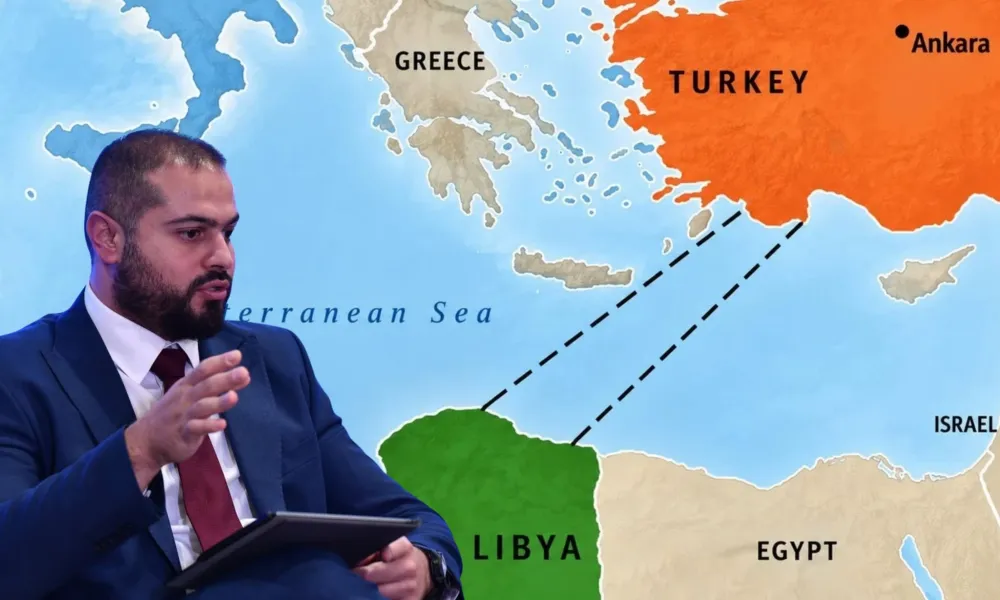



Libya’s House of Representatives approved the maritime delimitation agreement with Turkey earlier this week, the deal known as the Turkish-Libyan memorandum, drawing reactions from several Eastern Mediterranean states, including Cyprus, Greece, Egypt and Israel, which reiterated that the agreement is null, void and illegal. The European Union responded in similar terms, stressing that the agreement does not comply with the law of the sea. The US State Department, by contrast, took no explicit position on the deal’s legality and instead called on Greece and Turkey to enter bilateral dialogue to address their differences. For many international relations experts, the Libyan parliament’s decision was expected given the change in relations between eastern Libya and Turkey, although several media outlets described it as a major reversal in light of the parliament’s earlier stance on the memorandum.
How the memorandum came about
Speaking to Politis, Alexandros Zachariades, an international relations analyst and research associate at the University of Cyprus and the London School of Economics, recalled that after the fall and death of Muammar Gaddafi, civil war broke out in Libya and the country was gradually divided in two. The internationally recognised Government of National Accord prevailed in the west, while a second government backed by the Libyan parliament and Field Marshal Khalifa Haftar took hold in the east. The internationally recognised government, based in Tripoli, was also supported by Turkey, and the two sides signed the Turkish-Libyan memorandum in 2019. The Libyan parliament rejected the agreement in 2020, leaving it without strong domestic legitimacy. Since then, Zachariades said, eastern Libya has seen a political realignment. The position of Haftar’s family has been strengthened, and Turkey has developed working relations with it. He also pointed to the US effort to unify the country and Turkey’s involvement in advancing the American plan for a single Libyan state. As a result of these developments, the Libyan parliament changed course and ratified the memorandum.
Washington’s plans for Libya
Asked what aims the US plan to unify Libya serves, Zachariades said it is linked in part to the Russian factor, which at one stage had gained a foothold, mainly on Haftar’s side. He added that the US is seeking to stabilise the region, noting that Egypt to Libya’s east and Morocco to its west both play a role in normalisation with Israel and in wider US policy. Under these plans, he said, Abdul Hamid Dbeibah would remain prime minister or another member of his family would take over, while a member of the Haftar family would sit on the presidential or executive council, either Khalifa Haftar himself or his son Saddam, who now plays a particularly important role.
Ankara changes sides
Turning to Ankara’s role, Zachariades said Turkish policy in Libya has changed since 2023. Until then, Turkey backed the Tripoli government, supplying it with equipment and military support. He recalled that in 2018–2019, Haftar’s forces appeared militarily stronger than those of the internationally recognised government, but Turkey’s intervention restored the military balance. At that time, he said, Turkey’s relations with Khalifa Haftar were hostile. Gradually, however, Ankara shifted its policy and developed very close relations with Haftar’s sons, particularly Saddam Haftar. It then began providing the Haftar camp with equipment, diplomatic support and financial resources as well, as part of the broader effort to unify the country.
Cyprus, Greece and a reactive diplomacy
Asked whether Cyprus had any involvement in developments in Libya, Zachariades said the Republic of Cyprus was involved mainly through Greece, France and the United Arab Emirates. Between 2019 and 2021, Cyprus, Greece, France, the UAE and Egypt supported Haftar’s side, while several European states, the EU, the UN and the United States maintained closer ties with the Tripoli government, meaning there were differing lines even within the European Union. He made clear that Cypriot diplomacy played no particular role of its own but followed Greece. He pointed to Greek claims concerning its exclusive economic zone (EEZ), gas exploration in deposits off Crete and the electricity interconnection, noting that laying the cable does not require the delimitation of an EEZ and continental shelf. On the interconnection, he said there is a geopolitical risk as well as a financial one, and questioned how Turkey would ultimately react. Greece, he added, faces the risk of having yet another state opposite it that shares Turkey’s interpretation of the law of the sea.
What the latest developments over the memorandum have shown, Zachariades said, is that Greece’s role in Libya is steadily diminishing and that Greek diplomacy lacks a long-term strategy for dealing with these problems. Instead, he said, it is reactive. “It reacts to developments instead of trying to shape them,” he said. The question, he stressed, is to what extent Greece could shape them, and here some classic questions of international relations come into play. The balance of power is not on Greece’s side, and it lacks the resources to play the enhanced role it would like, for example in Libya. “I think this development sums up the limits of Greek diplomacy,” he said. Greece and Cyprus alike, he added, try to use various tools, whether trilateral partnerships or outreach to specific partners, but these are not always part of a coherent strategy and are often reactions to developments that have already taken place.
A new balance in the Eastern Mediterranean?
Asked whether the balance in the Eastern Mediterranean would shift if Libya were unified, Zachariades said a source of conflict in the wider region would clearly be removed, which would help strengthen stability. “This is not a frozen conflict, like the Cyprus problem, but a civil war whose intensity has risen and fallen since 2011, and particularly since 2014,” he said. The question, however, will be who holds influence in the new state, and Turkey will clearly have significant influence, he said. The UN and the EU, he noted, want a single state they can talk to and work with, citing migration as an example, since Libya is one of the main routes for migrant flows to Europe, particularly to Italy. The country’s fragmentation and conflicts have also allowed various illegal activities to flourish, including drug trafficking. International reports link forces in eastern Libya to networks trafficking people and synthetic drugs such as captagon through ports including Tobruk and Benghazi, he said, arguing that a unified government could, in theory, create better conditions for controlling these activities.
On competition between states in the Eastern Mediterranean, Zachariades pointed to the rivalry between Turkey and Israel and to Greece and Cyprus’ well-known relations with Turkey, rooted in the long-standing questions of the Cyprus problem and the Aegean. The other players, however, operate in a far more fluid way, he stressed, working with different sides depending on the issue. States that compete in Syria may share a view on certain developments in Libya. Egypt, for example, cooperates with Greece and Cyprus but has also opened channels of communication with Ankara, both because of Gaza and because of wider developments in the Arab world. The situation is therefore highly complex, he said, and the Eastern Mediterranean cannot be viewed as two fixed and unchanging camps.
Turkey’s widening influence
Asked which other states in the Eastern Mediterranean and North Africa are now under Turkish influence, Zachariades said that beyond Libya, Turkey has strong influence in Syria and its reach extends to Iraq, which is affected by developments on the Kurdish question. Turkish influence also stretches further south towards the Horn of Africa, particularly Somalia, and to other states in the region where it supplies equipment or maintains troops, such as Qatar. The rapid growth of Turkey’s defence industry in recent years, he explained, has allowed Ankara to supply military equipment to other countries and build relations with a range of states, and it is now a country with a much stronger defence industry seeking to export its products. “When you have your own defence industry, you can much more easily supply equipment to other states and, through that process, acquire or strengthen your political and diplomatic influence,” he said.