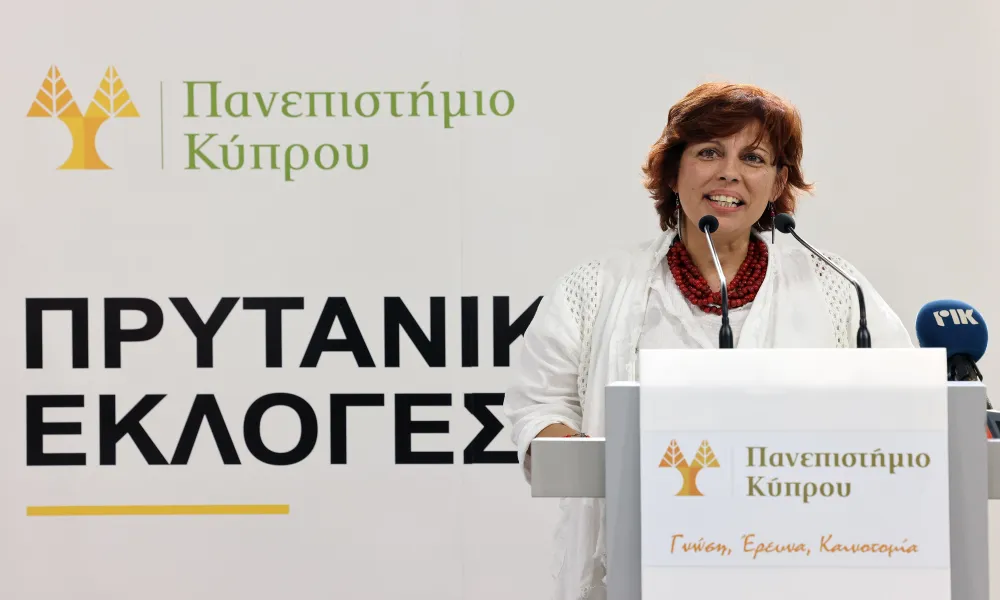



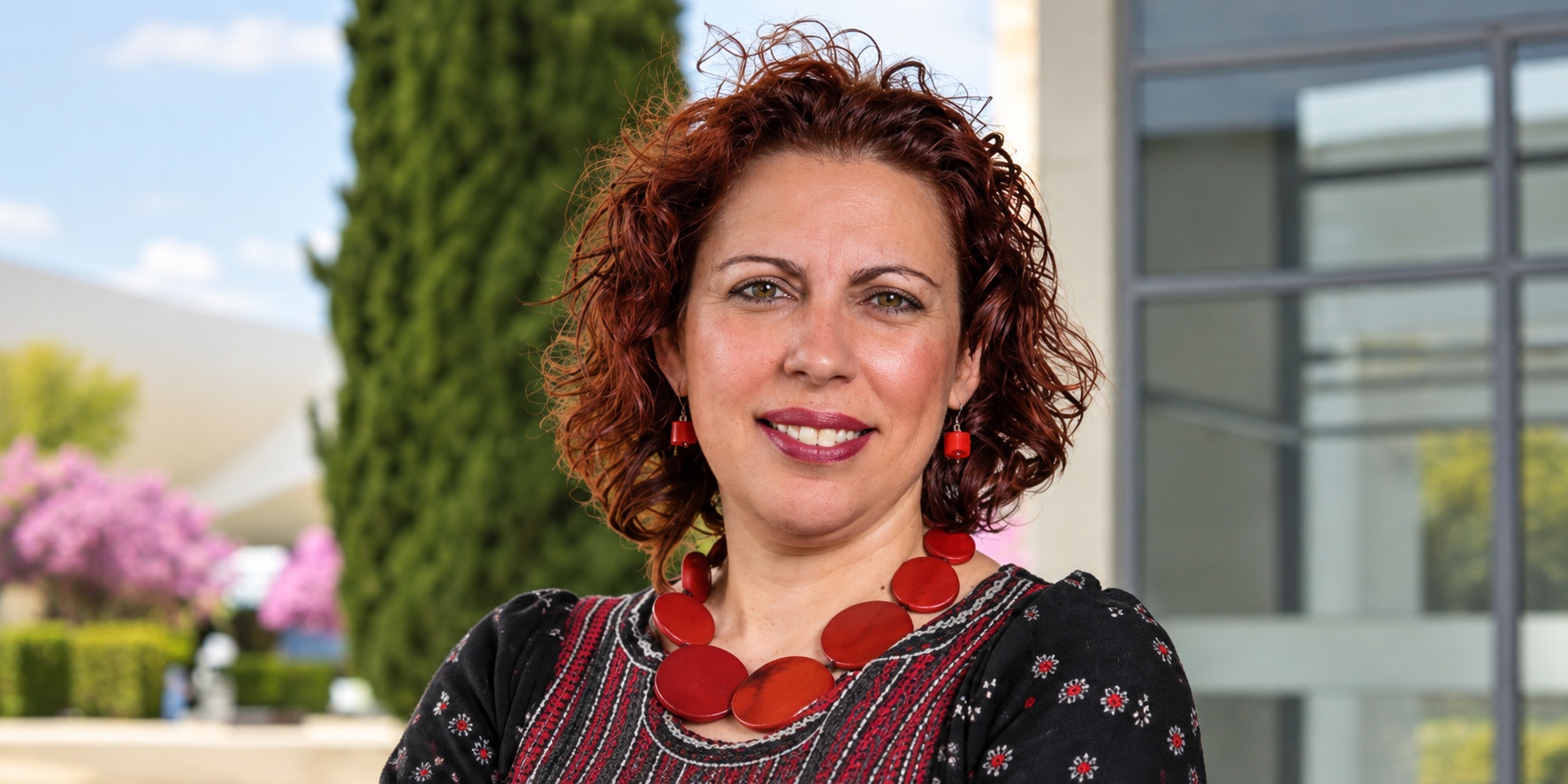
Marina Neophytou was elected rector of the University of Cyprus on 7 October 2026, becoming the first woman in the university’s history to hold the post, and will formally take office on 16 December 2026. Born just months after the 1974 Turkish invasion, she spent her childhood and teenage years in Limassol, while both her parents came from Paphos. She studied engineering at the University of Cambridge on a full university scholarship and, again on scholarships, completed a doctorate in environmental fluid dynamics there, staying on as a postdoctoral researcher working on the dispersion of air pollution in cities. From her student years she also worked at Schlumberger’s research centres in Cambridge and Paris. She joined the University of Cyprus as a lecturer in 2005, became professor of environmental engineering in 2020 and has served as elected dean of the Faculty of Engineering since 2023, preferring the feminine Greek forms of both titles, lektorissa and kosmitorissa. In 2006 she founded the Environmental Fluid Mechanics Laboratory, recognised as an island of excellence, which she still directs. She plays the piano and composes music. Speaking to Politis, she explains why freedom of knowledge, accountability and collective effort are the preconditions for a public university that shapes the future.
Breaking down the silos
What don’t you like about the University of Cyprus, and what would you like to change?
I will start on a positive note, with what I like. The University of Cyprus is a story of institutional success. It has achieved a great deal in a relatively short time, and we are rightly proud of it. In less than four decades it has built strong academic units, including 22 departments, eight faculties, 10 research centres and three centres of excellence, developed a significant international research presence, forged international partnerships, built high-quality infrastructure and, as the relevant surveys show, earned the trust of society. But panta rhei, everything flows. Times change and new challenges emerge. Yesterday’s institutional success does not guarantee tomorrow’s, and constant vigilance is needed. What concerns me is that we do not always make use of our collective strength. Internal procedures often absorb too much energy that could be channelled into academic work, while opportunities for collaboration go untapped. A “silo” culture has developed [each faculty or department working on its own, without collaboration or communication], which is understandable while a new organisation is growing, but is anachronistic today. I also want us to move from individual excellence to collective achievement, from administration to strategic capacity, and from the boundaries of individual units and silos to synergy and interaction.
What will the first changes be?
The first steps will be to map our real needs and capabilities, set priorities and simplify procedures. Above all, though, I want to change the way we make decisions, with more meaningful dialogue, stronger strategic thinking, clear responsibilities, greater freedom of initiative and matching accountability.
Knowledge, artificial intelligence and a new social contract
How will you turn research as a social responsibility into concrete policy?
Science has value first and foremost because it expands the boundaries of knowledge. The history of science shows that basic research is often a journey into the unknown, which is why it needs the freedom to experiment, even when we do not know where it will lead. At the same time, we have a responsibility to create pathways through which new knowledge can benefit society, building a university that is open, inclusive, lively and interactive. The expertise of the University of Cyprus has already served the state in many ways. Think, for example, of the decisive role of the Medical School during the pandemic, the Faculty of Engineering’s contributions on environmental management and renewable energy or, more recently, the important role of the Economics Research Centre in shaping the tax reform. We will strengthen knowledge and technology transfer, support for the protection and exploitation of research results, and cooperation with public bodies, businesses and social organisations. I do not, however, see social impact solely in economic or, more broadly, utilitarian terms. Knowledge has value in itself, and education opens horizons. Research also creates value through culture, letters, philosophy and historical understanding. Eu zen, the good life, is not exhausted by “what benefits me” but includes “what refines me as a thinking, creative human being”.
How will you make use of artificial intelligence without undermining academic integrity?
Artificial intelligence does not only change our tools. It forces us to re-examine what learning means and what the value of human thought is. This is a change of colossal importance, one that is changing us as human beings. Today we might say that artificial intelligence may be weakening the capacity for critical thinking and for telling the true from the fabricated, or that technical skills are not enough for the good life, and we also need justice and respect for others. In other words, every technological change brings new possibilities and creates new problems at the same time. We need to remain alert. We cannot respond to artificial intelligence with bans; that is a simplistic stance. We need to find good ways to integrate it into our lives, and to redesign teaching and assessment with an emphasis on critical thinking, synthesis, creativity and well-founded judgement. The aim is to harness the potential of the technology without handing over to it the responsibility of human judgement. Artificial intelligence gives us wonderful tools, as long as we know how to use them.
What does a “new social contract” between the university and society mean?
It means the relationship cannot be one-way. The knowledge produced at the university must reach society, and society’s questions must also return to the university, feeding research, learning and innovation. I want us to create permanent spaces for dialogue and co-creation with municipalities, public organisations, professional and social bodies and civil society. Success will not be measured only by events or cooperation agreements, but by results: solutions developed, policies improved, new opportunities created and trust built.
Autonomy and the Socratic gadfly
How independent is the university today from governments, parties and economic interests?
Autonomy is a precondition for academic freedom and for our public mission. The university has institutional autonomy, but substantive independence also requires a real ability to plan its development, manage its resources and take decisions on academic criteria. A World Bank study some years ago placed the University of Cyprus among universities with relatively limited autonomy, measured against international best practice. Dependence on state approval for important aspects of staffing and operations limits that autonomy. I want us to claim more degrees of freedom, with stronger strategic capacity, transparency, accountability and institutional checks and balances. A public university is not an extension of whichever government is in power, nor an instrument of political or economic interests. It must cooperate with the state and be the Socratic “gadfly” that raises and debates new questions. Autonomy is not a privilege of the university. It is a guarantee to society that knowledge is produced and expressed freely.
Why do many academics avoid taking a position on major social issues?
I think that is an overgeneralisation, and it is unfair to many colleagues who have a meaningful public presence. There is, however, a real problem. Public engagement is not always adequately recognised in existing systems of academic evaluation, which may discourage colleagues from speaking publicly. I believe in academic citizenship, in the responsibility of scientists to take part in public debate. We need to create opportunities, recognise this contribution and cultivate a culture of outreach. Public presence is not an obligation to agree. It is an opportunity to make a meaningful contribution through knowledge and dialogue.
Will you encourage public interventions even when they provoke a backlash?
Of course. That is what it means to be the “gadfly” of the polis. A university is, above all, a space of intellectual freedom. The search for truth, questioning and the coexistence of different ideas are its essence. Academic freedom is tested precisely when scientific positions are uncomfortable. I will defend the right of academics to speak publicly, with scientific evidence and responsibility. There must, of course, be a clear distinction between personal scientific positions and the official positions of the institution. Independence does not mean neutrality towards scientific evidence, nor silence in the face of difficult issues. These are fine distinctions, and after almost 40 years of operation we are in a position to make them.
The first woman rector
Asked whether gender is linked to leadership, Neophytou, the first woman elected rector of the University of Cyprus, said that gender and society remain a problematic issue in Cyprus. “Women’s representation in the public sphere is at a great disadvantage compared with other EU countries,” she said. “In other words, we live in a male-dominated society. I am deeply honoured to have been elected rector, but that is not enough. A battle must be fought for gender equality in Cyprus. Nevertheless, the election of the first woman rector carries particular symbolism. It broadens the picture of who can lead and creates a responsibility to open up more paths. I hope my election will serve as a role model for young women. No field is off-limits. The pursuit of excellence must go hand in hand with truly equal opportunities.”
A campus for its people
What measures will you take on the cost of housing, food and transport?
Student welfare is an essential precondition for equal opportunities. Financial means cannot be allowed to determine the quality of the university experience. The priority is to speed up the development of student residences, explore complementary affordable housing solutions and expand affordable dining. On transport, we need to work with the relevant authorities on better public transport and safe options for walking and cycling. I want a campus that is more accessible, lively and welcoming to its people.
Should students, academics and administrative staff have a stronger say in decisions?
Change concerns how we decide as well as what we decide. Universities are inherently polyphonic organisations. I believe in participatory governance, with meaningful dialogue, timely information, clear responsibilities and accountability. We also need to review the representation of groups in stable employment who currently have a limited institutional voice. Students are active members of the academic community, and administrative staff are essential partners in academic work. Participation does not mean more bureaucracy. It means better decisions, greater trust and collective responsibility.
Young researchers, teaching and evaluation
How will you support young researchers and keep them in Cyprus?
It is not enough to offer young scientists a place on research projects. They need prospects, recognition and the conditions to develop their own scientific identity. I will take the initiative for more doctoral scholarships and postdoctoral fellowships, a research career framework with opportunities for advancement and social welfare provision, and better access to infrastructure and research support. I want to create an environment in which young people can imagine and build their scientific future in Cyprus.
Are the quality of teaching and the performance of academics evaluated?
There are evaluation procedures, but we need to examine whether they lead to real improvement. It is an issue that concerns us constantly. The aim is a culture of continuous academic development that strengthens the quality of the learning experience.
Which matters more, research or teaching?
The dichotomy is a false one. Both matter. The strength of a research university lies in the creative connection between research and teaching. It is true that in a research university, research output is often easier to measure and more highly rewarded. We need to find ways to give more meaningful recognition to the quality of teaching, the mentoring of students and educational creativity. Academic excellence does not take a single form, and we must recognise different ways of producing knowledge and value.
Footprint and funding
What role should the University of Cyprus play as private and international institutions expand?
Competition is welcome. At the same time, cooperation is desirable wherever there is common ground. The University of Cyprus is different from private universities. It is, and must remain, a public, research-led and internationally oriented university that combines academic excellence with freedom of thought, equal opportunities and public responsibility. Its value is not limited to awarding degrees. It lies in creating new knowledge, cultivating critical thinkers and opening new paths for society. As a public university we do not serve profit-making aims. We regard the production and transmission of knowledge as an end in itself, without forgetting our obligation to be effective and efficient. That is the distinctive footprint I want us to strengthen, a public research university that helps shape developments rather than simply following them.
What is your goal for the university’s international presence and competitiveness?
I want the University of Cyprus to develop an even more distinctive international academic footprint. That requires strategic partnerships, international and interdisciplinary programmes, greater mobility and an environment that attracts students and researchers from around the world. It also requires greater autonomy. International rankings matter a great deal, but they are not an end in themselves. Real international recognition comes when we create new knowledge, attract talent and take an active part in scientific developments. That is when we also rise credibly in the rankings.
Is public funding sufficient? Should the model change?
We need a funding framework that matches the mission and development needs of a public research university. The priorities are greater predictability, multi-year planning and flexibility in the use of resources, with transparency and accountability. I would like to see the block funding model as it operates in Britain, where public funding is granted to public universities, which then decide how to allocate it internally on the basis of principles, indicators and, of course, accountability. At the same time, we must do more to attract research funding, donations and other complementary resources, and I will take initiatives to that end. Diversifying our revenue strengthens our autonomy, but it does not replace the state’s responsibility to give meaningful support to the public university.
The university and the Cyprus problem
Asked whether the University of Cyprus can contribute to a solution of the Cyprus problem and to bringing the two communities closer, Neophytou said she belongs to the generation born and raised in a divided homeland. “The division of Cyprus pains me, and I cannot accept it as a normal or inevitable reality,” she said. “Perhaps that is why I believe so deeply in the power of synthesis, dialogue and cooperation, in the ability to cross dividing lines without disregarding history, differences or the real difficulties. I remain committed to the prospect of the reunification of Cyprus, with respect for human rights, freedom and universal values.” The university, she stressed, cannot of course replace the political process. “It can, however, help create the intellectual and social conditions for a common future,” she said. “Universities serve universal values in the ‘republic of letters’, to use Cardinal Newman’s famous Renaissance phrase. We serve universal values through independent research, the study of history and society, open dialogue and cooperation between Greek Cypriot and Turkish Cypriot researchers and students. I would also recall the founding law of the University of Cyprus, which set as its aim mutual understanding between the communities of the Republic and the cultivation of their traditions and culture.”
Neophytou pointed to challenges that concern everyone, including climate change, water, energy poverty, the environment, public health and cultural heritage. “These issues know no dividing lines,” she said. “I would like us to develop more joint research and educational initiatives and, in particular, opportunities for young people from the two communities to meet and work together. Of course, I do not believe such initiatives are enough to solve the Cyprus problem. They can, however, create real experiences of cooperation, challenge stereotypes and build the trust we will need in a reunified Cyprus. Reunification requires political decisions. It also requires a society that can imagine coexistence and build a common future. The university has a responsibility to contribute to that.”
Science and the environment
Should the university intervene on environmental issues such as Akamas and the salt lakes?
Of course. As an environmental engineer, I know how complex these issues are and how important scientific evidence is for decision-making. The university must independently present the data, the uncertainties, the impacts and the alternatives, drawing on different scientific approaches. Science does not replace the democratic process, but it must inform it meaningfully. And when scientific evidence points to serious risks, we have a responsibility to highlight them, even if that provokes a backlash.