


American voters go to the polls on Tuesday 3 November in midterm elections that will decide whether Donald Trump spends the final two years of his presidency with a Congress that does his bidding or one that can investigate him, block his nominees and stall his legislation. All 435 seats in the House of Representatives, 35 of the 100 seats in the Senate and 36 governorships are on the ballot, along with thousands of state contests and ballot measures. Reuters reported that polls and nonpartisan analysts favour the Democrats to take the House from the Republicans, while control of the Senate remains uncertain and will be settled in a cluster of races, most of them in states the president won with ease two years ago.
A referendum on Trump
The midterms take their name from their place in the calendar, halfway through a four-year presidential term, and they have long served as a verdict on the president of the day. History weighs heavily against Trump. The president’s party has lost an average of 27 House seats in midterm elections since 1934, the BBC reported, and has gained seats in only three of those 23 contests. Trump has leaned into the referendum himself, repeatedly urging supporters to vote as though his own name were on the ballot.
Trump began his second term with an approval rating of just over 50%, according to the polling site Silver Bulletin, and the BBC reported that his approval now stands at about 38%, lower than at the same point in his first term. The sharpest fall followed the air strikes the United States launched on Iran alongside Israel at the end of February. The war disrupted Middle Eastern energy supplies and pushed petrol prices in the United States to about $4 a gallon, days after Trump had boasted in his State of the Union address that prices had fallen below $2.30 in most states. Voters rank affordability as their main concern and disapprove of Trump’s handling of it, after his sweeping tariffs and the attack on Iran drove up domestic costs. Republican candidates, have struggled to distance themselves from a president who demands loyalty and rarely admits mistakes.
The battle for the House
The House, the lower chamber, is elected in full every two years, and the Republican majority there could hardly be narrower. The party holds 218 seats, exactly the number needed for control, plus one independent who votes with it, the BBC reported. Democrats need a net gain of four seats on their current numbers to win the chamber, according to Reuters.
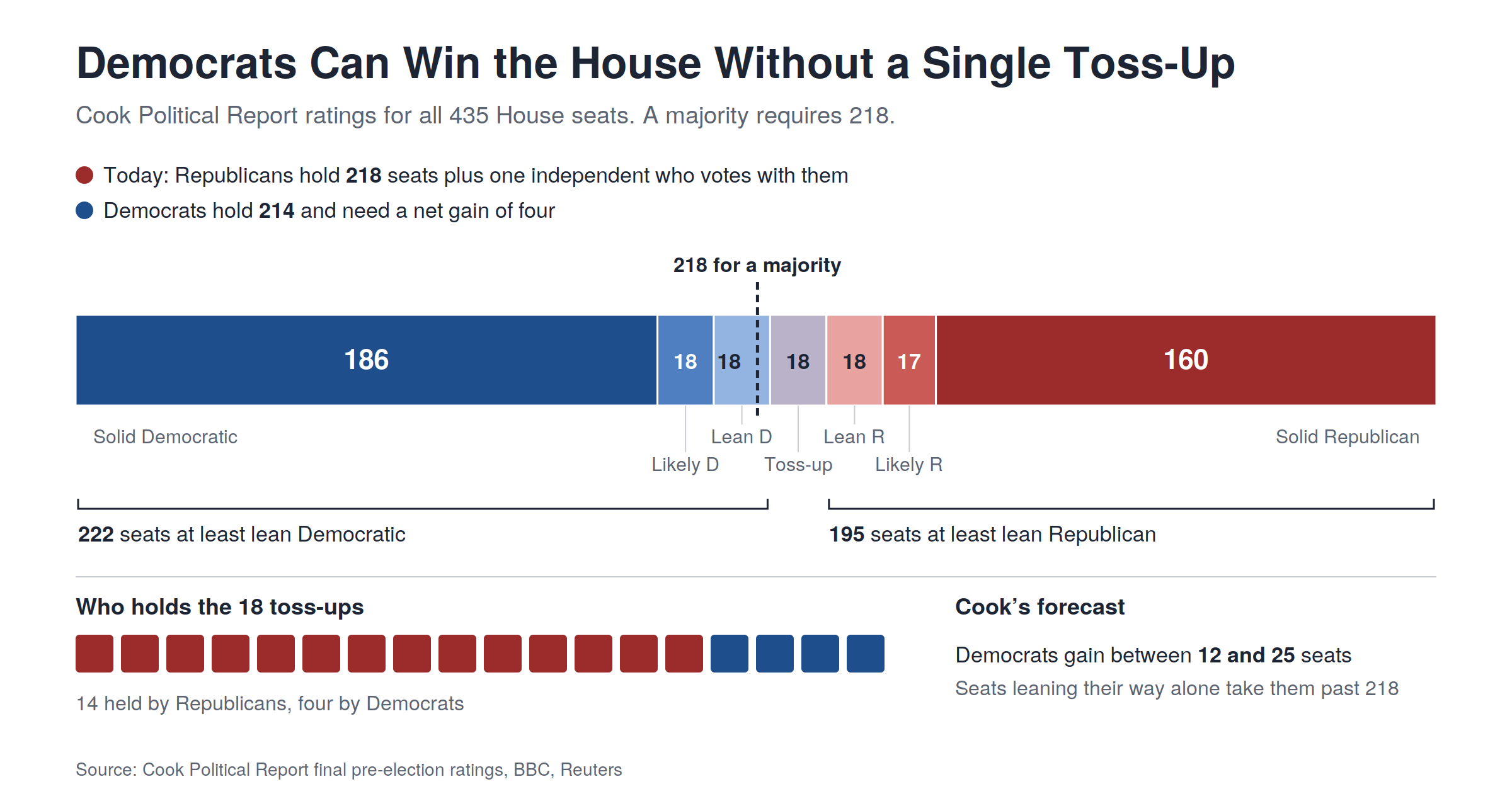
Most districts are safe for one party, so the contest is fought on a narrow strip of territory. The Cook Political Report, a nonpartisan analysis service, rates 18 districts as toss-ups, 14 of them held by Republicans and four by Democrats. The BBC noted that the Democrats could win the House without taking any of those toss-ups if they win the seats Cook classes as likely or leaning their way. Cook expects the party to gain between 12 and 25 seats.
The Republicans tried to protect themselves by redrawing congressional maps in the middle of the decade, an unusual step, since boundaries are normally redrawn once every 10 years after the census. Texas led the way with a Trump-backed map designed to produce five additional Republican seats. California voters answered by approving Proposition 50, which redrew their state’s map in the Democrats’ favour by a similar margin, and several other states followed on both sides. Reuters reported that the effort appears not to have delivered the gains the White House expected, and Cook’s projections suggest the new maps will net the Republicans only about three or four seats overall.
Six states and a tie-breaker
The Senate, where members serve six-year terms and roughly a third of the seats come up every two years, is where the night will be decided. Republicans hold 53 seats, the Democrats 45, and two independents vote with the Democrats. To take control, the Democrats need a net gain of four seats, reaching 51, because a 50-50 chamber would be broken in the Republicans’ favour by Vice-President JD Vance.
The map pushes the Democrats onto hostile ground. In its final ratings, published on 2 November, Cook classes six races as toss-ups, every one of them held by Republicans: Maine, Alaska, Texas, Ohio, Kansas and Iowa. To reach a majority, the Democrats would need to hold their open seat in Michigan, capture North Carolina, where former governor Roy Cooper is favoured, win Maine and then add at least two more victories in states Trump carried by double digits in 2024. Reuters reported that polls show the Democrats either narrowly ahead or within striking distance in all of those states, though many of the leads in the final New York Times/Siena College polls fall within the margin of error.

Michigan, the one Democratic seat in serious doubt, was thrown into turmoil on Sunday, when Democrat Haley Stevens, who narrowly lost the party’s primary to the progressive Abdul El-Sayed, 42, endorsed his Republican opponent, the former congressman Mike Rogers, 63. Reuters described the race as a test of whether Republican attacks built on identity can succeed in a battleground state, since El-Sayed would become the first Muslim member of the US Senate.
Cook nonetheless moved the race towards the Democrats in its final ratings, and the last Times/Siena poll gave El-Sayed a lead of 53% to 42%. In Maine, the Republican Susan Collins, 73, is seeking a sixth term in a state that leans Democratic, against Troy Jackson, 58, a former president of the state senate who became the Democratic nominee after the oyster farmer Graham Platner withdrew amid misconduct accusations, which he denied. Jackson led 51% to 45% in the final Times/Siena poll.
The races that would hand the Democrats a majority lie deeper in Republican territory. In Texas, the state representative James Talarico, 37, a former teacher, is trying to become the first Democrat to win a Senate seat in the state since 1988, the BBC reported. His opponent, the Republican Attorney General Ken Paxton, 63, whom Reuters described as scandal-plagued, has benefited from a nine-figure investment by Elon Musk. In Kansas, which voted for Trump by more than 16 percentage points in 2024 and has not elected a Democratic senator in nearly a century, the megachurch pastor Adam Hamilton, 62, has held a narrow polling lead over Senator Roger Marshall, 66. Ohio is holding a special election for the seat Vance vacated, where the former Democratic senator Sherrod Brown is trying to unseat the appointed Republican Jon Husted. The final Times/Siena polls showed Talarico ahead by seven points and Hamilton and Brown each by five, while the Democrat Josh Turek and the Republican Ashley Hinson were separated by a single point in Iowa.
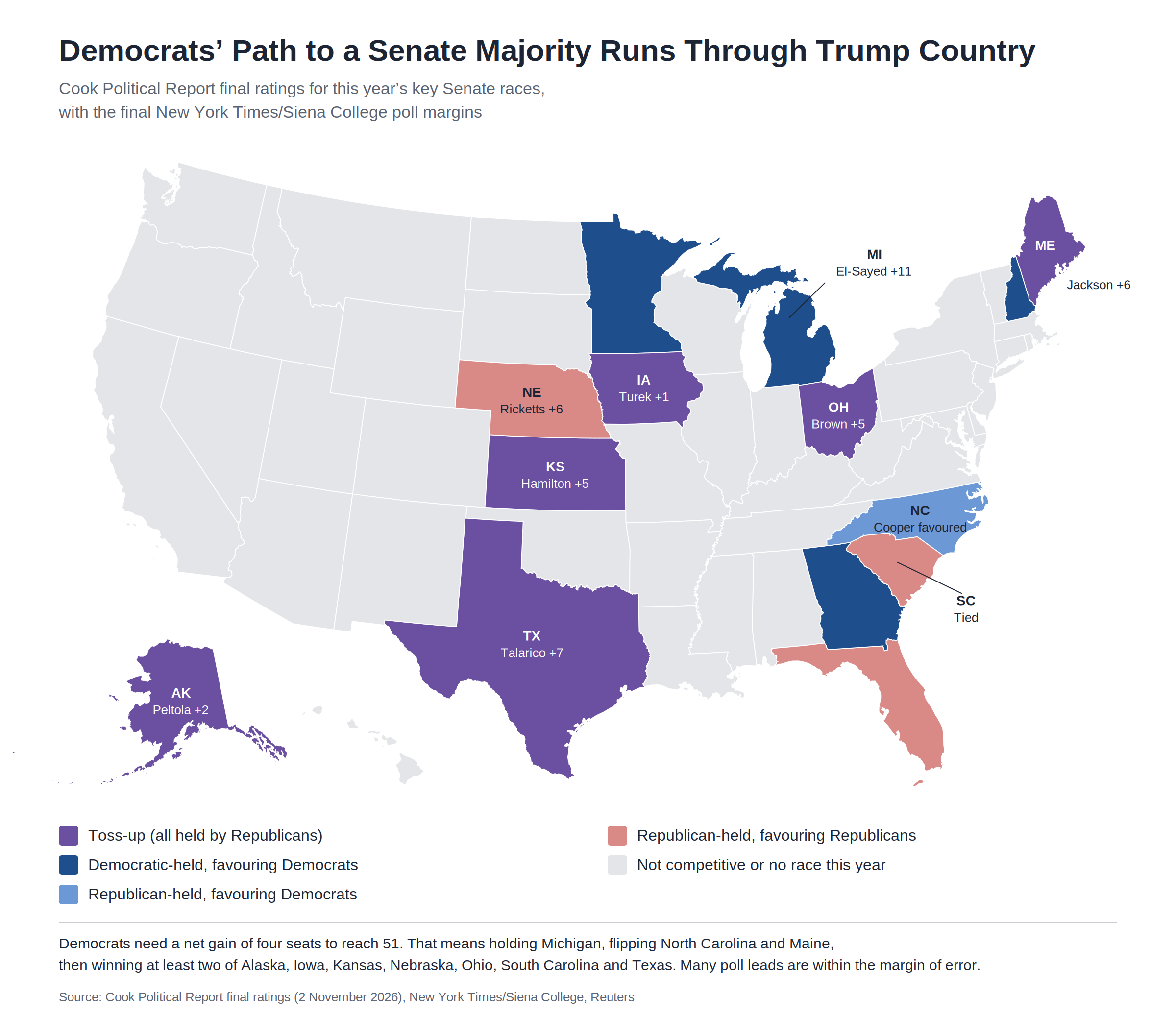
Alaska has produced the strangest contest of the year. The New York Times reported that the campaign of the Democrat Mary Peltola, 53, helped recruit a third candidate who shares the first and last name of her opponent, the Republican Senator Dan Sullivan, 61. Peltola has denied any involvement. The Justice Department opened a criminal investigation and sued to block certification of the result, an effort a federal judge dismissed on Sunday. Peltola led by two points in the final Times/Siena poll. Further down the list, the Republicans are defending Nebraska against Dan Osborn, an independent who has not said which party he would sit with, and South Carolina, where the final Times/Siena poll showed the appointed Republican senator, Darline Graham, tied with the Democrat Annie Andrews.
For readers in Cyprus, which is seven hours ahead of Washington, the night will unfold in the early hours of Wednesday 4 November. The first polls close at 1am Cyprus time in parts of Indiana and Kentucky. South Carolina and Georgia follow at 2am and North Carolina and Ohio at 2.30am. Maine, Pennsylvania and most of Michigan, Texas and Kansas close at 3am, and Iowa, Nebraska and the remaining parts of Michigan, Texas and Kansas at 4am. California closes at 6am and Alaska’s last polling stations at 8am. Some decisive results may take days. Alaska and Maine count by ranked-choice voting, which requires further rounds of tabulation if no candidate wins an outright majority, and California counts its vast volume of mail ballots slowly, which could leave the final balance of the House unresolved for some time.
What changes if Democrats win
A Democratic majority in either chamber would give the party the power of investigation, which Trump cannot sidestep through executive action. Reuters reported that senior House Democrats have discussed using hearings, subpoenas and document requests to examine whether Trump has used his office to benefit himself, his allies or his donors. A Democratic Senate could also block Trump’s judicial and executive nominees, including any Supreme Court pick should a vacancy arise. Andrew Busch, a professor of public policy at the University of Tennessee, Knoxville, told Reuters he expected Democrats to be very reluctant to approve the president’s appointments. A Democratic House could impeach Trump by a simple majority, but removing him from office would require 67 votes in the Senate, far beyond even the most optimistic Democratic forecast.

Trump would keep his veto, and the Democrats are unlikely to win the two-thirds majorities in both chambers needed to override it. Trump told the New York Post’s Pod Force One podcast that he would veto Democratic legislation for a month or two before striking deals. “I guess I’ll become Mr. Veto,” he said. Nathan Gonzales, editor of the nonpartisan Inside Elections, told Reuters that Trump has “basically ignored Congress” during his second term, governing through executive orders on tariffs, immigration and the war with Iran, and expects that approach to intensify under Democratic majorities. European officials share the scepticism. A senior EU diplomat told AFP, “We don’t think the unpredictability is going to change,” and the European Leadership Network, a London-based think tank, concluded that a Democratic victory “would not give Europe a veto over Trump.”
Senior officials including deputy chief of staff Stephen Miller and budget director Russell Vought have been working since April on executive actions that would need no congressional approval, according to a White House official and two people familiar with the plans who spoke to Reuters on condition of anonymity. The options include tariffs on critical minerals and wind turbines, tighter visa rules for international students and temporary foreign workers, and spending funds Congress has already appropriated. White House lawyers have been briefing appointees on how to handle subpoenas and have sought a Justice Department opinion that could shield the president’s communications with private advisers from congressional scrutiny. Asked how comfortable Trump would be governing by executive authority alongside a Democratic Congress, one of the people told Reuters he would be “very comfortable.”
Sources: Reuters, BBC, Politico, AFP, The New York Times, Cook Political Report, New York Times/Siena College