
The risk of a nuclear accident in Ukraine is increasing ahead of winter, nuclear safety authorities from 38 countries warned on Monday, calling on Russia to halt attacks on the country's energy infrastructure.
The joint statement, reported by Reuters ahead of its publication, was issued by HERCA (the European radiological protection authorities), WENRA (the Western European nuclear regulators association) and NORA (the Nordic nuclear safety authorities).
The organisations, which collectively represent regulators from EU member states, the United States, the United Kingdom, Canada and Japan, said there is an urgent need for Russia to stop attacks on Ukraine's nuclear facilities and the energy infrastructure required for their safe operation.
Fears of a major blackout
Nuclear power stations depend on a stable electricity supply from the grid to cool nuclear fuel.
Without it, the risk of overheating and reactor core damage increases, potentially leading to the release of radioactive material despite the existence of backup systems.
Per Strand, head of HERCA and NORA, told Reuters that recent Russian attacks have become more destructive, with drones carrying larger explosive payloads and striking with greater accuracy.
He warned that the worst-case scenario would be a nationwide blackout affecting all nine operating reactors that currently generate electricity in Ukraine.
According to Strand, such a scenario could still be prevented if sufficient pressure is exerted on Moscow. Otherwise, European countries may need to intensify preparations for the possible consequences of a nuclear accident.
Ukraine's nuclear dependence
Ukraine operates four nuclear power plants.
Three remain operational and are expected to provide approximately 80% of the country's electricity needs this winter.
The fourth, the Zaporizhzhia Nuclear Power Plant, Europe's largest, remains under Russian control near the front line.
Although it no longer generates electricity, the facility still requires external power to cool its nuclear fuel.
According to the International Atomic Energy Agency (IAEA), the plant has lost external power 27 times since the start of the war. Since late March, it has relied on a single external power line.
The IAEA also reported over the weekend that military operations during the previous week reduced power generation at units within Ukraine's operating nuclear stations.
Record drone attack hits Crimea bridge
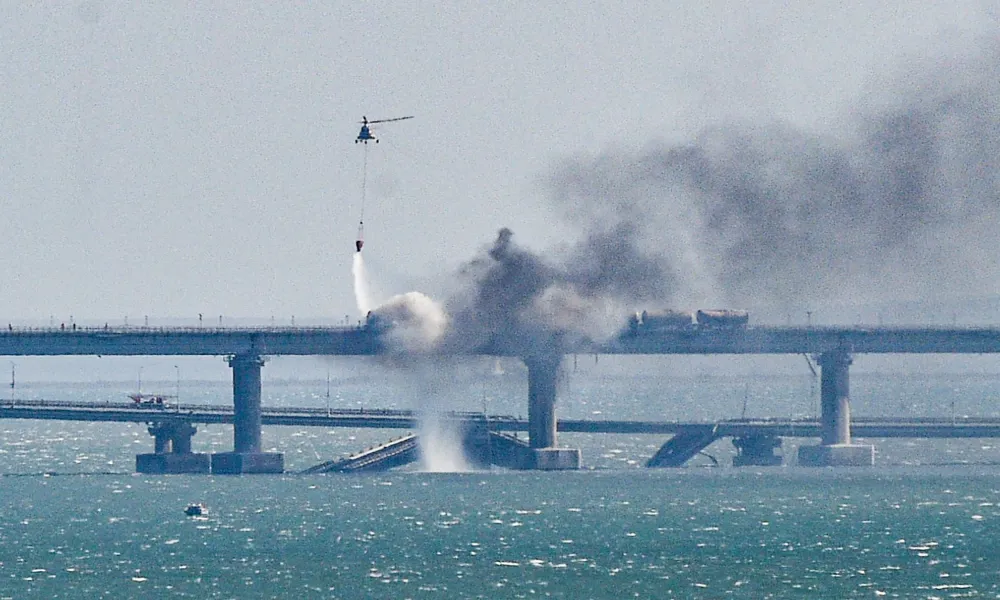
In a separate development, Ukrainian drones struck the Kerch Bridge in the early hours of Monday.
The bridge is the only direct road and rail link connecting Russia to the Crimea peninsula, which Moscow annexed in 2014.
The Russian-installed head of Crimea, Sergei Aksyonov, confirmed the attack and announced temporary traffic restrictions.
Kremlin spokesperson Dmitry Peskov described the damage as minor, although pro-Ukrainian channels circulated images appearing to show damage to part of the structure.
Around 2,000 vehicles were reportedly caught in traffic queues and four passenger trains were delayed.
Kyiv did not comment on the operation.
Moscow reports record number of drones intercepted
Russia's Defence Ministry said its air-defence systems shot down 1,336 Ukrainian drones, a figure that has not been independently verified.
If confirmed, it would exceed the previous reported record of 1,254 drones, recorded on October 29.
The attack took place two days before the APEC summit in Shenzhen, where a meeting between Xi Jinping, Donald Trump and Vladimir Putin is expected.
Source: Reuters