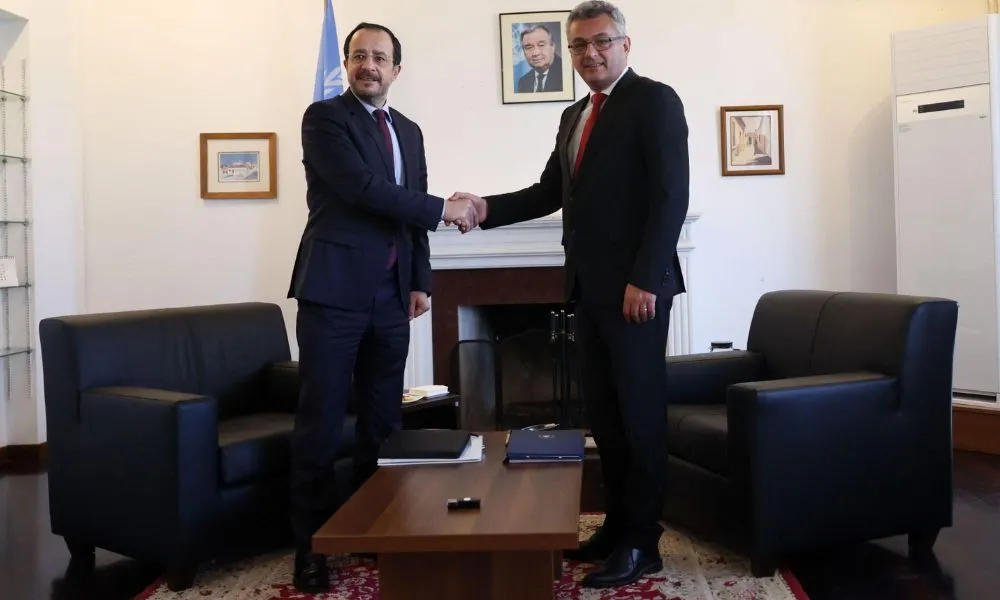
The recent meeting between President of the Republic Nikos Christodoulides and Turkish Cypriot leader Tufan Erhürman once again confirmed the deep political deadlock over the Cyprus problem. Despite public statements expressing willingness for a settlement, the inability to agree even on limited confidence‑building measures, such as the opening of new crossing points, reveals that the problem lies not only in technical details but mainly in a broader lack of common strategy and political trust.
Today, the Cyprus problem appears to be in a peculiar phase of 'frozen management.' Both sides state that they seek the resumption of talks, yet in practice operate within two entirely different political frameworks. The Greek Cypriot side continues to speak of a bizonal, bicommunal federation based on United Nations resolutions. At the same time, however, the parallel effort to build alliances with countries viewed by Turkey as unfriendly does little to encourage the start of negotiations. On the other hand, the Turkish Cypriot leadership, in full alignment with Ankara, now openly promotes the logic of 'sovereign equality' and a two‑state solution. This strategic gap makes agreement even on low‑politics issues extremely difficult.
At the same time, the Cyprus problem has lost the sense of urgency that existed in previous decades. Daily life on both sides of the dividing line continues without major upheaval, fostering a gradual normalisation of division. Younger generations are growing up without meaningful experience of coexistence, while political leaderships often invest more in managing their domestic audiences than in assuming the political cost required for compromise.
Meanwhile, international developments have shifted global attention elsewhere. Wars in Ukraine and the Middle East, energy and geopolitical crises, and fatigue within the United Nations after decades of fruitless efforts have reduced pressure on the two sides. The result is a Cyprus problem that is politically maintained but is not moving meaningfully towards a settlement.
Perhaps the greatest problem today is not only disagreement over the form of a solution, but the absence of a shared understanding that time works against both communities.