
*By Neophytos Loizides, University of Warwick
The most politically interesting — and perhaps strategically underestimated — idea came from ISPD Director Christoforos Fokaides. The former Minister effectively outlined a Cypriot version of Germany’s Ostpolitik: a policy of gradual opening and relationship-building instead of indefinitely freezing the status quo while waiting for the elusive “perfect solution” to emerge. His intervention touched upon a possible opening for Varosha, new forms of connectivity, and practical cooperation that could transform the political climate and alter the dynamics of negotiations.
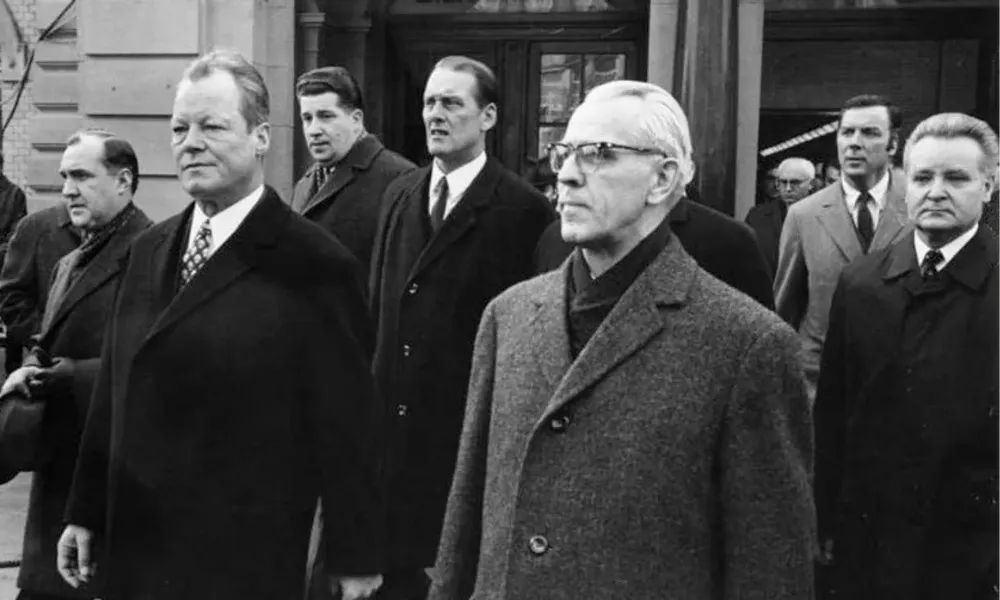
Ostpolitik was the strategy advanced by Chancellor Willy Brandt, who pursued gradual rapprochement and cooperation with East Germany and the Eastern bloc rather than waiting for full political settlement or reunification. Its core logic was simple but profound: meaningful change can emerge through contact, economic ties, and confidence-building measures — not solely through pressure or isolation.
For many foreign mediators and diplomats, moreover, it remains genuinely puzzling why the Greek Cypriot leadership appears to have gradually abandoned the active pursuit of Varosha’s return, despite the fact that this was explicitly envisaged in both the High-Level Agreements and successive UN resolutions. Particularly at a moment when new openings and confidence-building measures are being discussed, many international actors continue to regard Varosha as perhaps the most realistic and symbolically powerful starting point for relaunching a meaningful peace process.
Seen from this perspective, it was no coincidence that the discussion moved beyond the traditional dilemmas of the Cyprus problem. Niyazi Kızılyürek revived the vision of a “Whole Cyprus” — a Cyprus functioning as a shared political and European space for both Greek Cypriots and Turkish Cypriots, rather than two parallel and alienated worlds. Meanwhile, Harry Tzimitras placed greater emphasis on diplomacy and the need to capitalize on a rapidly changing regional and European environment, arguing that the relaunch of a meaningful process requires smart diplomacy, regional synergies, and gradual confidence-building.
Perhaps this also points to a broader lesson from Europe itself. Post-war Europe experienced the longest and safest period in its modern history not because of unchecked armaments, but primarily through smart diplomacy, cooperative institutions, and mutual guarantees. Without wise diplomacy, even the largest military buildups can produce the opposite of what they intend, leading to what international relations scholars describe as the Thucydides Trap: when a rising power generates fear in an established power, conflict dynamics can emerge even if neither side actively seeks war. It is no coincidence that Chinese President Xi Jinping quoted Thucydides emphasizing that strategic competition without robust diplomatic safeguards can lead to dangerous escalation.
In Cyprus too, what only a few years ago was considered politically taboo is increasingly entering mainstream debate. Ioannis Kasoulides spoke openly about possible new security arrangements beyond the outdated system of guarantees, including roles for the European Union, NATO, or other international mechanisms that could provide a sense of security to both communities. The broader European debate on strategic autonomy and common defence — particularly after the war in Ukraine and growing instability in the Middle East — creates an entirely new framework for thinking about Cyprus.
In our own interventions, Charis Psaltis and I presented findings from parallel public opinion surveys conducted in both communities through the Inclusive Peace project. The results converge on something highly significant: society appears more open to international involvement and security arrangements than political elites often assume — especially when proposals are concrete, credible, and practically implementable.
This becomes even clearer in the experimental conjoint analysis data we recently presented on Cyprus. Consider two contrasting scenarios shaped by differing levels of international diplomatic engagement.
In the first scenario, a settlement receives active international backing and is accompanied by meaningful compensation and housing guarantees for property claims, a dedicated dispute-resolution mechanism — or even a UN-supported international tribunal, an idea advocated by Takis Hadjigeorgiou — international guarantees from major EU states, and practical forms of cooperation such as joint energy projects and federal zones of cooperation. Under this scenario, support rises to 57% among Turkish Cypriots, while among Greek Cypriots it reaches as high as 70%, surpassing the threshold of political viability in both communities.
In the second scenario, by contrast, a weaker and more traditional settlement model is maintained: without substantial international involvement, without meaningful compensation, without a dedicated dispute-resolution mechanism, and with the old guarantees system remaining intact. Support collapses to just 22% among Greek Cypriots and 37% among Turkish Cypriots.
The significance of these findings lies not merely in the numbers, but in the broader political conclusion they suggest: public opinion does not necessarily reject a viable and durable compromise. On the contrary, citizens respond positively when they feel that a proposal offers seriousness, international credibility, and genuine security. Perhaps, then, the problem is not that people do not want peace settlements — but that they are often presented with proposals that fail to inspire trust.