By Anastasia Petrou
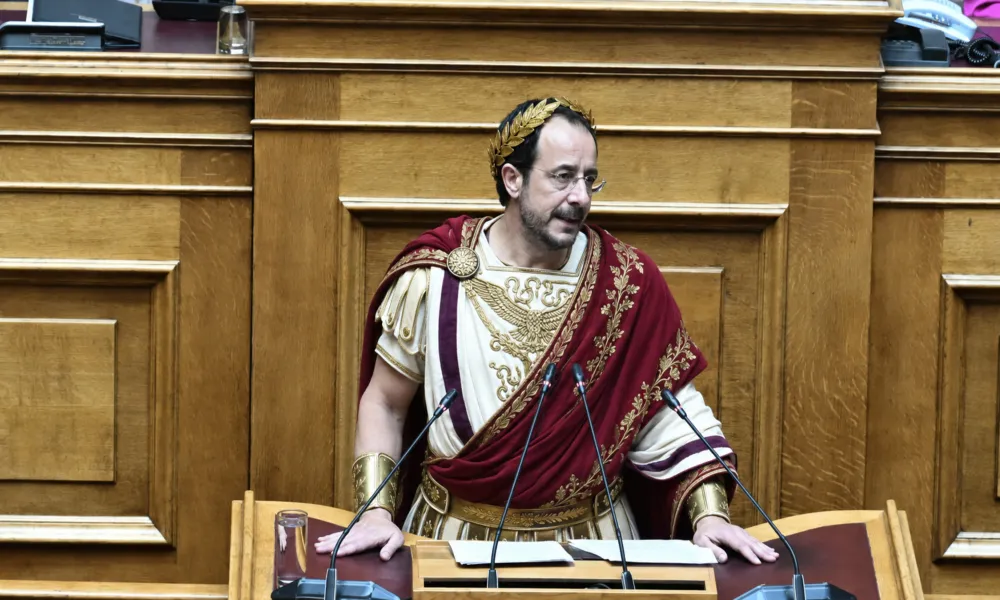
Nikos Christodoulides is not merely the President of the Republic of Cyprus. Let us make that clear from the outset so there are no misunderstandings. There have been many presidents of the Republic of Cyprus.
Nikos is something else.
He comes from another planet.
He is what one might call iconic, magnificent, cosmic.
Anyone who has not realised this has either missed a few episodes or simply has not been paying attention. To grasp the greatness of the man, one need only observe how the former Deputy Minister for European Affairs looks at him when he speaks. It is not the gaze of a colleague looking at a president. It is the gaze of a believer witnessing a miracle. As if the Red Sea had parted, the Cypriot vision had crossed through it, and on the opposite shore Macron, Trump and von der Leyen were waiting with candles, singing Hosanna while Ms Raouna sprinkled him with rose water.
Historic moments
Whenever Nikos Christodoulides speaks, a strange silence settles around him.
Not because everyone understands what he is saying.
It is more out of concern.
People fear they might interrupt the uninterrupted flow of History itself.
Christodoulides' great misfortune is that he was born in Cyprus. A small country. An insignificant, cramped little island in the Eastern Mediterranean which, as Ms Piki has observed, is objectively out of proportion to his stature.
Cyprus simply cannot contain him.
The man is suffocating
He wakes up in the morning thinking about redesigning the Middle East and before he has had his coffee he is being briefed on a burst pipeline in Tersefanou.
He plans Europe's new security architecture and someone calls him about lifeguards' working hours.
He contemplates how to isolate Turkey and they bring him a file on whether Makarios Avenue should be opened.
Are these really the kinds of problems a global leader should be dealing with?
Some nights, after everyone has left the Presidential Palace and he remains alone gazing at the globe, he looks out the window and wonders:
"My God, why was I born in Geroskipou? Why did my grandfather have to come from Choulou? Couldn't I have been born in Paris? In New York? In Beijing?"
After all, how much more promising it would be to wake up in the morning and say "bonjour", "good morning" or "ni hao" instead of "kalimera".
What terrible luck
Imagine being born to govern the world and ending up inaugurating a roundabout in Lakatamia.
Of course, he is not the first Cypriot leader to feel larger than the country in which he found himself trapped. Makarios suffered from the same problem. His robes could not contain him. He wanted the Non-Aligned Movement, international prestige, Nasser, Tito, historic speeches, photographs with Kennedy and television documentaries featuring newly baptised children in Kenya.
As part of his missionary work, the Cypriot President left behind a thousand little Makarioses when he departed Nairobi.
Christodoulides, too, cannot be contained by the suits he barters from Paraikkas the Indestructible.
A jacket may become tight.
Ambition never does.
Nikos dreams of triumphing across Europe, passing beneath the Arc de Triomphe in Paris. Of arriving in Brussels and instantly changing the atmosphere. Conversations stop. The lights dim. A voice comes over the loudspeaker:
"European leaders are requested to take their seats. President Christodoulides is entering the room."
Macron rises to his feet.
The German chancellor takes notes while he speaks.
Von der Leyen whispers:
"This man sees further ahead."
Nikos, wearing that calm and iconic smile, distributes dreams and, above all, puts Turkey in a corner.
Not violently. Institutionally.
With a roadmap and a timetable.
With European Council conclusions and a special monitoring mechanism dedicated to the corner itself.
The problem is that Turkey does not take kindly to being put in the corner.
But that is what initiatives are for.
When the first one fails, you announce a second.
When the second goes nowhere, you present the third as an upgraded version of the first.
And when nothing at all happens, you emphasise that the Republic of Cyprus now possesses a strong geopolitical footprint.
The footprint is very important.
You may not know exactly where you stepped, but the footprint is there.
Clerides called it "the old man's stride"; Christodoulides calls it "the Little Giant's walk".
Trump
In the Middle East, the President is working to make Cyprus a factor of stability.
A bridge.
A hub.
A pillar.
A corridor.
A humanitarian passage.
A safe harbour.
A forward outpost.
Whatever is required.
In the morning it can be a bridge, at noon a pier in Gaza being swept away by the waves, and by the afternoon a pillar of stability.
No problem.
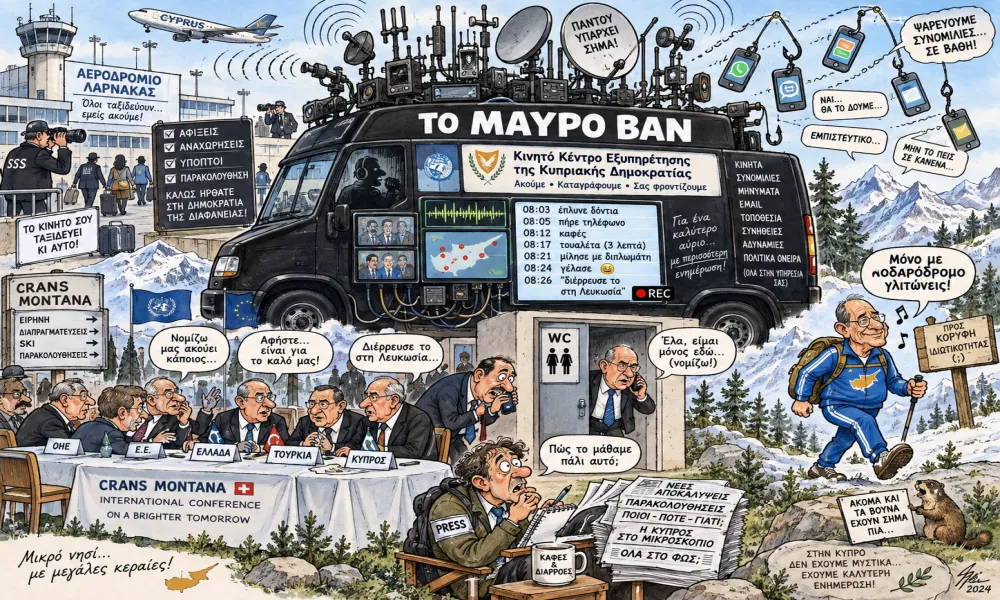
Nikos can do it all, pursuing a foreign policy that now inspires everyone.
He thinks about how, alongside Netanyahu, he can make himself useful to Trump.
A useful leader.
A useful ally.
Or, in the worst-case scenario, a useful idiot.
In international politics, no role should ever be ruled out.
The important thing is to be in the photograph, because without a photograph there is no geopolitics.
There is only a meeting.
Ambitions
His ambitions, however, do not stop at Europe and the Middle East. Those are the easy parts.
Nikos wants Cyprus to host the World Cup. And why not? What do others have that we do not?
Large stadiums, modern transport systems, railways, adequate road networks, water resources and fifty years of preparation. Those are merely details. We have vision.
Matches will be played at the GSP, Alphamega and Arena stadiums and, if necessary, at an upgraded stadium in Choulou or the ultra-modern AEK Korakou ground.
The opening ceremony will feature halloumi, rides on Cypriot donkeys, fireworks and a giant hologram of the President kicking the ball from Geroskipou all the way to Nicosia.
The ball may arrive slightly late due to traffic in Limassol.
After the World Cup, bigger goals will naturally follow. Perhaps it will be time for space. Cyprus must acquire a satellite launch facility. Establish an astronaut academy. Create a Deputy Ministry for Space and Extraterrestrials. Why should only the great powers launch satellites?
What are we, then?
After Baikonur and Cape Canaveral, a space centre will be built in Paphos, right next to the chapel of Prophet Elias in Tala.
As Metropolitan Athanasios explained to the President, Elijah was airborne, travelling in a fiery chariot that flew above Jerusalem and Jericho.
Legend has it he once flew over Tala and Choulou as well.
Thus, the first mission will be called Choulou 1 and will be financed 60% by European funds, 20% by private investors and 20% by money provided by the Church of Cyprus.
The crew will consist of a scientist, a government spokesman, an adviser, a party observer and Archimandrite Nektarios of the Avvakoum Monastery, whom Archbishop Georgios wishes to send to Mars to establish the first Orthodox Church for the extraterrestrial Anunnaki, whom von Däniken specifically mentions in his books.
As for the Cypriot astronauts, they will be the best trained in the world.
They will learn how to survive without gravity, without oxygen and without water, like cacti from the Arizona desert.
The President himself could lead the mission.
He would step onto Mars, plant the Cypriot flag and declare:
"The Republic of Cyprus once again proves that it can function as a bridge between Earth and Space."
He would then invite the Martians to an informal multilateral conference.
He would propose Confidence-Building Measures and explain the positive agenda, with María Ángela Holguín at his side, before leaving her behind as an adviser while he returned to Earth.
The Nobel Prize
After all this, the Nobel Peace Prize would naturally follow.
After all, the Cyprus problem may remain unresolved, no war may have ended and peace may not have been achieved exactly, but intentions count.
And Nikos' intentions are always iconic, just like his achievements.
In Oslo he would receive the prize with modesty.
He would say it belongs not to him, but to the Cypriot people, to Europe, to the Eastern Mediterranean, to the international community, to Geroskipou and to visionaries everywhere.
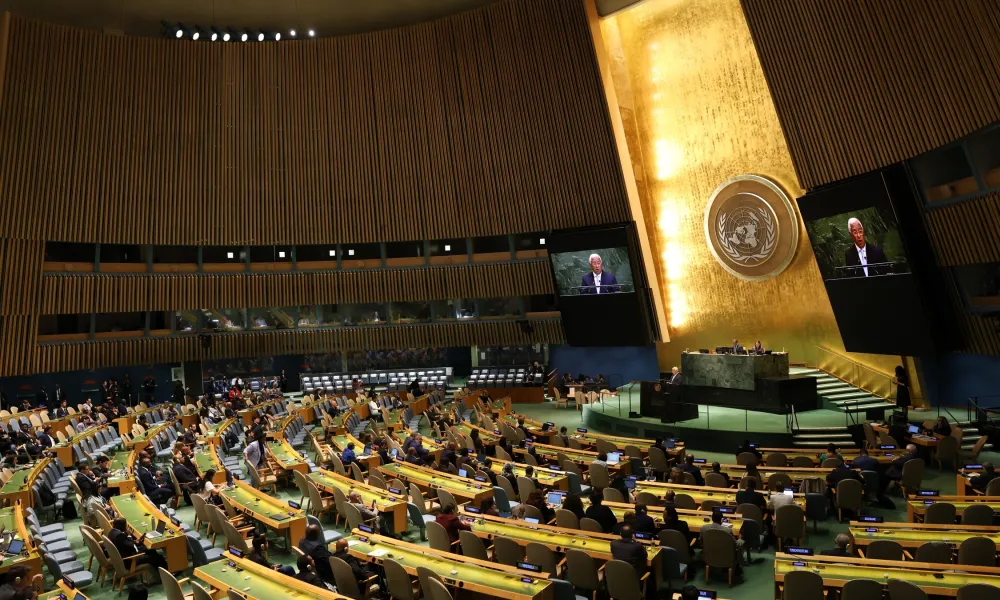
Afterwards he would travel to New York, where the United Nations General Assembly would present him with the special "Little World Leader" award.
Former deputy foreign minister Ms Raouna would be seated in the front row, looking at him in awe.
The Secretary-General would applaud.
World leaders would give him a prolonged standing ovation.
But Nikos, following the advice of his confessor at the Mesa Potamos monastery, would stand there smiling humbly, almost awkwardly.
Truly great leaders never say how great they are.
They simply make sure they have the right people standing beside them to keep repeating it.